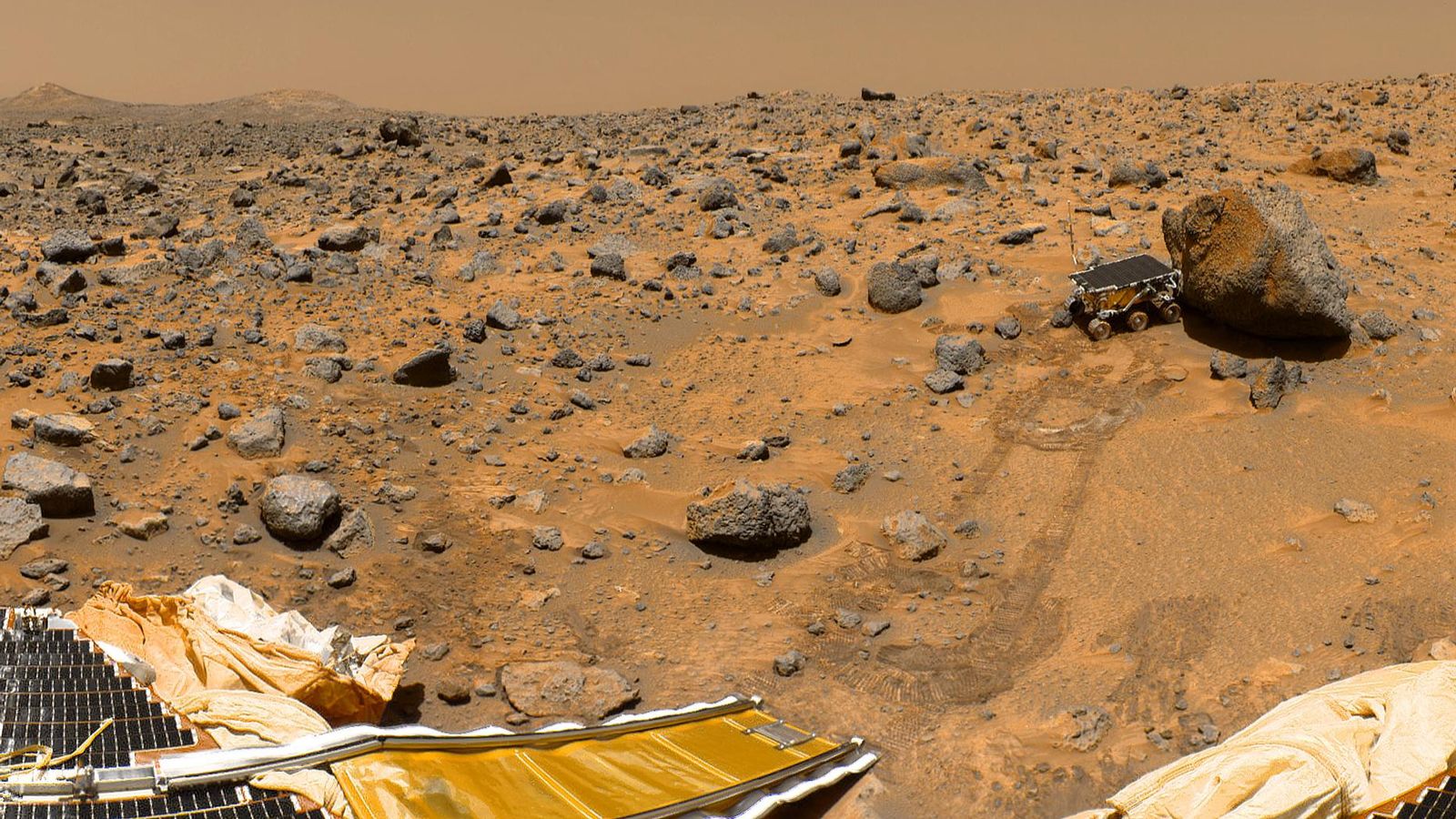
On September 27, 1997, NASA's Mars Pathfinder mission transmitted its final data back to Earth. The mission, initially planned for one month, was already three months in when the base station's battery began to fail. NASA attempted to regain contact over the ensuing five months before concluding the mission.
Read More
Mars Pathfinder, which included the first Mars rover named Sojourner, was launched on December 4, 1996, by NASA's Jet Propulsion Laboratory in Pasadena, California. It successfully landed on Mars on July 4, 1997.
The significance of the Mars Pathfinder lander lies in its role in advancing NASA's exploration of the Red Planet. As part of a "faster, better, cheaper" initiative, the mission cost $262.3 million (in 1997 dollars), a small fraction compared to the billions spent on earlier missions like the Viking landers. Pathfinder served as a technology testbed, showcasing methods that would be used in future Mars missions, including the deployment of airbags for landing and the rocker-bogie suspension system for Sojourner. These techniques were later applied to the Spirit and Opportunity rovers, which launched in 2004.
Throughout its mission, Pathfinder captured over 16,500 images of the Ares Vallis landing site, with Sojourner taking an additional 550 photos. The mission conducted 15 chemical analyses of Martian rocks and soil and collected weather data. The lander was renamed the Carl Sagan Memorial Station in honor of the famed astronomer.
The Pathfinders mission demonstrated two crucial capabilities: the successful landing and scientific operation of a wheeled rover on Mars and the durability of the Jet Propulsion Laboratory's rover designs, which exceeded their intended lifespans. While originally designed to last only 30 days, Pathfinder and Sojourner operated for three times that duration, mirroring the success of Spirit and Opportunity, the latter operating for 14.5 years.
Sojourner’s achievements laid the groundwork for larger rovers like Curiosity, which landed in 2012, and Perseverance, which arrived in 2021. Unlike their predecessors, these rovers are powered by nuclear batteries, allowing for extended missions.