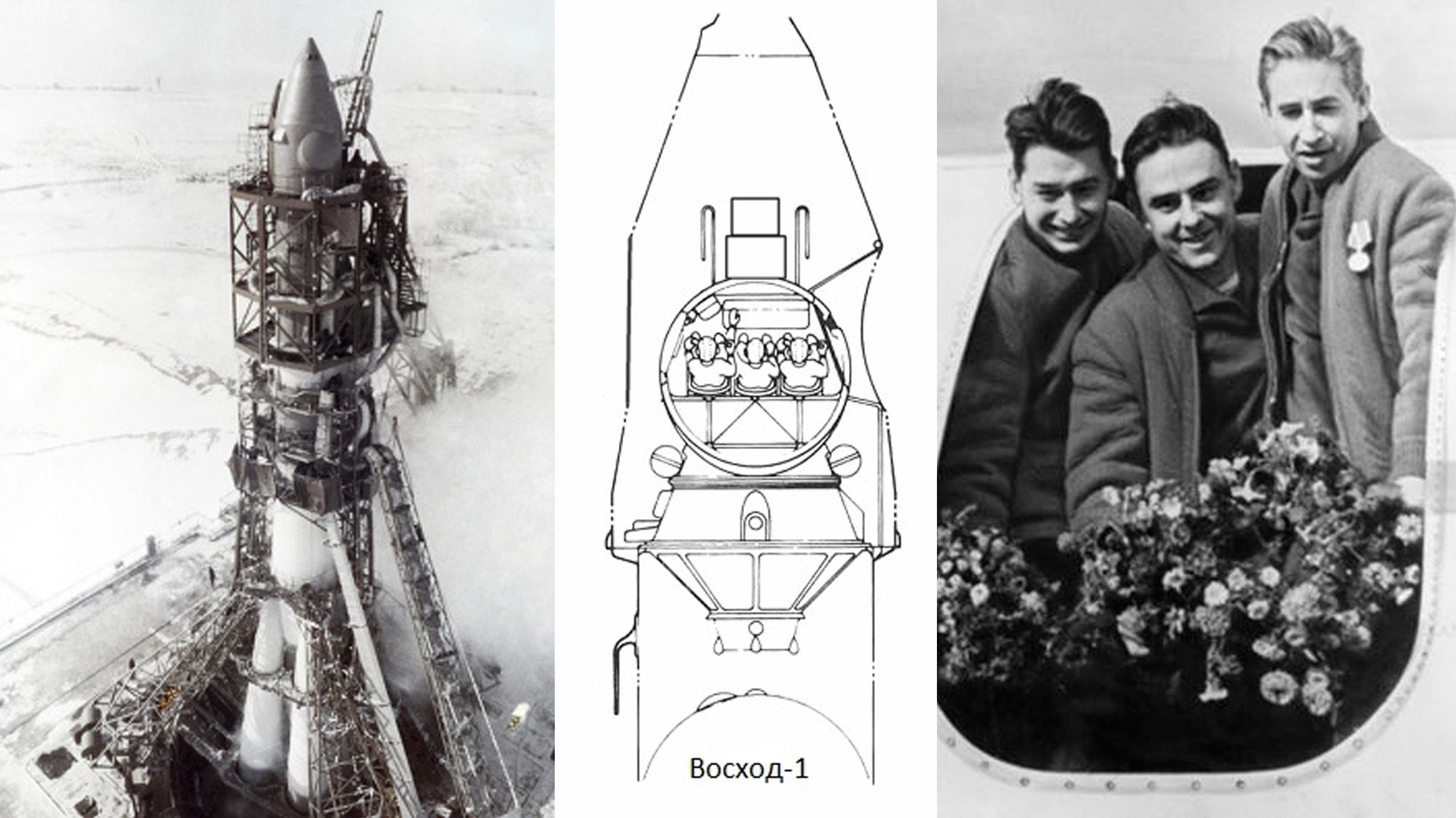
On October 12, 1964, the Soviet Union launched Voskhod 1, marking a significant milestone in human spaceflight by sending the first multi-person crew into orbit. This mission, which lasted 24 hours, included three cosmonauts: Vladimir Komarov (commander), Konstantin Feoktistov (engineer), and Boris Yegorov (doctor).
Read More
Originally, the mission was planned for only two cosmonauts, but political pressures within the Soviet space program led to the inclusion of a third member. Due to space constraints, this flight became notable for being the first to occur without spacesuits, significantly increasing the risks involved.
Feoktistov and Yegorov were notable as the first civilians to travel into space. Voskhod 1's launch followed earlier achievements in the space race initiated by the Soviet Union's deployment of Sputnik 1 in 1957 and Yuri Gagarin's historic flight in 1961. Prior to this mission, all crewed flights had included only one astronaut.
The change was driven by geopolitical competition; with NASA developing the two-person Gemini spacecraft, Soviet leader Nikita Khrushchev ordered Sergei Korolev, the chief designer of the Soviet space program, to adapt the existing Vostok spacecraft to accommodate three cosmonauts. The crew remained inside the spacecraft for the landing, differing from Vostok missions where astronauts like Gagarin parachuted out after reentry.
During the mission, the Voskhod 1 crew conducted experiments related to the behavior of liquids and gases in microgravity while capturing photographic images of Earth. Approximately six months later, on March 23, 1965, NASA would follow with its own multi-crew mission, Gemini 3.