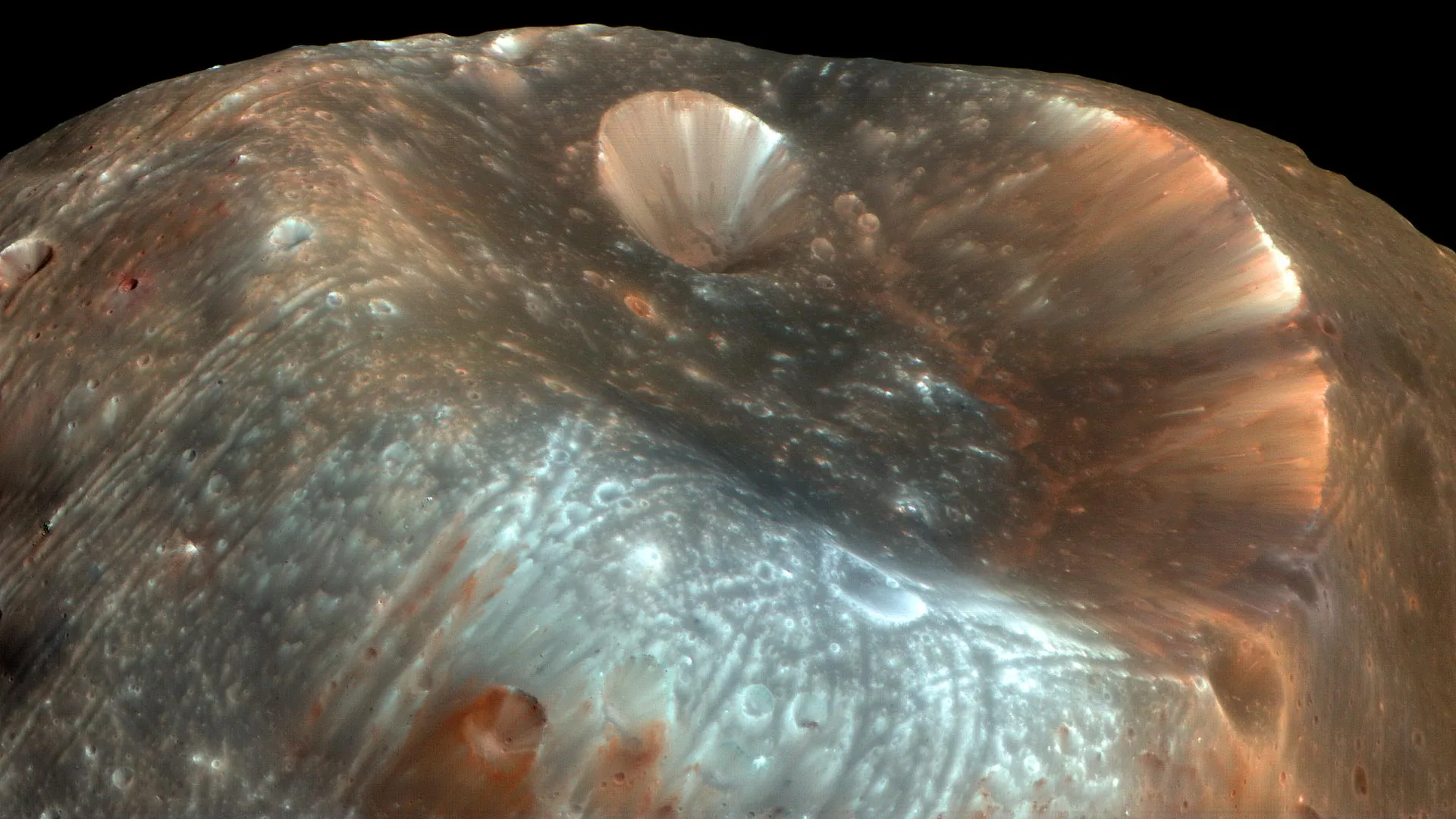
The origin of Phobos, Mars' innermost moon, continues to intrigue planetary scientists. There are two main theories regarding its formation: one suggests that Phobos is an asteroid captured by Mars, while the other posits that it originated from debris produced by a massive impact on the planet.
Read More
Research into Phobos' internal structure is crucial for resolving this debate. At the recent European Geosciences Union assembly in Vienna, scientists shared their findings related to one of Phobos' significant features, Stickney Crater, which is central to understanding the moon's history.
Stickney Crater is approximately 9 km (5.6 miles) in diameter and may provide vital clues about Phobos' origin. If Phobos formed from debris from a giant impact, that event could date back roughly 4.2 billion years. Conversely, if it was captured as an asteroid, the impact that created Stickney could have occurred around 2.6 billion years ago.
Current research indicates that Phobos has a porous interior, possibly containing water ice, according to findings by Benjamin Haser and co-author Thomas Andert published in The Monthly Notices of the Royal Astronomical Society in 2026. A thorough mapping of Phobos' gravitational field could reveal whether the Stickney impact resulted in a concentration of denser material beneath the crater.
Understanding Phobos involves more than just its physical properties. With a mean diameter of 22.2 km (13.8 miles) and a rapid orbit around Mars, Phobos is small and irregularly shaped. Two main theories explain its origin: one involves material blasted into orbit by a giant impact that formed both Phobos and its companion moon, Deimos, and the other suggests that both moons were captured from the asteroid belt.
Haser emphasizes the importance of understanding Phobos' gravitational field to learn how mass is distributed within the moon. Initial estimates point to a porous structure with a potential region of denser material near its equator.
Stickney Crater poses an additional challenge; it raises the question of how a small moon like Phobos could survive such a large impact. Haser explains that Phobos might have absorbed the impact due to an unusually low and uniform density, functioning like a sponge during the collision, even though the impact site would have generated intense heat and compression.
Investigating Phobos' characteristics, including its irregular shape and evolving orbit, is difficult. Haser notes that the current gravitational field and other properties must be reconciled within a unified geophysical model. They are specifically looking at how any denser material beneath Stickney affects the moon's gravitational signal and oscillations.
Phobos is not only significant for its historical context, but it is also in a state of gradual change. Its orbit is slowly spiraling inward, with expectations that it will either break apart or collide with Mars in the future.
Anticipation grows for Japan's Martian Moons Exploration (MMX) mission, expected to launch in late 2026. This mission aims to study Phobos directly and return surface samples to Earth by 2031. The spacecraft will operate in a challenging orbit around Phobos, which lacks a stable gravitational environment due to the dominance of Mars' gravity.
Haser highlights that the most pressing question is not merely about the moon's materials but the internal structure that accounts for its unusual characteristics. Addressing this will be key to understanding the origins of Phobos and distinguishing between the competing theories regarding its formation.