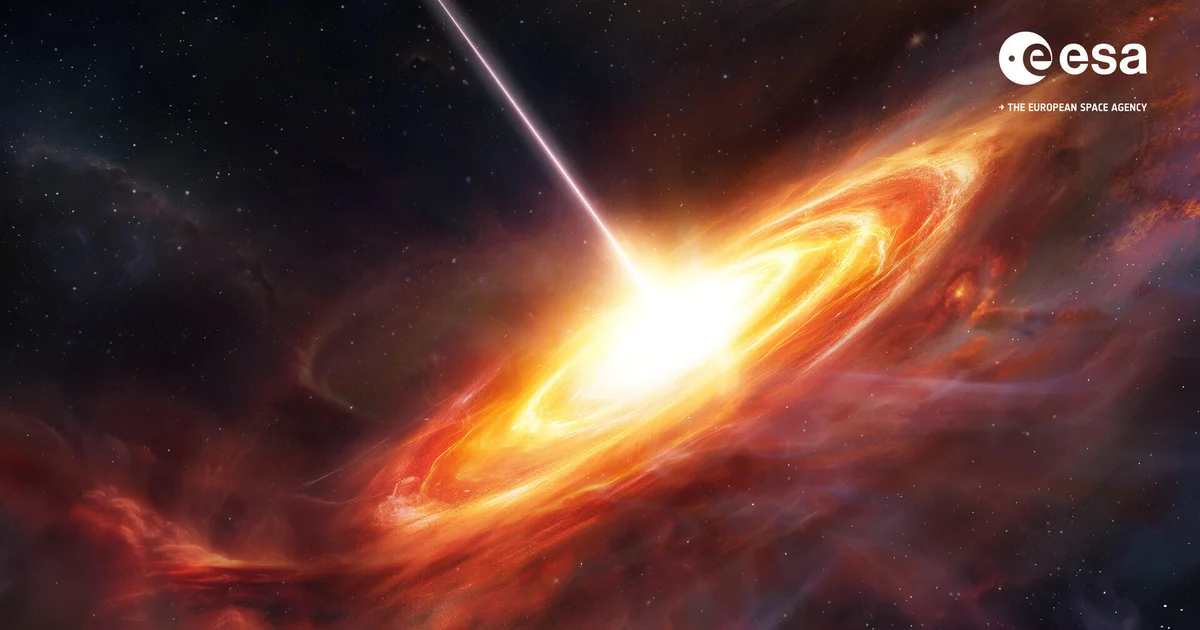
The Euclid space telescope has identified the oldest known quasars, significantly contributing to a longstanding cosmic mystery. Quasars, among the brightest objects in the universe, are powered by supermassive black holes that consume surrounding matter, shining trillions of times brighter than the Sun. Their extreme brightness enables astronomers to look back in time, prompting a quest for ancient quasars to enhance understanding of the early universe.
Read More
An international team of astronomers published a study on Monday revealing the discovery of 31 quasars, including the two oldest observed to date, using the European Space Agency's Euclid telescope. Positioned at a stable point approximately 1.5 million kilometers from Earth, the light from these ancient quasars dates back to when the universe was about 670 million years old, which is only five percent of its current age of 13.8 billion years. This finding surpasses the previous record for the oldest quasar, set in 2021, by about 20 million years.
Traditionally, searches for quasars were primarily conducted using ground-based telescopes, but the launch of Euclid in 2023 has significantly enhanced this research field. Daming Yang, the study's lead author and a PhD student at Leiden University, emphasized Euclid's transformative capabilities, stating that it allows for a more efficient search of vast sky areas to detect fainter light.
The newly discovered quasars originate from the epoch of reionization, a period when the first stars and galaxies were forming, marking the end of the cosmic dark ages. Yang explained that quasars serve as beacons for studying the interstellar gas between the Earth and these distant objects, offering insights into how the universe underwent reionization during its formative years.
However, the findings also present a growing challenge for scientists. As telescopes like Euclid reveal more ancient galaxies, these objects are often found to be larger than previously conceived for their early age. Joseph Hennawi, a co-author of the study, noted that every new discovery complicates the understanding of how such massive structures existed in the young universe.
The team is eager to find even older quasars. Recently, the James Webb Space Telescope also observed these newly identified quasars, and the team plans to analyze its data. Hennawi expressed hopes to compile a comprehensive narrative of quasars from the first billion years of the universe.
Launched on July 1, 2023, from Cape Canaveral atop a SpaceX Falcon 9 rocket, the $1.5 billion Euclid telescope aims to survey one-third of the sky, unraveling mysteries surrounding dark matter and dark energy. Last month, scientists showcased Euclid's capture of the largest and most detailed image of the Milky Way's galactic core, featuring 60 million stars. In 2024, Euclid took notable images of vast cosmic structures, including the Abell 2390 galaxy cluster, located 2.7 billion light-years away, comprising over 50,000 galaxies.