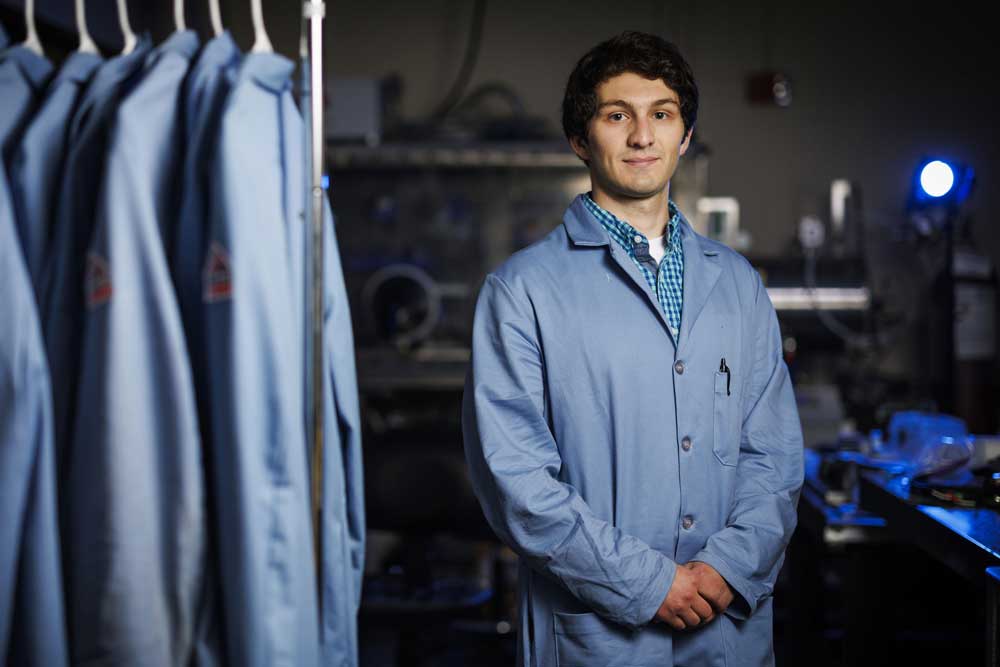
Hugh Smith, a fifth-year PhD candidate at MIT's Department of Materials Science and Engineering, emphasizes the importance of developing the right battery for specific applications rather than striving for the 'best' battery overall. His research focuses on sodium-ion batteries, which aim to replace the costly critical minerals found in lithium-ion batteries with more abundant materials such as sodium, iron, and manganese. Smith's work seeks to make energy storage systems more affordable and environmentally sustainable.
Read More
Smith identifies batteries as a crucial bottleneck in the transition to clean energy, stating, "I’ve believed for a very long time that the biggest engineering problem humanity faces is the transition to clean energy. Batteries are a critical bottleneck in that transition."
Growing up in Albany, New York, Smith was drawn to materials science because it intertwined his interests in chemistry and mathematics. He believes that the materials we encounter daily are deliberately designed for specific functions, which led him to batteries. After completing his undergraduate degree in materials science at Case Western Reserve University, he joined MIT to explore how novel battery chemistries can cut costs while maintaining performance.
Consumers typically desire batteries that charge quickly, last long, store significant energy, and are inexpensive. However, improvements in one area can often lead to compromises in another. For example, smartphone batteries prioritize energy density and longevity, while batteries for electricity storage focus more on cost and reliability.
Instead of pursuing a one-size-fits-all solution, Smith aims to strike a balance among competing priorities depending on the intended application. "It’s trying to balance everything," he explains. The sodium-ion batteries he studies may provide lower-cost alternatives for electricity grids and more affordable electric vehicles, benefiting from manufacturing processes similar to those used for lithium-ion batteries.
Smith's research journey at MIT has involved learning to navigate the complexities of research independently, as he became the first graduate student in a newly established lab under Professor Iwnetim Abate. This experience required him to adapt and develop problem-solving skills without the support of senior colleagues, transforming him into a more autonomous researcher.
Before entering graduate school, he spent seven months at the Battery Innovation Center in Newberry, Indiana, where he gained practical insights into the battery development process. Collaborating with a diverse team of engineers and scientists reinforced his understanding that addressing battery challenges requires multidisciplinary knowledge.
Outside of his academic pursuits, Smith engages in various sports through MIT's intramural program, including soccer, ultimate frisbee, and volleyball, providing a break from his rigorous research. He enjoys fishing and exploring the historic sites and coastal towns of New England.
As Smith approaches graduation this winter, he aims to contribute to the advancement of technologies that facilitate the shift to clean energy. "Lots of smart people have already made wind and solar very cheap. The issue is reliability, and batteries can help solve that problem," he states, expressing hope that his work will help make the transition to an electric grid powered by reliable clean energy more affordable.