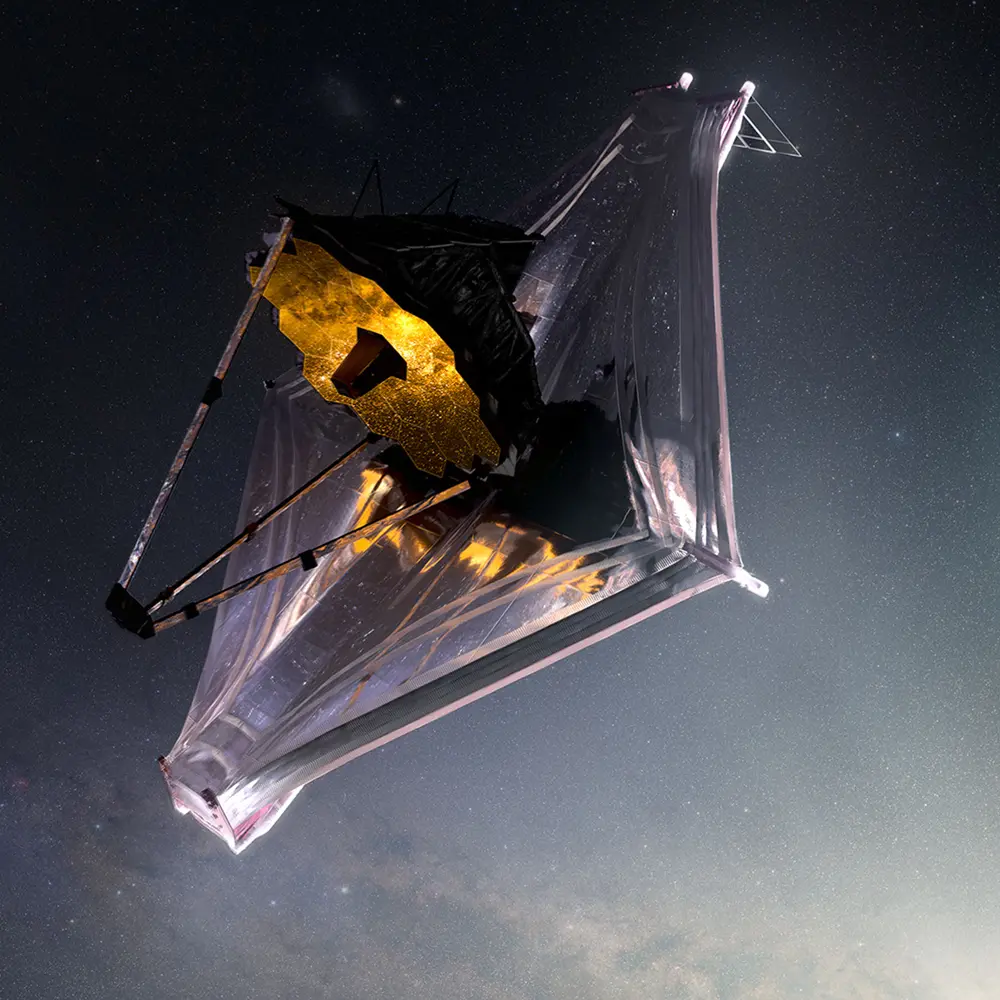
Since its launch on December 25, 2021, the James Webb Space Telescope (JWST) has transformed our understanding of the universe, revealing fascinating insights ranging from planetary atmospheres to the dynamics of distant galaxies. Carnegie Science astronomers have played a significant role in this endeavor, contributing to over two dozen research teams with 1,328 hours of allocated observation time. Here are six significant discoveries made through JWST.
Read More
1. First Observations of Moon Formation
Astronomers at Carnegie used JWST to observe the gas and dust disk surrounding the exoplanet CT Chamaeleontis b, located 625 light-years away. This marks the first detailed look at a moon-forming disk. The data revealed that the moon-forming materials consist of various carbon-containing molecules, such as benzene, but the surrounding star's disk showed no detectable carbon. This observation may help explain the diverse characteristics of Jupiter's moons, indicating that chemical processes can vary significantly within a planetary system.
2. TOI-561 b: An Unexpected Atmosphere
TOI-561 b is a super-Earth exoplanet with a surface temperature of approximately 3,200 degrees Fahrenheit and a magma ocean. Surprisingly, it appears to have a thick atmosphere, contrary to prior expectations for such extreme conditions. Research led by Carnegie scientists indicates that the planet's lower temperature suggests an atmosphere that redistributes heat, challenging conventional theories regarding rocky planets and their atmospheres in hostile environments.
3. The Lemon Planet: A Unique Carbon Atmosphere
The exoplanet PSR J2322-2650b, which orbits a pulsar, has a bizarre atmosphere made of pure molecular carbon. Its unusual shape, resembling a lemon due to gravitational forces, also features carbon clouds that can condense into diamond rain. This discovery sets PSR J2322-2650b apart from other studied planets, as it holds unique molecular properties that defy existing formation models.
4. Rapid Star Formation in Early Galaxies
Alan Dressler of Carnegie examined galaxies that formed just two billion years after the Big Bang and found they produced stars at rates surpassing expectations for that early cosmic era. This unexpected burst of star formation signifies the need for revised models of galaxy growth and suggests a more dynamic early universe than previously understood.
5. Chemically Immature Galaxies
Carnegie scientists studying a group of teenage galaxies discovered that these early systems displayed varying levels of oxygen production but were notably low in sulfur and argon. This finding suggests that these young galaxies are chemically immature, lacking elements typically produced in supernovae, which may indicate their evolving nature.
6. Giant Planets Around Small Stars
A team from Carnegie is investigating gas giants like TOI-5205b, which orbits a relatively small star. The observations reveal that this exoplanet has a very metal-poor atmosphere while its interior is much more metal-rich. This inconsistency raises questions about how such large planets could form around low-mass stars, indicating that our understanding of planet formation may need to be reevaluated.
Carnegie scientists are also involved in various other JWST initiatives, including studying why some galaxies ceased star formation and refining measurements of the universe's expansion rate. With ongoing observations, they aim to unlock more cosmic mysteries, promising further insights into the universe's evolution and structure.