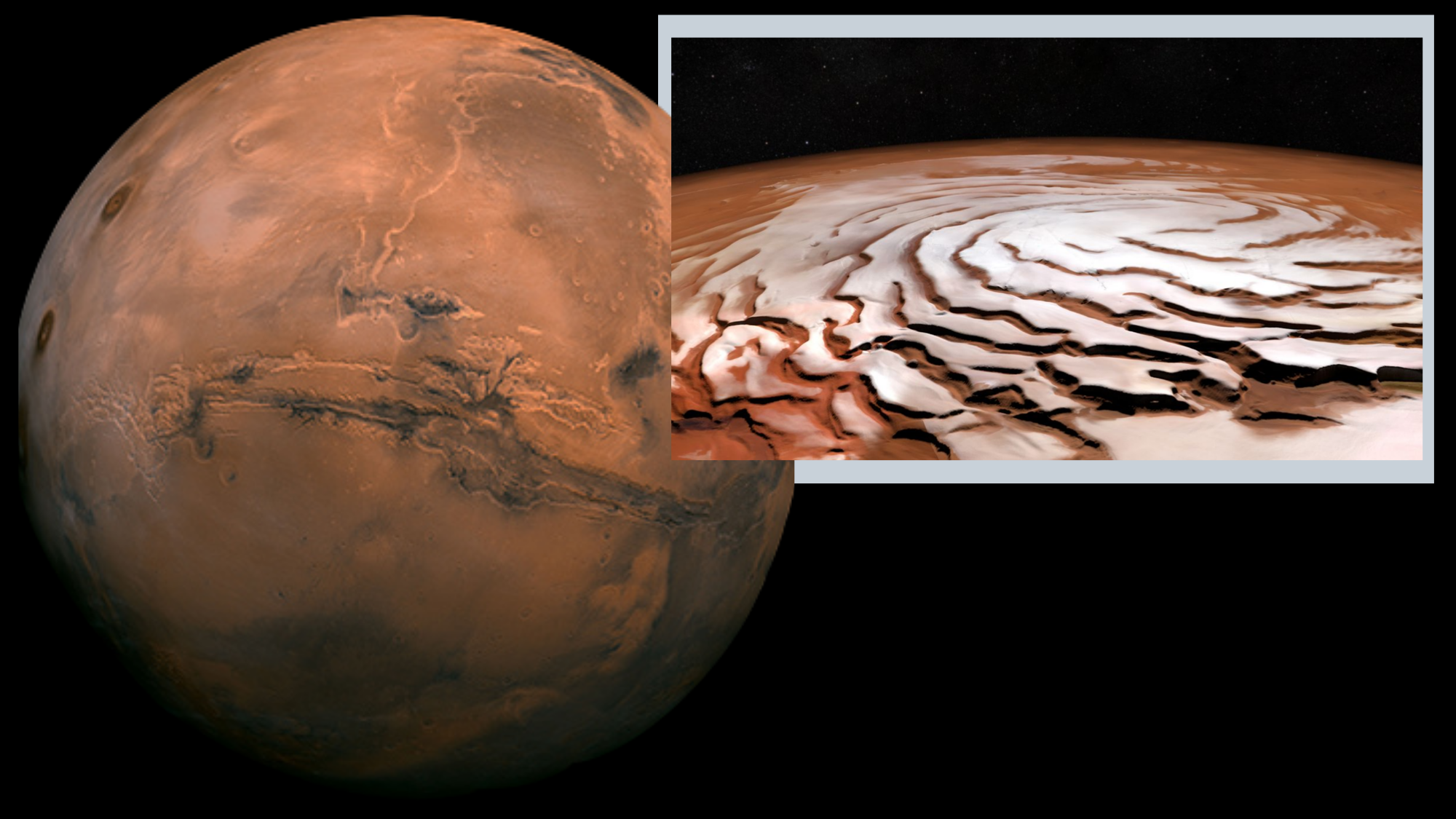
Recent findings indicate that the water ice at Mars's north pole contains only about 3% dust by mass, significantly less than the previously estimated 25%. This discovery could alter our understanding of the planet's climate history and its ability to support life.
Read More
The presence of dust in ice can act as an insulator, causing it to absorb sunlight and melt or sublimate more readily, which affects the ice's stability. Aditya Khuller from the University of Washington emphasized the implications of these findings, stating that less dusty ice means it reflects more sunlight, thus retaining less heat and potentially impacting Mars's colder climate conditions.
For years, scientists utilized a model based on lunar regolith to study Martian ice, which Khuller found unsuitable after comparing it with Earth's ice properties. Together with graduate student Pari Mohan, he applied a method developed by professor emeritus Steve Warren, which has been effective in analyzing snow and ice on Earth. This new approach led to the conclusion of the reduced dust content in Mars’s north polar ice.
Mars hosts ice caps at both poles. The north polar cap has a thinner seasonal layer of carbon dioxide ice, about a meter deep, which sublimates in summer, exposing the permanent water ice beneath. This residual cap, described as an "ice-cream sandwich," consists of various layers, some cleaner and less dusty than others, affecting the planet's climate differently over time.
Despite the polar caps’ stark conditions today, Khuller noted that during earlier periods, when dustier layers would have absorbed more sunlight, pockets of liquid water might have formed, offering potential habitats for microbial life. This raises questions about why Earth has thriving life while Mars appears barren.
The research, published on September 8 in the journal npj Space Exploration, adds another layer to our understanding of Mars's climate and habitability and how it has evolved over time.