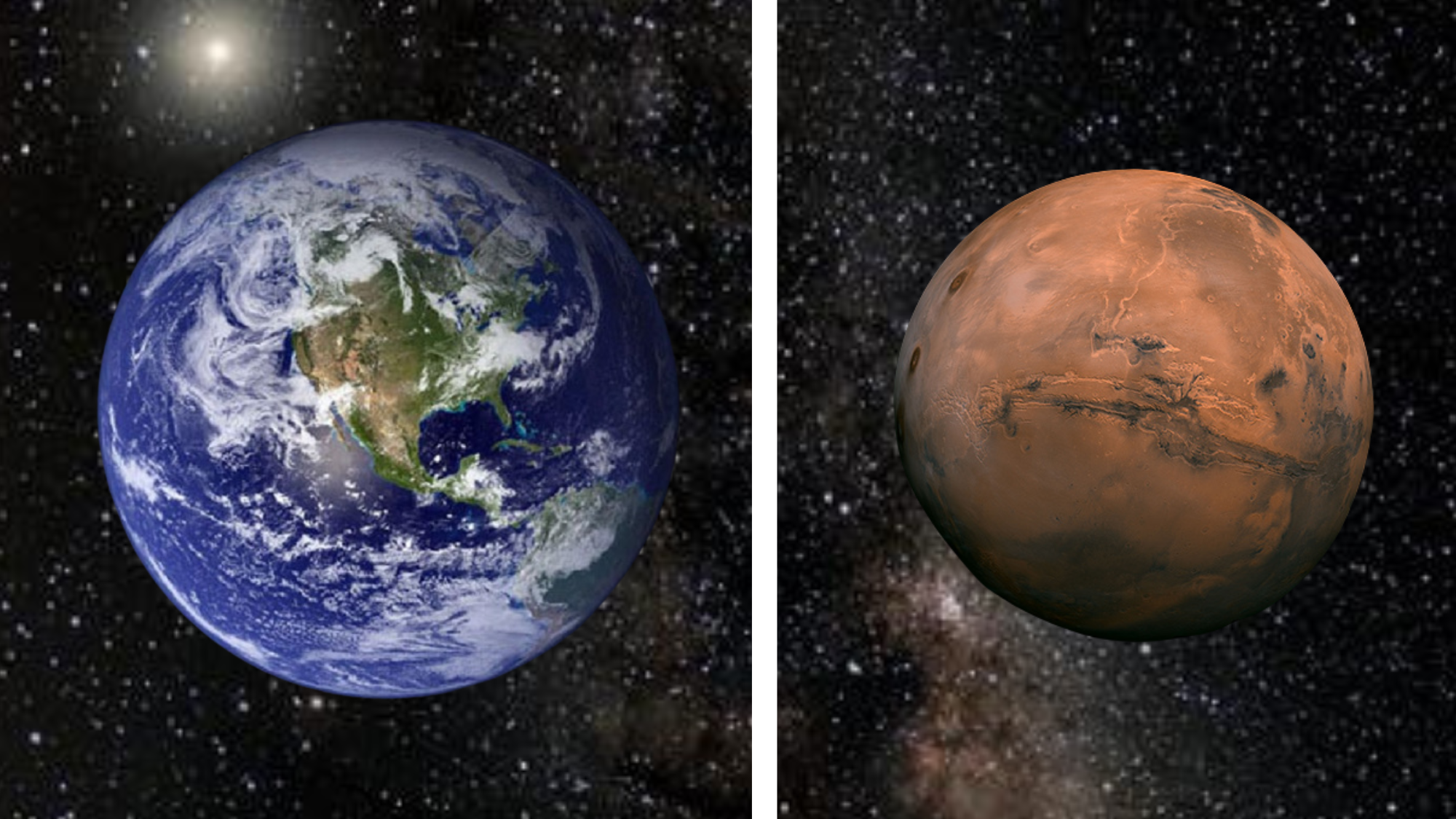
Research indicates that although Earth and Mars formed in the same region of the solar system around 4.5 billion years ago, they developed through different mechanisms. This finding challenges the assumption that neighboring planets share similar formation histories, as stated by Anders Johansen, a professor of planetary sciences at the University of Copenhagen and co-lead of the study.
Read More
The young solar system was characterized by a rotating disk of gas and dust, where the first planetesimals began to form. A prevailing theory posits that dust grains collided to form larger pebbles, eventually coalescing into kilometer-sized bodies known as planetesimals. These planetesimals merged over millions of years, leading to planet formation. However, the specific processes that led to the formation of Earth and Mars have remained a topic of debate.
To investigate, the research team analyzed the chemistry of both planets' crusts and mantles, focusing on volatile elements like sodium, zinc, and potassium, which may evaporate at high temperatures. The presence or absence of these elements serves as a chemical indicator of the conditions each planet experienced during formation. Despite the 4.5 billion years since their formation, the elemental compositions of Earth and Mars have remained distinct.
The researchers utilized computer models to interpret the data on volatile elements. Their findings suggest that approximately 75% of Earth's mass originated from protoplanets that collected material through pebble accretion, while 25% was due to planetesimals. In contrast, about 75% of Mars' mass seems to have come from planetesimals, with the remaining 25% from pebble accretion.
Despite uncertainties regarding the exact composition of the materials that formed Earth and Mars, adjustments in assumptions did not alter the central conclusions. The team's methodology is considered more straightforward compared to the isotope-based techniques commonly used in the field, which can produce ambiguous interpretations.
This research has broader implications for the study of exoplanets, as understanding the formation processes of planets can help assess their potential habitability. As scientists discover Earth-like planets orbiting other stars, insights into how volatile elements are retained during formation will be crucial in evaluating the conditions that support life.
The findings were published on September 25 in the journal Nature Astronomy.