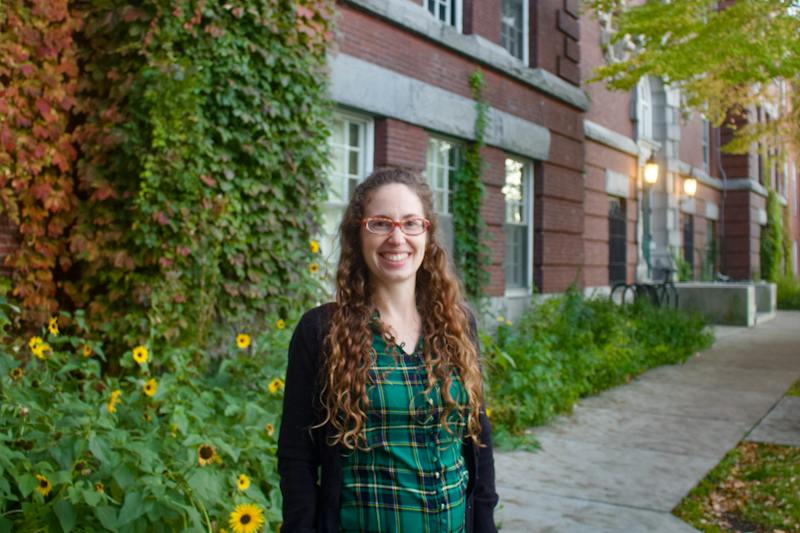
On September 23, the American Geophysical Union honored Professor Sarah Slotznik of Earth and Planetary Sciences with the Takesi Nagata Early Career Award. This accolade recognizes outstanding contributions to the fields of geomagnetism, paleomagnetism, and electromagnetism.
Read More
Slotznik's research focuses on coevolution, particularly the reciprocal effects of evolution between two species throughout history. She leads the Dartmouth Mag Lab, where she characterizes the composition and magnetism of Earth materials.
In 2025, Slotznik received the U.S. Department of Energy's early career research program award, which provides a five-year grant for emerging researchers. She utilized this funding to study natural magnets that contain cobalt.
In an interview, she discussed the evolution of her research with the DOE funding, emphasizing that her primary focus is on cobalt, a critical element important for the ongoing energy transition away from fossil fuels. Her group's direction has shifted to studying mineral magnetism, challenging previous findings in the literature. Slotznik noted discrepancies in existing studies and aims to investigate potential substitutions in her samples that could lead to differing structures.
When asked about the impact of federal funding cuts, Slotznik expressed gratitude for having submitted several grant applications before significant restructuring occurred. She believes that current priorities have now shifted to focus on critical elements, benefitting her work.
Slotznik described the AGU as a vital influence in her field, having first attended their meeting as a college sophomore. She highlighted the AGU's specialized division for magnetism, which provides a unique platform within the scientific community.
Regarding the Dartmouth Mag Lab, Slotznik shared that they recently got a second magnetometer operational, which is particularly beneficial for their ongoing project in the Gobi Desert. This advancement allows undergraduates to engage more directly with data collection and analysis.
She also expressed excitement about investigating the role of microbes in mineral formation, planning to collaborate with biologists to deepen her understanding of these processes through controlled lab experiments.
Slotznik acknowledged the challenges of balancing her research with teaching commitments. She integrates her research with her courses, such as “Astrobiology” and “Stratigraphy and Sedimentary Petrology,” finding that teaching enhances her research perspectives.
Looking ahead, Slotznik aspires to explore new applications of magnetism and anticipates that unforeseen opportunities may arise in her future work.