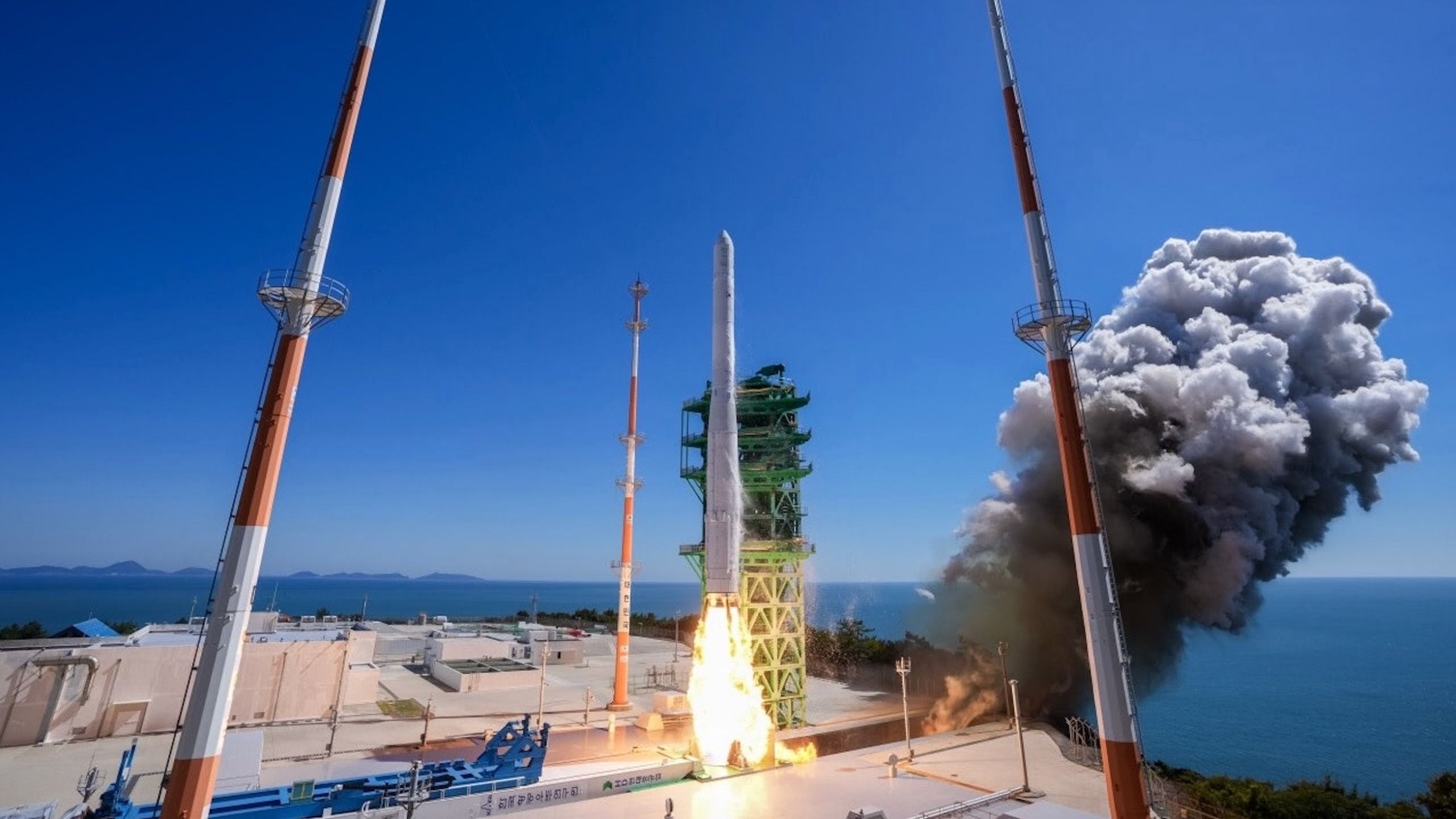
On October 6, 2026, South Korea's Nuri rocket achieved a significant milestone by lifting 15 satellites into orbit on its fifth flight. The launch took place from the Naro Space Center at 11:25 p.m. EDT (0325 GMT, 12:25 p.m. local time on October 7). According to the Korea Aerospace Research Institute (KARI), all but one of the payloads was successfully deployed into low Earth orbit.
Read More
Five of the satellites are microsatellites for the New-space Earth Observation Satellite Constellation for National Safety (NEONSAT) network. Each NEONSAT satellite weighs under 100 kilograms (220 pounds) and is equipped with an electro-optical camera capable of detecting objects as small as 1 meter (3.3 feet) in black-and-white images and 4 meters (13.1 feet) in color images. These satellites aim to enhance national security and disaster response capabilities, as reported by South Korea's Yonhap news agency.
Prior to this launch, two NEONSAT satellites were successfully deployed aboard Rocket Lab Electron vehicles in April 2024 and January 2026. Five more NEONSAT satellites are scheduled to launch on a Nuri rocket next year.
The remaining 10 satellites included cubesats from various operators. However, during the launch, the cubesat PERSAT02, developed by the South Korean company Quaternion, failed to deploy, as confirmed by KARI in an X post two hours after the liftoff.
The Nuri rocket, measuring 155 feet (47 meters) tall, is South Korea's first entirely domestic orbital launch vehicle and is operated by KARI and Hanwha Aerospace. Although the rocket failed during its inaugural mission in October 2021, it has since completed four consecutive successful launches. KARI noted that this fifth launch demonstrates the Nuri rocket's enhanced capability for precise satellite deployment in a single mission.
In an X post, KARI expressed gratitude for the public's support and interest in the successful flight of the Nuri rocket.