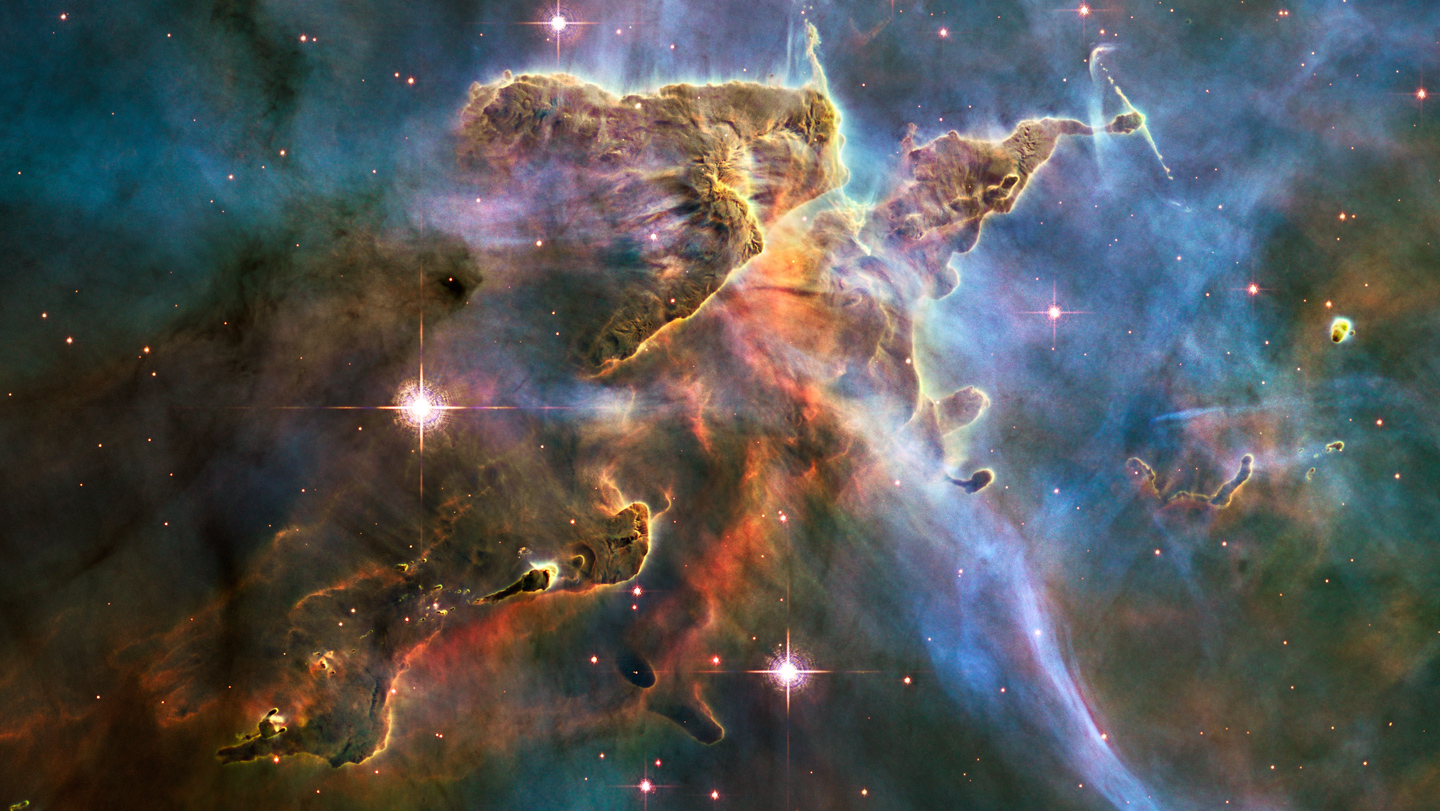
Before the formation of the Sun, small rock fragments began to capture the magnetic influences prevalent in the early solar system. Scientists have now developed methods to interpret these ancient records.
Read More
Research published on August 24 in the Proceedings of the National Academy of Sciences indicates that the gas and dust cloud that birthed our solar system was imbued with a powerful magnetic field. This magnetic field may have played a role in the Sun's development, suggesting that gravity alone did not account for the formation of our solar system or other planetary systems in the Milky Way.
This geological evidence is preserved in meteorites, which act as time capsules from that era. Specific mineral inclusions found within these meteorites, solidified over 4.5 billion years ago, provide insights into the early solar system's conditions, according to Cauê Borlina, a planetary scientist at Purdue University. He points out that these inclusions formed prior to the Sun and planets.
Scientists have long debated the mechanisms through which gas accumulated to form the Sun—whether primarily through gravity or magnetic forces. While past studies indicated a solar system-wide magnetic field post-formation of the Sun, understanding its presence during the Sun's early formation stages has proven more challenging, Borlina explains.
The meteorite analyzed by Borlina and his team, which fell to Earth in 2008, exhibited calcium- and aluminum-rich inclusions that record magnetic fields from over 4.5 billion years ago. These ancient readings may shed light on the Sun's formation process. Using advanced magnetometers, they determined the magnetic fields in the inclusions to be several gauss, significantly stronger than Earth’s current magnetic field.
Simulations of planetary formation predict that robust magnetic fields facilitate the transport of more gas to a forming star. During the Sun's Class 0 phase, certain models posit that it could have absorbed over 300 Earth masses of gas annually. The intensity of the newly measured magnetic field suggests that magnetism could have significantly contributed to this gas accumulation. “You can’t ignore the contribution of magnetism,” states Borlina.
Indrani Das, a theoretical astrophysicist at the Academia Sinica Institute of Astronomy and Astrophysics in Taipei, Taiwan, remarks that these findings provide valuable insights into the solar system's formation, labeling it as one of the first measurements concerning the Class 0 phase. However, Das emphasizes the need for additional measurements from other meteorites to strengthen these results, advocating for a larger sample size.