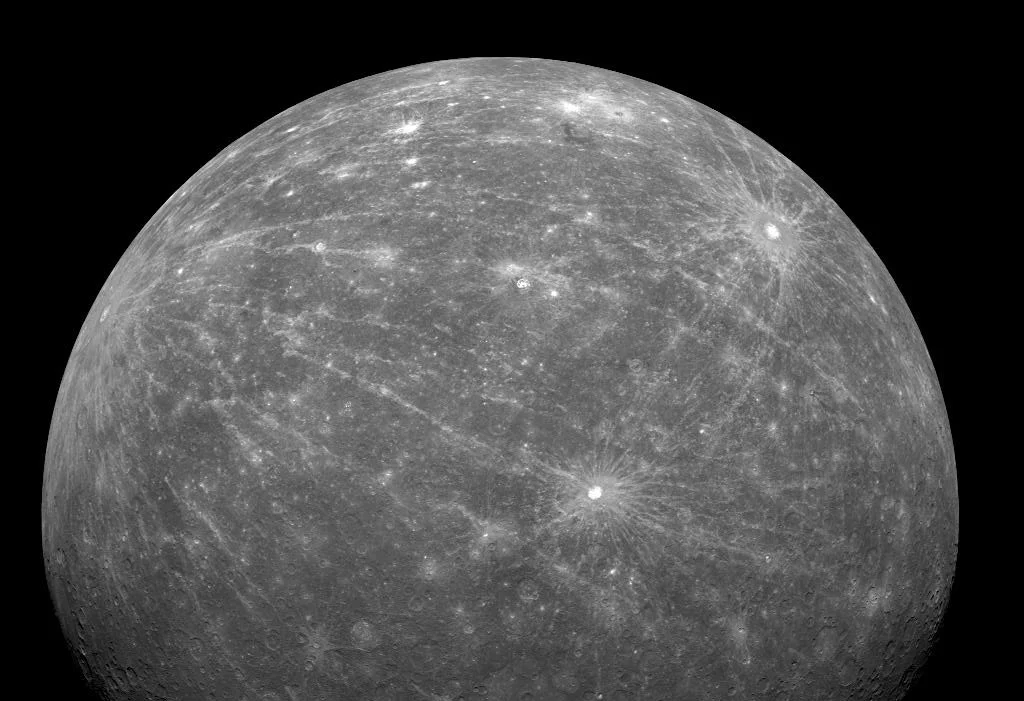
Recent research from the German Aerospace Center's (DLR) Institute of Space Research indicates that Mercury, the closest planet to the Sun, is shrinking at a rate 10% to 30% faster than previously calculated. This study, published in Geophysical Research Letters, suggests that the planet's surface has contracted up to 23 kilometers (14.5 miles) more than current estimates suggest.
Read More
Understanding the rate of contraction in rocky planets is essential for piecing together their geodynamic history. Scientists typically infer Mercury's shrinkage by mapping structures formed during global cooling, a process that began after its formation about 4.5 billion years ago. Initially a molten mass from violent collisions, Mercury cooled over time, leading to the creation of tectonic features like scarps and ridges.
Observations from NASA's MESSENGER mission revealed Mercury to be tectonically active. Despite this, impacts over billions of years have left it marked with craters, obscuring the signs of contraction. Gaku Nishiyama, the lead researcher, and his team integrated geological maps with new data on Mercury's surface roughness. They found that rougher areas on the planet exhibited fewer surface wrinkles, suggesting that impact debris was likely concealing signs of contraction in those regions.
By estimating contraction based on the smoothest areas, the researchers concluded that the planet’s diameter has decreased between 7.5 and 23 kilometers (4.75 to 14.5 miles), surpassing previous estimates of 4 to 16 kilometers (2.5 to 10 miles). These findings imply significant implications regarding Mercury's internal structure, suggesting that its metallic core could be larger and more complex than previously thought.
This new understanding aligns better with physical models of Mercury's development over time. However, Nishiyama cautioned that the estimates may still be conservative, as the data from the MESSENGER mission can only detect features larger than approximately 5 kilometers (3 miles). Looking ahead, the arrival of the ESA's BepiColombo mission on November 21, 2026, is expected to provide higher-resolution images and more detailed insights into Mercury's surface, enhancing our comprehension of the planet’s contraction and the evolution of rocky planets in close orbit to their parent stars.