Researchers at KAIST have developed a technology that enables smartphones to function as detectors for hidden cameras, using a low-cost LED device. This advancement in security technology aims to enhance privacy protection and prevent illegal filming in places such as hotels and short-term rentals.
Read More
The project, known as "SweepLED," was led by Professor Jun Han from the School of Computing, in collaboration with institutions in Singapore, including the National University of Singapore and Singapore Management University. The findings were presented on June 20 at the ACM MobiSys 2026 conference, with KAIST doctoral student Jonghyuk Yun as the primary author.
As hidden cameras become more common in everyday environments, there is a growing need for accessible detection technologies. Traditional portable detectors require users to visually spot bright reflections, which often results in false positives due to reflections from various surfaces like metal or glass.
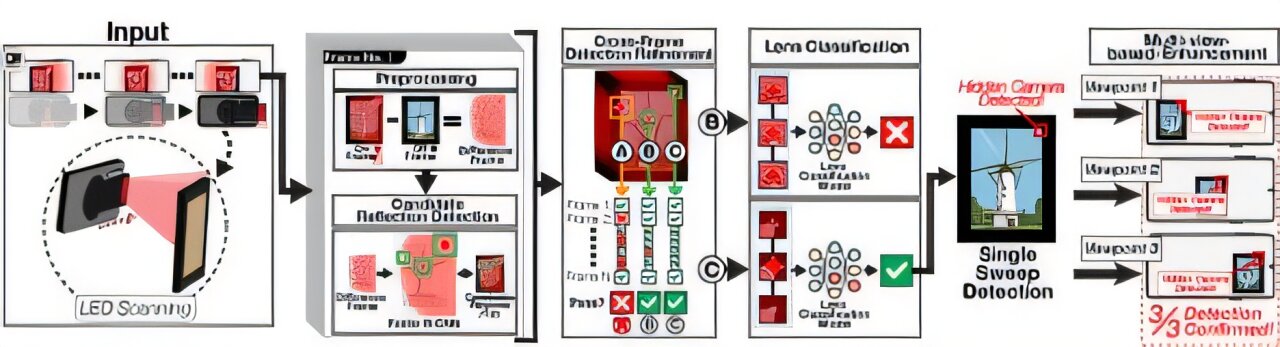
SweepLED addresses these limitations by fixing the smartphone camera's position while varying the direction of the LED light. This method allows the system to analyze the reflected light patterns on surfaces. Unlike ordinary glossy objects, which may show alterations based on light direction, camera lenses present unique reflection patterns due to their internal structures.
Utilizing deep learning, the team developed an analysis system to differentiate between these reflection characteristics. This sophisticated approach enhances the reliability of detecting hidden cameras hidden in common items like chargers or remote controls, as it examines both movement and shape changes across different lighting angles.
Testing on 30 typical objects revealed that SweepLED achieved about 94% detection accuracy, completing inspections in under five seconds per object. The cost for the LED components used in the smartphone attachment is under USD 7, or approximately KRW 10,000, making it a feasible detection tool for everyday users.
Han emphasized the importance of this research in combating privacy violations, noting that it merges affordable smartphone hardware with AI to create practical detection technology for non-experts.