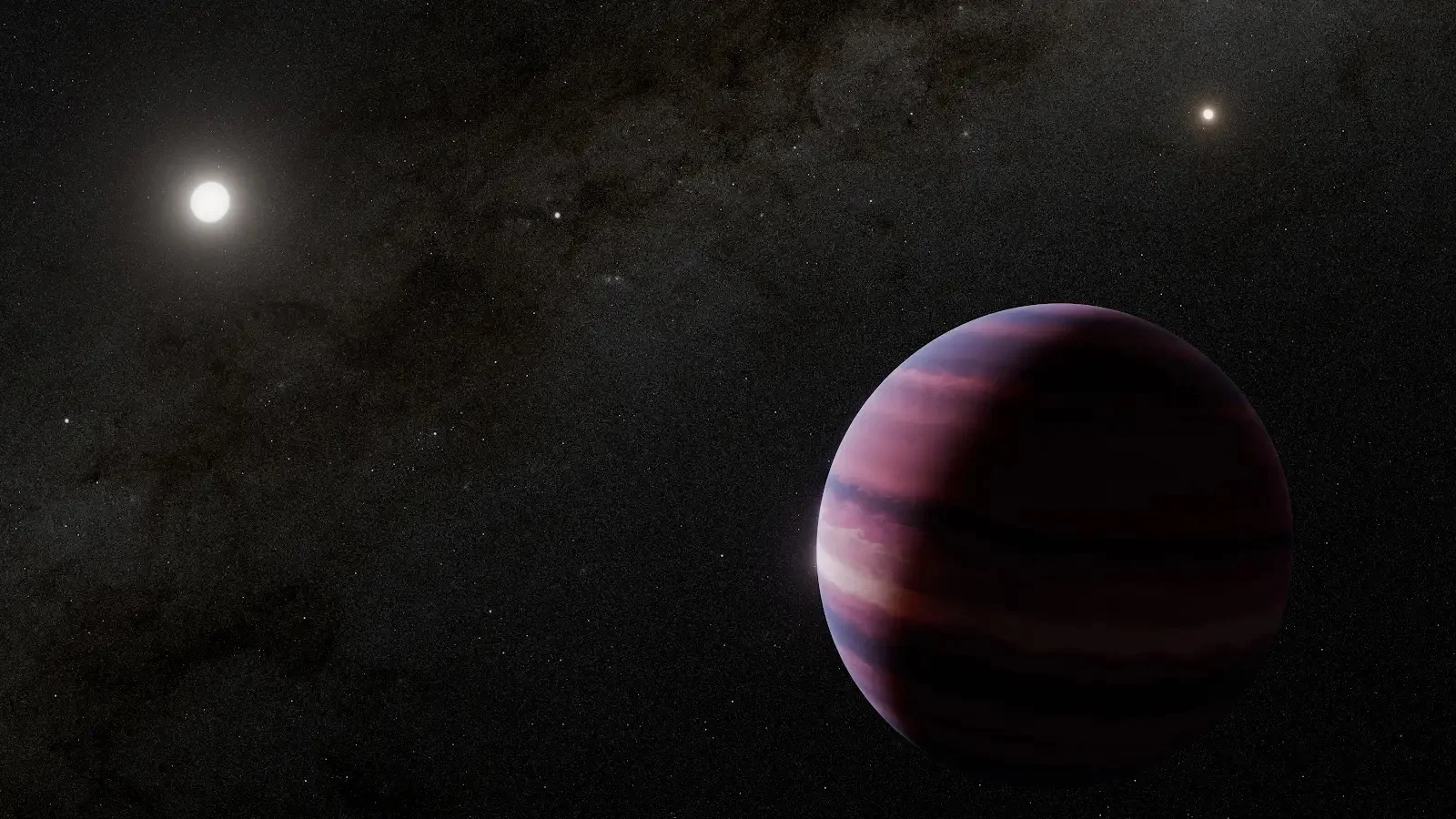
A new study published in the Astrophysical Journal indicates that the binary star system 70 Ophiuchi AB may harbor an Earth-sized planet capable of supporting liquid water. Located approximately 5 parsecs from Earth, 70 Ophiuchi AB consists of two stars that are both cooler and slightly smaller than the Sun, with masses around 88% and 73% of the Sun's mass.
Read More
Despite decades of observations, no planets have been confirmed to orbit either of the stars in this system. Using measurements from the University of Michigan to analyze the stars' movements, researchers simulated how an Earth-sized planet could maintain a stable orbit in the habitable zone of the larger star. The habitable zone is defined as the region where a planet can sustain liquid water on its surface.
Skylar D’Angiolillo, a doctoral student in Earth and planetary sciences at UC Riverside, conducted the modeling with her advisor, astrophysicist Stephen Kane. They focused on determining whether stable orbits are feasible in the habitable zone. D’Angiolillo explained that despite the presence of the second star, stable orbits for an Earth-sized planet are indeed possible.
The study found that the dynamical interactions in the binary system do not necessarily disrupt these orbits as one might expect in a two-star scenario. This is noteworthy because many star systems feature multiple stars, making 70 Ophiuchi an important area for understanding planetary system dynamics.
The authors emphasized that while the solar system is unique with its single star, the presence of other stars can create different conditions for planet formation and stability. D’Angiolillo noted the significance of evaluating whether systems can host habitable planets before attempting direct observation.
As NASA plans its Habitable Worlds Observatory mission for the 2040s, insights from this research may guide future investigations into similar binary systems. While there are currently no confirmed planets in the 70 Ophiuchi system, the findings suggest that the possibility of an Earth-sized planet in a stable orbit exists.