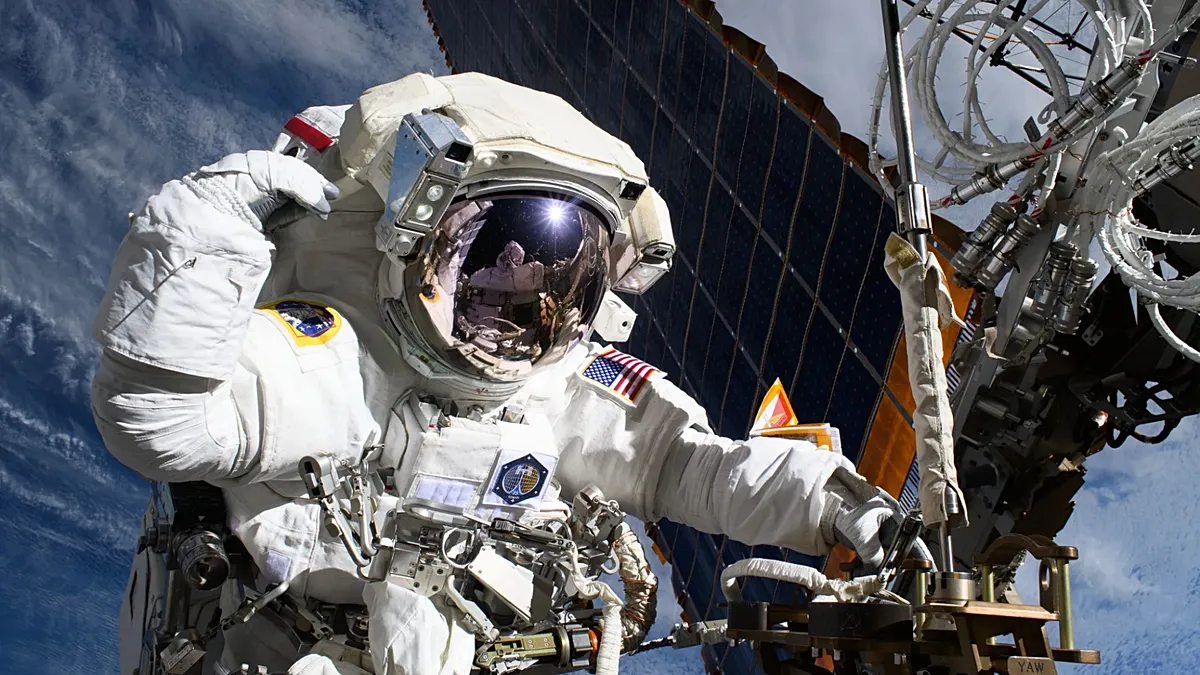
As journeys to Mars could span several months, the possibility of astronauts developing serious eye issues during transit raises critical questions about medical care in space. A team of American researchers is investigating the durability of artificial lenses used in cataract surgery, sending them outside the International Space Station (ISS) to evaluate their suitability for potential operations on Mars.
Read More
Morgan Micheletti, an ophthalmic surgeon and director of research at the Berkeley Eye Center, emphasized the need for accessible cataract treatment during long space missions. A Mars transit could take nearly a year, making a return to Earth for eye-related surgeries impractical. "Eventually, treatment will need to happen where the patient is,” Micheletti stated.
Cataracts occur when the natural lens of the eye becomes cloudy, necessitating its removal and replacement with an intraocular lens. Performing such surgical procedures millions of kilometers from Earth would require skilled personnel, as well as the necessary equipment and sterile supplies that can withstand the journey.
In the study known as JAMES, the researchers launched 135 unpackaged artificial lenses to the ISS. These lenses were exposed to harsh conditions outside the station for approximately six months: one set faced atomic oxygen, another was exposed to intense ultraviolet radiation, and a third was partially shielded from both. For comparison, 45 unpackaged lenses remained on Earth.
Upon their return, researchers at the Intermountain Ocular Research Center at the University of Utah examined 61 of the space-exposed lenses alongside 20 lenses kept on Earth. Most of the lenses, 42 out of 61, showed no significant changes. However, among the others, eight acrylic lenses exhibited cracks and surface erosion consistent with atomic oxygen exposure, while five lenses developed yellow discoloration, affecting light transmission at certain wavelengths. Six light-adjustable lenses displayed a cobblestone appearance, though the cause is still undetermined.
The researchers caution that the conditions in which the lenses were tested may not reflect actual travel scenarios, as the lenses were purposely unpackaged to assess potential points of failure in the harsh space environment. In practical applications, the lenses would be transported securely within a spacecraft. Future research will aim to determine the necessary packaging and shielding while avoiding unnecessary weight.
While the experimentation focused on the lenses' resilience to space conditions, it did not evaluate the feasibility of performing cataract surgery in space. The long-term goal involves thorough testing of surgical equipment under microgravity, beginning with devices that use ultrasound to remove cataracts.
Micheletti expressed that progress will be methodical, starting with materials, then equipment, and ultimately the surgical procedure itself. "My long-term hope is to help make the first eye surgery beyond Earth possible," he remarked.
These findings were presented at the European Society of Cataract and Refractive Surgeons congress in London. This experiment is believed to be the first controlled study to directly expose various types of modern artificial eye lenses to the external environment of the ISS, followed by laboratory analysis upon their return.