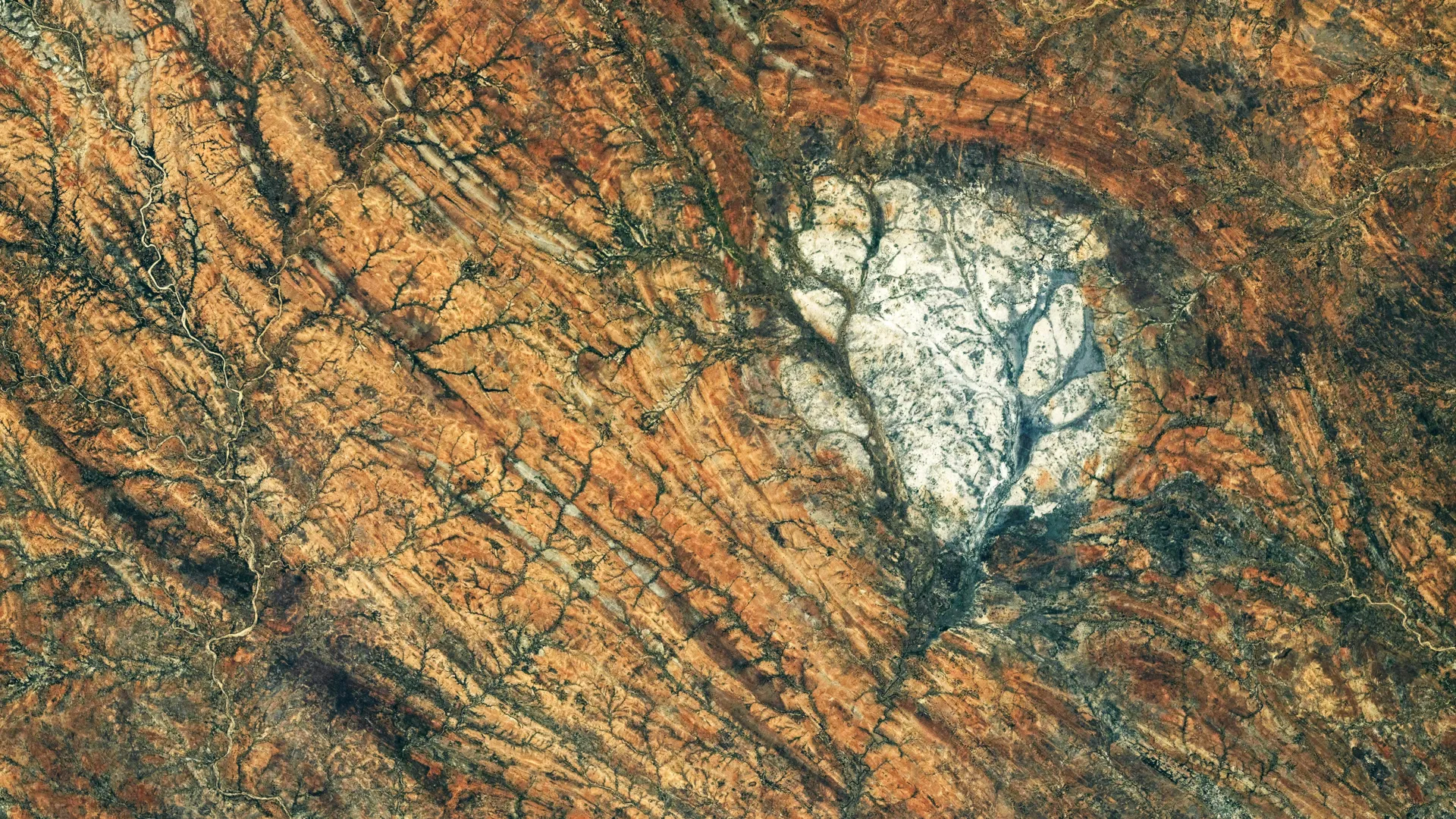
A striking rock formation in southern Madagascar, known as anorthosite, shares a surprising connection with the Moon. This ancient geological structure stands out against the dry landscape when viewed from space, resembling the same type of rock found extensively on the lunar surface.
Read More
Anorthosite is an igneous rock that constitutes much of the Moon's bright, reflective highlands, recognizable even to the naked eye from Earth. While it is prevalent on the Moon, significant deposits also exist on Earth, including regions in eastern Canada, Scandinavia, southern India, and Madagascar.
In southern Madagascar, the Saririaky anorthosite massif forms a roughly circular feature that distinguishes itself from its surroundings. On August 28, 2026, an astronaut aboard the International Space Station photographed this unique formation, which is exposed at Earth's surface.
As an intrusive igneous rock, anorthosite forms when molten material cools and solidifies beneath the surface, allowing minerals to develop into larger crystals. Geological research indicates that the Saririaky formation originated during the late Precambrian, over 600 million years ago, covering approximately 100 square kilometers (40 square miles).
The surrounding landscape provides further geological insights, reflecting the significant forces that have shaped the area over millions of years. The Saririaky massif resides within a ductile shear zone, where intense deformation occurs due to geological forces acting deep within Earth's crust. Under high temperatures and pressures, solid rock can bend and change structure without breaking, leading to metamorphism.
Geological studies have revealed long, parallel features extending from north to south in the region, documenting the substantial deformation experienced by the rocks around Saririaky. This transformation is believed to have occurred during the collision of ancient landmasses forming Gondwana, a supercontinent that included parts of present-day Africa, India, Madagascar, Australia, and Antarctica.
Some scientists propose that another anorthosite massif, located about 60 kilometers (40 miles) north, may have once been connected to Saririaky. This separation is attributed to tectonic forces that caused the original rock body to stretch, resulting in a geological process known as boudinage, where solid layers of rock are divided into segments as surrounding materials deform.
The study of anorthosite is crucial not only for understanding Earth's geology but also for investigating the Moon's history. The Moon’s anorthosite-rich highlands date back over 4 billion years and are thought to have formed when the Moon was covered by a vast ocean of molten rock, which later cooled and crystallized.
Materials returned by Apollo astronauts have provided researchers with lunar anorthosite samples for study; however, due to their limited quantity, similar terrestrial formations are valuable for comparative analysis. One notable comparison can be found in Montana's Beartooth Mountains, where anorthosite deposits have a composition similar to those on the Moon.
The Saririaky formation exemplifies the geological links between Earth and the Moon, showcasing how extensive tectonic activity has transformed ancient rocks into a distinctive landscape observable from orbit.