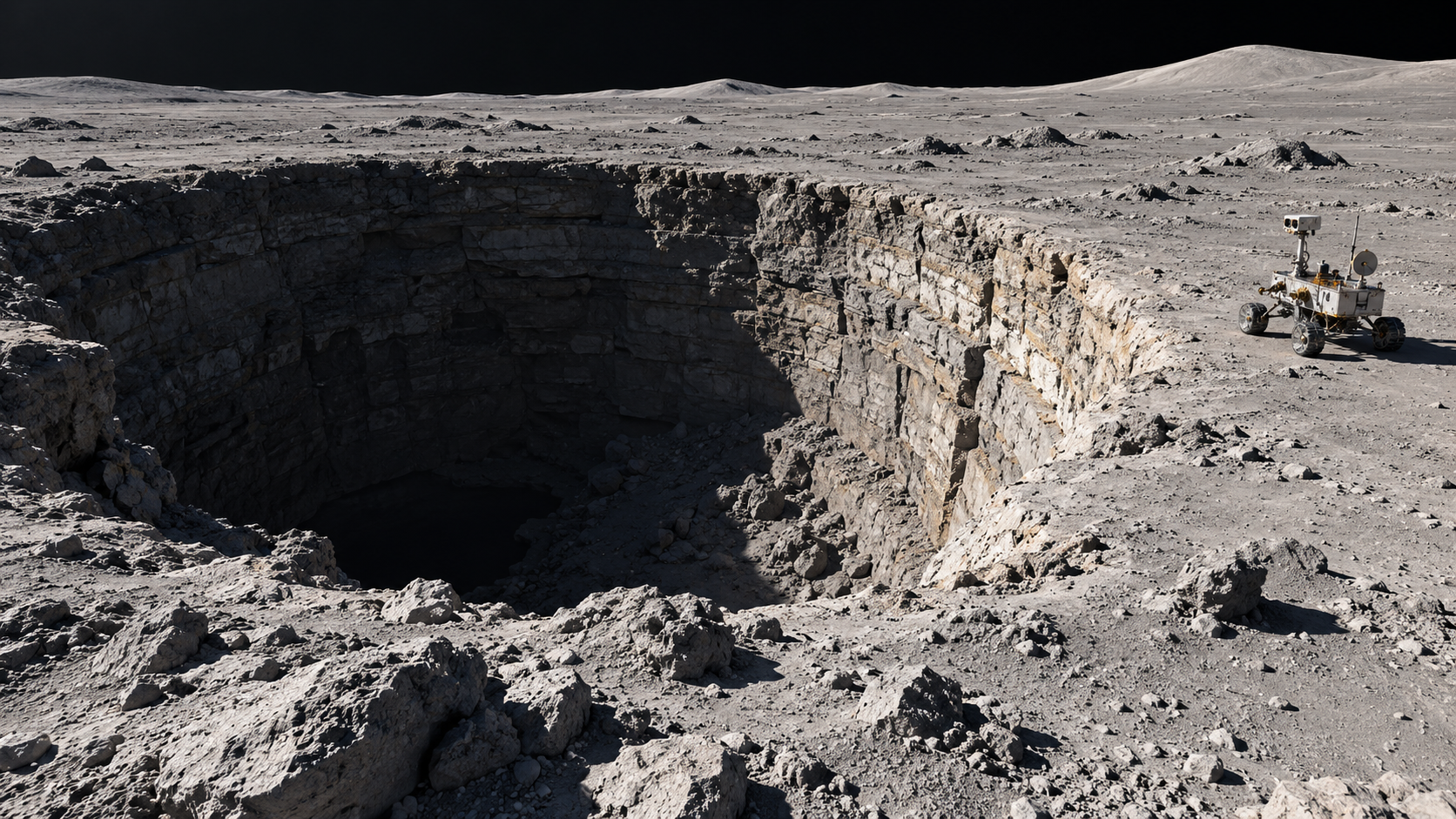
NASA has chosen the Geophysical Instruments for Marius Lunar Pit Investigation (GIMLI) project to assess whether the Marius Hills Pit may lead to an underground lava tube on the Moon. The investigation will utilize radar, seismic, and gravity measurements to understand the cave's dimensions and gather insights about the Moon’s volcanic history. Although a cave could offer astronauts natural protection from radiation and extreme temperatures, its existence remains unverified at this site.
Read More
The Marius Hills Pit, a potential entrance to an ancient lava tube formed by volcanic activity, will be the focus of the study. The Planetary Science Institute (PSI) will lead the project, which involves multiple scientific tools, including radar, seismic sensors, gravity detectors, and cameras, to provide a comprehensive view of the subsurface around the pit.
NASA announced the selection of the GIMLI project on September 30 as part of its Payloads and Research Investigations on the Surface of the Moon (PRISM) program. This initiative aims to select scientific investigations for deployment via the Commercial Lunar Payload Services initiative. GIMLI’s instruments will be carried by a commercially provided lander and rover. Nathaniel “Than” Putzig, associate director and senior scientist at PSI, will spearhead the investigation.
Previous orbital observations have hinted at the existence of underground caves and lava tubes on the lunar surface. However, simply identifying a pit does not confirm the depth of the opening or whether it is connected to a larger underground space. Earlier research, including a 2017 study using Japan’s SELENE (Kaguya) mission data, pointed to patterns indicating a potentially intact lava tube.
The GIMLI project will directly assess the pit from the lunar surface, seeking to determine if it connects to a larger underground void or simply terminates at its opening. Various methods will be employed: ground-penetrating radar will probe underground structures, seismic sensors will analyze vibrations in the ground, and gravity measurements will contribute to understanding the material distribution below the surface.
Putzig aims to revive active-source seismic methods not used since the Apollo missions, utilizing technology from Honeybee Robotics to develop the equipment necessary to generate vibrations and assess their passage through the Moon's surface. The investigation is also being supported by the Norwegian Space Agency, along with PSI's partners including Boise State University and Johns Hopkins University.
Understanding the geological context of lunar pits is critical, even if no significant underground void is found. The walls of the Marius Hills Pit could provide valuable insights into the lunar volcanic record, potentially revealing the history of lava movement and eruption intervals in the region.
The GIMLI project is one of three selected payloads focusing on lunar exploration. Other investigations planned under the PRISM program will monitor environmental hazards and search for resources vital for future lunar missions under NASA’s Artemis program. Together, these studies will address key questions as preparations continue for a sustained human presence on the Moon.