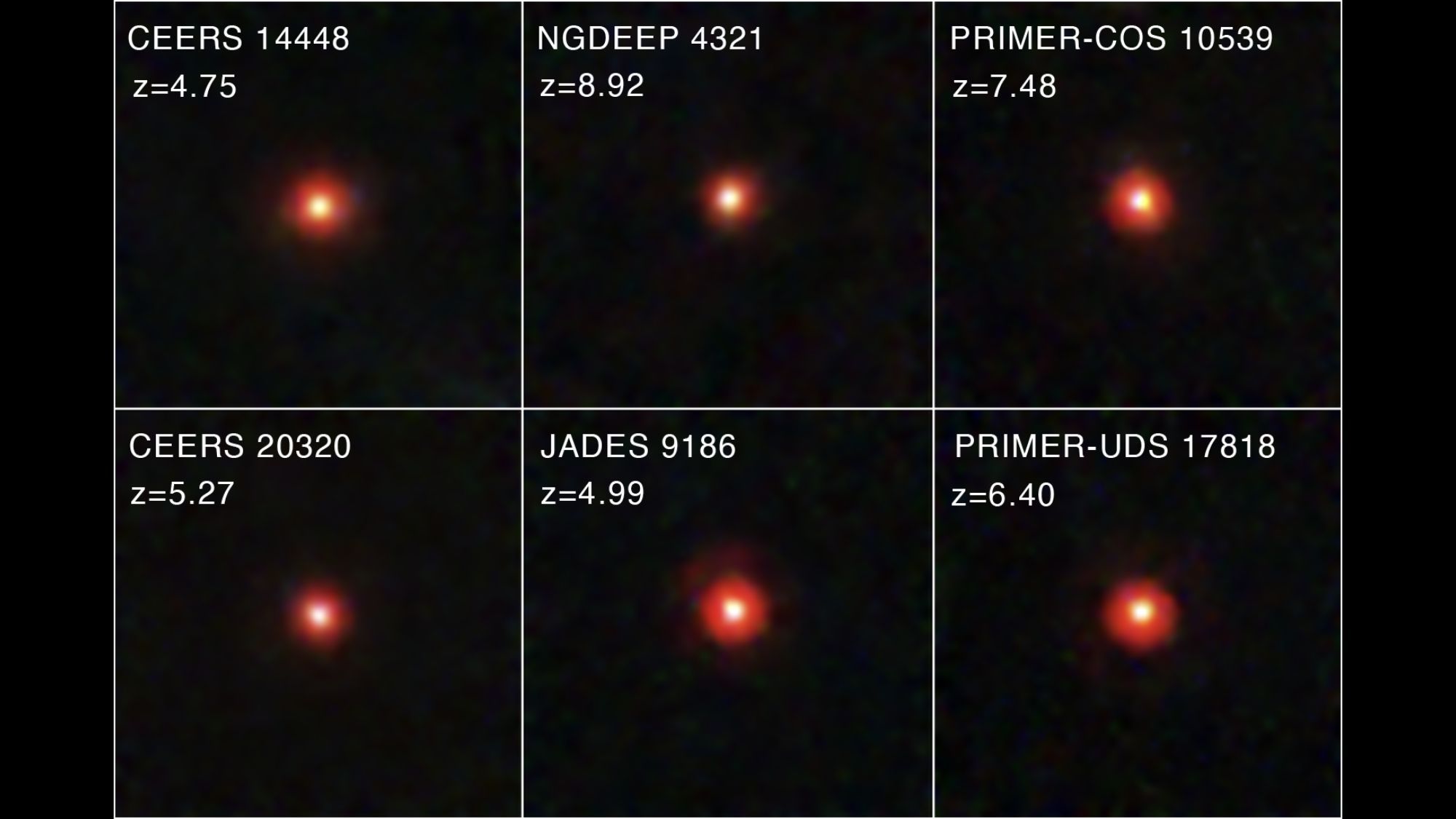
Recent findings suggest that the 'little red dots' identified by the James Webb Space Telescope (JWST) may evolve into active centers of fully formed galaxies. George Rieke from the University of Arizona stated, "Everything created in the early universe must evolve into something around us. We have had little idea of what little red dots become, but these results finally show us how to find their progeny."
Read More
The little red dots, discovered shortly after JWST became operational in 2022, are small, bright, red objects primarily located at redshift values indicating they existed between 13.2 and 12.2 billion years ago. Their brightness suggests they could be quasars, but their light resembles that of bloated stars, mainly in infrared with some ultraviolet, lacking the expected X-ray emissions from active black holes.
Researchers have proposed that these dots could be "black hole stars," indicating vast clouds of gas heated by an obscured supermassive black hole. However, their numbers significantly drop at redshifts corresponding to less than 12 billion years ago. This raises questions about their fate, whether they died off or transformed into more recognizable objects.
A recent hypothesis suggests that they might have evolved into large globular clusters, but alternative possibilities are emerging. A team led by Pierluigi Rinaldi, now at the Space Telescope Science Institute in Baltimore, believes they have pinpointed a descendant of a little red dot in the form of a distant galaxy named WISEA J123635.56+621424.2, observable at a redshift of 2, indicating its state 10.5 billion years ago.
The Saguaro galaxy, nicknamed for its resemblance to a species of cactus, exhibits spiral arms around a red core. Rinaldi’s team observed that the galaxy's core displays characteristics of a little red dot, shining brightly in infrared light as seen by JWST and emitting ultraviolet light captured by the Hubble Space Telescope. Furthermore, NASA's Chandra X-ray Observatory detected faint X-rays from Saguaro, hinting at an active galactic nucleus.
Carys Gilbert from the University of Cape Town noted that these X-ray observations indicate the galaxy has a very obscured active nucleus, which may explain the lack of X-ray emissions from other little red dots. Earlier this year, scattered X-rays were detected from another little red dot, lending support to the idea that these objects are black hole stars, where black holes consume gas clouds from within, eventually allowing X-rays to escape.
Saguaro likely provides crucial insights into the development of little red dots and their connection to modern galaxies. Rinaldi's team simulated how Saguaro would appear 1 billion years after the Big Bang, revealing that much of its structure would have appeared less developed and dimmer, akin to other little red dots. This suggests that little red dots represent a developmental phase for galaxies with supermassive black holes, akin to the early Milky Way.
These findings were detailed in The Astrophysical Journal on July 29.