BEIJING - In 2025, China's space program reached significant milestones, including a groundbreaking in-orbit emergency rescue and the country's first asteroid mission.
Read More
This year, China maintained a consistent human presence in its space station operations, starting with the launch of the Shenzhou XX crewed spacecraft on April 24. Astronauts Chen Dong, Chen Zhongrui, and Wang Jie began a planned six-month mission at the station. The Shenzhou XIX crew later returned to Earth with results from successful experiments.
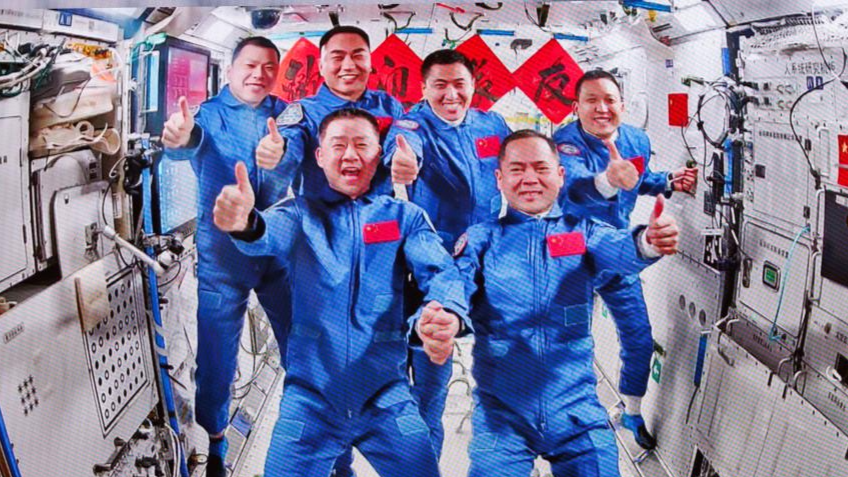
However, prior to the Shenzhou XX's scheduled return on November 5, small cracks appeared in the viewport of its return capsule, likely due to space debris, making it unsafe for the crew's return. In response, China executed two innovative and critical procedures. The Shenzhou XX crew safely returned to Earth on November 14 aboard the Shenzhou XXI, which had launched on October 31 with new astronauts Zhang Lu, Wu Fei, and Zhang Hongzhang. This event marked the first successful use of an alternative return procedure in the country's space program.
To ensure a dedicated return vehicle for the Shenzhou XXI crew, China conducted an emergency launch. On November 25, the uncrewed Shenzhou XXII launched, delivering essential supplies, including repair devices for the Shenzhou XX window, enhancing astronaut safety. This marked the first emergency backup crew launch, demonstrating the evolving capabilities and maturity of China’s space program.
China's international collaboration efforts progressed as well; in February, China and Pakistan signed an agreement for selecting and training Pakistani astronauts for future space station missions, showcasing China's commitment to partnerships with developing nations in crewed spaceflight.
In deep space endeavors, China's Tianwen II probe was successfully launched on May 29, initiating the nation's first asteroid exploration and sample-return mission. Designed to last about 10 years, the mission aims to explore and sample the asteroid 2016 HO3 and later examine the 311P main-belt comet. It will measure various physical parameters, including orbital dynamics and thermal properties, while investigating the two bodies' topography and internal structure.
The year also produced significant scientific advancements from China’s space station and lunar exploration programs. The Shenzhou XIX crew pioneered advances in physics and biology, including achieving the first orbital preparation of spinor Bose-Einstein condensates and establishing a groundbreaking optical lattice platform for quantum simulations. They successfully bred three generations of fruit flies in orbit, gathering valuable data on the impacts of microgravity on living organisms.
The Shenzhou XX crew reported accomplishments in multiple fields, successfully growing protein crystals for tumor therapy, heating tungsten alloys to 3,100 degrees Celsius for material science, and observing charged colloids in microgravity. They returned to Earth with "mice astronauts" to further study behavioral adaptations to space conditions, aiding research in space biology.
Additionally, lunar research yielded promising results; the Shenzhou XXI spacecraft brought back experimental "lunar soil bricks" after a year in space, vital for China's long-term lunar exploration strategies, including plans to land astronauts on the moon by 2030 and establish the International Lunar Research Station by 2035. Analysis of these bricks will provide insights into the effects of the space environment on material properties, crucial for future extraterrestrial construction efforts.
Further analysis of soil samples from the far side of the moon, collected by the Chang'e VI probe, revealed that its mantle is cooler than that of the near side, contributing essential data to understand the moon’s geological evolution.