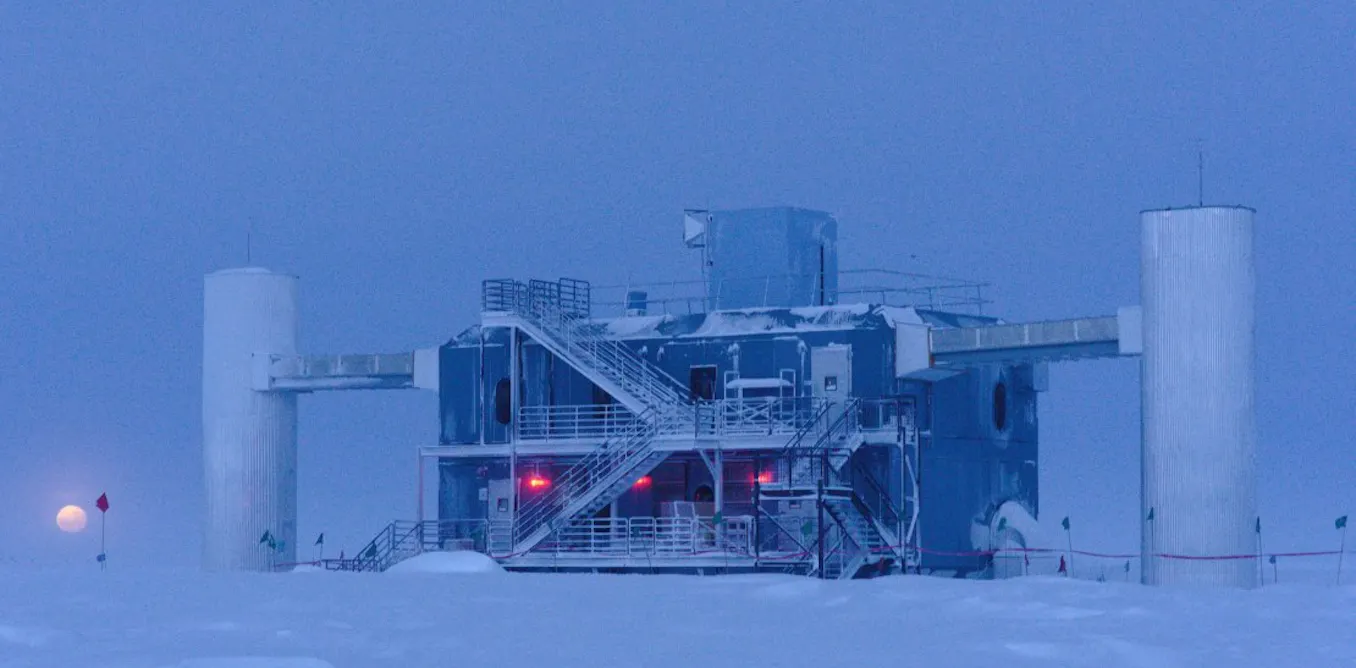
Francis Halzen, a Belgian American particle physicist, received the 2026 Nobel Prize in Physics for his significant contributions to the IceCube Neutrino Observatory and the discovery of high-energy neutrinos originating from astrophysical sources. This recognition underscores a long-standing scientific tradition of using Antarctica’s unique environments to explore beyond Earth.
Read More
For over a century, Antarctica has provided scientists with a natural laboratory for research related to space exploration. Its harsh conditions have proven ideal for testing equipment intended for the Moon, Mars, and other potential destinations in the cosmos. The continent’s glaciers have also captured meteorites from outer space, making it a prime location for astronomical observation.
Since the early 1900s, scientists have compared Antarctic environments to extraterrestrial settings. In 1901, Australian physicist Louis Bernacchi described Antarctica as akin to the Moon, while NASA officials in 1968 noted that the continent offered the best approximation of lunar conditions on Earth. Research conducted in the McMurdo Dry Valleys prior to the Viking mission to Mars in 1975-76 aimed to understand potential life on the Red Planet, a practice that continues today.
Researchers test various technologies in Antarctica, including spacesuits and robotics, hoping that success in these extreme conditions will mirror eventual performance in space. Additionally, studies of personnel in Antarctica help scientists understand long-term isolation and group dynamics, which are critical for missions in space. Notably, the Outer Space Treaty of 1967 was influenced by the Antarctic Treaty of 1959, both aimed at promoting cooperative scientific efforts.
Antarctic meteorites provide a unique opportunity to study materials from the Moon, Mars, and other bodies without leaving Earth. The first documented meteorite recovered from Antarctica was during the 1911-1914 Australasian Antarctic Expedition led by geologist Douglas Mawson. Modern efforts to collect meteorites began in earnest in the 1970s with the discovery of meteorites in the Yamato Mountains during Japan’s Antarctic Research Expeditions.
The continent’s blue-ice regions, which represent about 1% of its surface, are particularly rich in meteorites, owing to their visibility against the light ice background. Geologist William Cassidy formalized the U.S. efforts to search for meteorites in 1976, leading to significant discoveries, including the first recognized lunar meteorite and one from Mars, which stirred controversy when some suggested it contained evidence of ancient microbial life.
Despite earlier criticisms of Antarctic weather conditions for astronomical observations, telescope research has thrived there for more than a century. The central Antarctic ice sheet offers low wind, prolonged darkness, and a stable atmosphere, facilitating unprecedented access to cosmic signals. Since the 1990s, Antarctica has transitioned into an essential hub for astronomical research, hosting various sensors and telescopes.
The IceCube Neutrino Observatory, where Halzen's work prominently lies, is a major international collaboration with 450 physicists from 58 institutions across 14 countries. The project began in 1987 with Halzen's concept of a detector array, evolving to use a cubic kilometer of ice to capture neutrinos. The IceCube, built at the Amundsen-Scott South Pole Station between 2004 and 2011, allows researchers to detect, characterize, and trace neutrinos back to their cosmic origins, aiding in the understanding of phenomena such as supernovae, galaxy formation, and dark matter.
As demonstrated by Halzen and his peers, Antarctica's extreme conditions continue to provide invaluable insights into the fundamental mysteries of the universe.