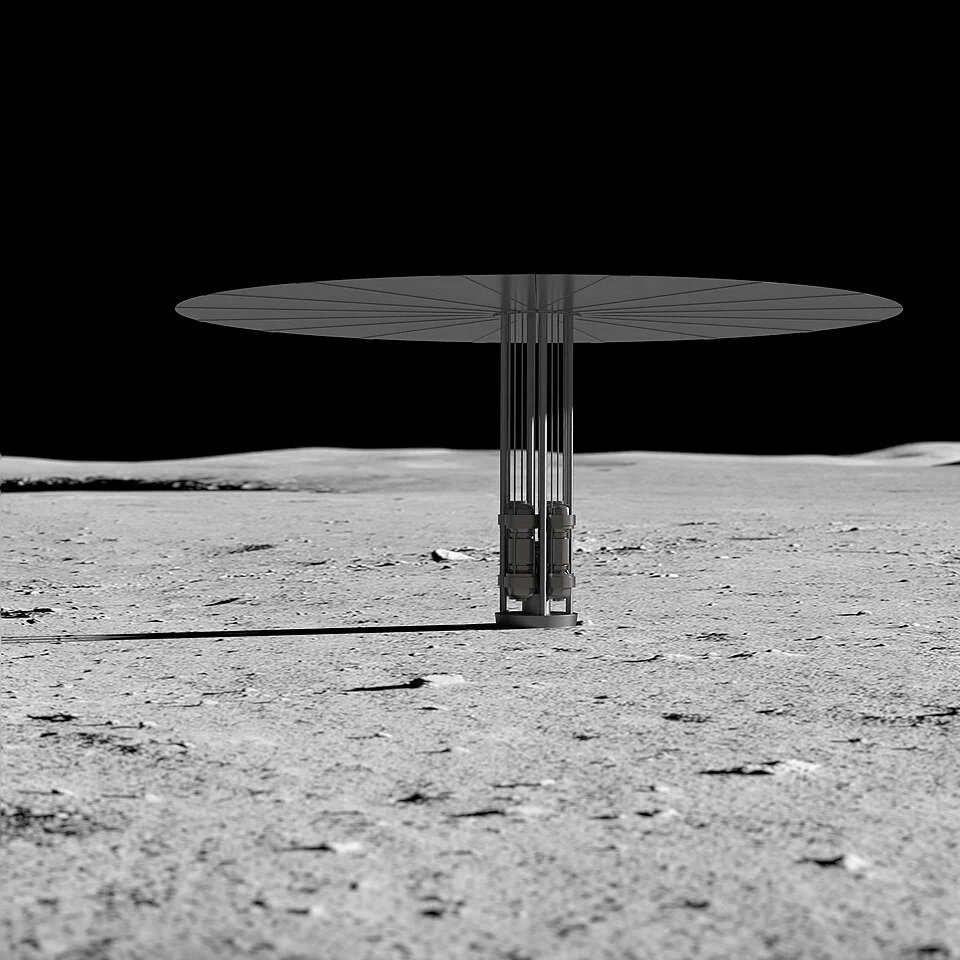
As plans for permanent lunar settlements progress, a key challenge is the lunar night, which lasts about fourteen Earth days, bringing temperatures down to -223°C. To withstand these extreme conditions, a reliable power source is essential, particularly one that operates independently of sunlight and does not rely on resources like coal or gas. A recent pre-print paper by Julius Mercz and colleagues from the Technical University of Munich discusses a novel nuclear reactor concept that could sustain environmental systems for moon habitats and support material extraction technologies.
Read More
"Living off the land" on the Moon, or in-situ resource utilization (ISRU), is crucial for any long-term lunar base, given the high cost of transporting supplies from Earth, which can exceed tens of thousands of dollars per kilogram. Fortunately, many necessary materials for construction are available on the Moon, embedded in the regolith, the fine dust covering its surface.
To access oxygen and other industrial materials from regolith, scientists are exploring Molten Salt Electrolysis. This process requires temperatures above 900°C, which are typically achieved using electrical heaters powered by nuclear or solar energy. However, conventional systems lose about 60% of their energy as waste heat, which limits efficiency for energy-demanding processes.
The proposed Microreactor Utilisation for Lunar Exploration (MULE) is designed to enhance efficiency. MULE's unique thermal chain uses a cascade system to prioritize thermal energy for the necessary MSE reaction, with expected output temperatures around 1000°C. It also incorporates a thermal storage bank to balance the thermal load, ensuring the reaction continues even if the reactor stops.
The reactor’s second stage involves generating electrical power at approximately 750°C using a closed-loop Brayton cycle, where expanding gas powers a turbine to produce electricity. The remaining heat is used to warm habitats and finally dissipated as infrared radiation into space at 75°C.
The design of MULE is another distinctive feature, utilizing an all-ceramic core primarily made of silicon carbide, alongside 37 hexagonal fuel assemblies containing TRIstructural-ISOtropic (TRISO) particles. These small pellets are designed to contain uranium-carbide fuel safely, with a high enrichment level of 93% U-235, although not quite weapons grade. Instead of control rods, MULE uses six pivot-controlled drums that alternate between neutron-absorbing and neutron-reflecting materials.
Compact in size, MULE measures 2.3 meters long and 0.78 meters wide, with a weight of 2.1 metric tons, compatible with current heavy-lift rocket capabilities. Simulation tools, specifically Serpent 2, were used to confirm the system's operational viability, with results suggesting a potential operational life exceeding 95 years without refueling.
However, challenges remain, including handling hot helium for thermal transfer and providing effective radiation shielding. The authors propose burying the reactor under several meters of lunar regolith, though excavating technology capable of such tasks is still in development. Despite these hurdles, the MULE reactor could play a pivotal role in powering future lunar colonies, ensuring the progress of long-term lunar goals.