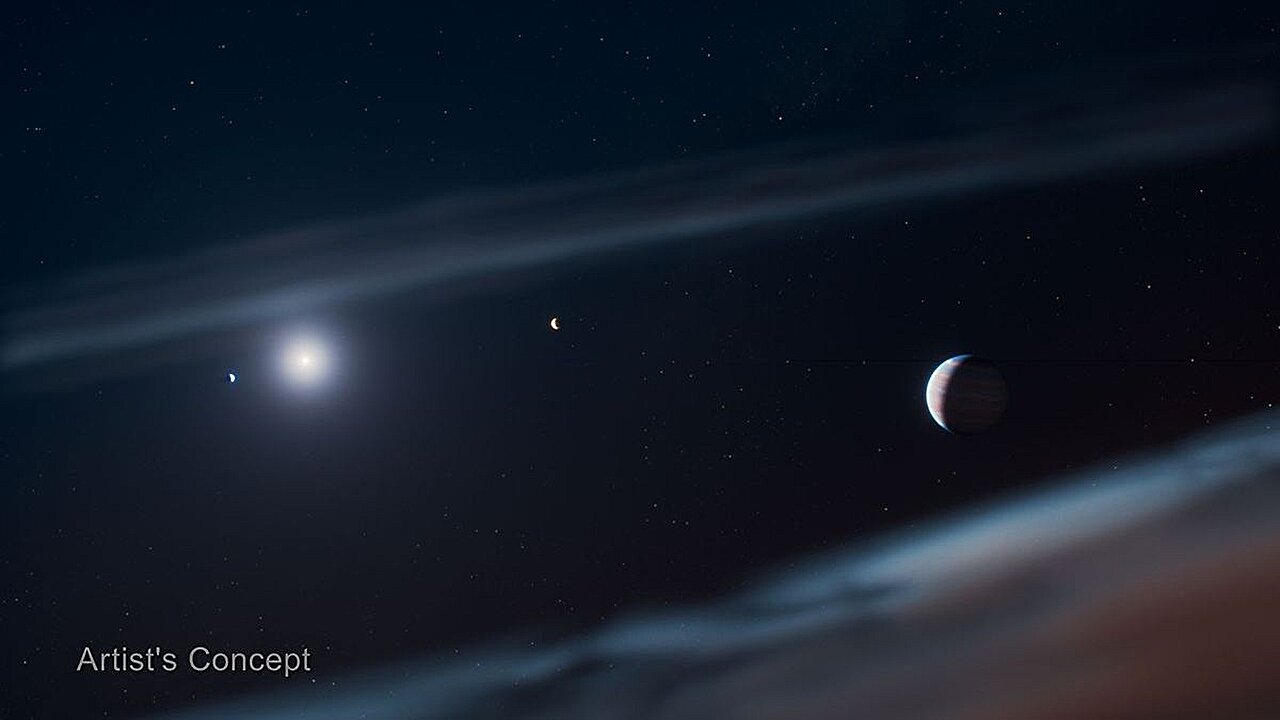
Astronomers using NASA's James Webb Space Telescope have discovered a new giant exoplanet, known as Beta Pictoris d, within the well-studied Beta Pictoris planetary system, located 63 light-years from Earth.
Read More
Beta Pictoris is famously home to two other giant planets, Beta Pictoris b and Beta Pictoris c. With the addition of Beta Pictoris d, this system becomes only the second known to have at least three directly imaged planets. Unlike its counterparts, Beta Pictoris d was found using a method that detects the chemical signatures of its atmosphere rather than just identifying it as a bright point of light.
Aidan Gibbs, lead author of the study published in the Astrophysical Journal Letters and a postdoctoral researcher at the University of California, San Diego, remarked that this new discovery enriches the narrative of how planetary systems form and evolve. The Beta Pictoris system, estimated to be around 23 million years old, provides a unique opportunity to observe the interactions between newly formed planets and the residual disk of dust and debris.
Beta Pictoris d is estimated to be at least twice the mass of Jupiter, making it the smallest of the three known giant planets in this system. It orbits its star at approximately 30 astronomical units, within the inner edge of the surrounding debris disk, similar to the orbit of Neptune in our solar system.
While the researchers were primarily investigating Beta Pictoris b's atmosphere with the telescope’s Near-Infrared Spectrograph (NIRSpec), the unexpected detection of Beta Pictoris d surfaced. They noted a distinctive pattern of carbon monoxide absorption lines, indicative of a giant planet's atmosphere, within the spectroscopic data.
Jean-Baptiste Ruffio, a research scientist at UC San Diego, emphasized that this spectrum provided crucial information about the planet's speed and alignment, confirming it was a planet orbiting Beta Pictoris rather than a background star.
Further observations with the Mid-Infrared Instrument (MIRI) on Webb identified water vapor and methane in the atmosphere of Beta Pictoris d, adding to the confirmation of the planet's existence and offering insights into its atmospheric composition.
The planet's detection was challenging due to its position within one of the brightest debris disks known, which obscured conventional imaging techniques. The spectroscopic approach allowed researchers to filter through the dust and focus on the molecular signatures unique to a planetary atmosphere.
The discovery of Beta Pictoris d not only expands our knowledge of this planetary system but also demonstrates a new method for finding exoplanets by using atmospheric fingerprints, rather than relying solely on traditional imaging techniques. Scientists plan to continue their analysis of Webb's observations to further delineate the planet's temperature, atmospheric composition, and orbital characteristics.