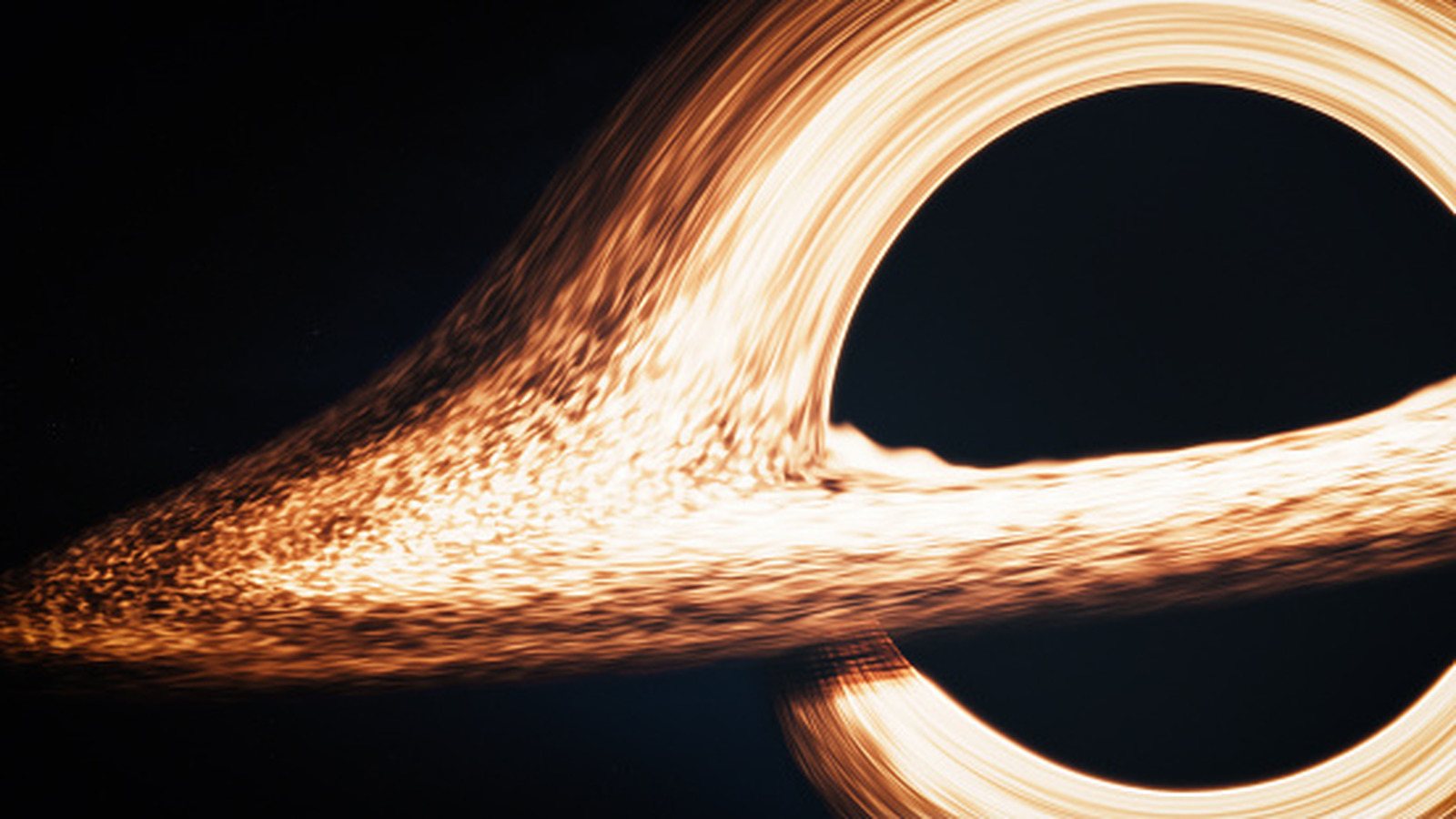
The James Webb Space Telescope has made significant strides in identifying ancient black holes, allowing astronomers to observe aspects of the universe previously hidden. In its imagery, several red dots have piqued the interest of scientists, and one particular discovery, designated GLIMPSE-17775, has been confirmed as a supermassive black hole, likely functioning as an active galactic nucleus. This black hole may also be classified as a 'black hole star,' where the accretion disc around the black hole emits light that mimics stellar characteristics due to its surrounding gas cocoon.
Read More
The cocoon consists of gases such as hydrogen, oxygen, helium, iron, and sulfur. GLIMPSE-17775 was identified while researchers were searching for Population III stars, which are the first stars formed after the Big Bang. Although GLIMPSE-17775 does not represent a groundbreaking find like images of colliding black holes, the data could enhance our understanding of black hole growth and galactic evolution.
Analysis suggests that GLIMPSE-17775 formed approximately 1.8 billion years after the Big Bang, determined through its cosmological redshift. This measurement is crucial for dating celestial objects, as the expansion of the universe results in light stretching to longer, redder wavelengths. The presence of over 40 distinct spectral lines has been documented in relation to GLIMPSE-17775, providing the most detailed observation of such a red dot to date. These spectral lines indicated strong concentrations of the aforementioned gases, ruling out the possibility that it is merely a rotating gas cloud.
However, a notable aspect is the absence of a pronounced Balmer break, which is commonly observed in both celestial dots and regular stars. Researchers utilized data from both the James Webb and Hubble telescopes to investigate this unusual finding. They concluded that a host galaxy surrounds GLIMPSE-17775, which is relatively rare for such objects.