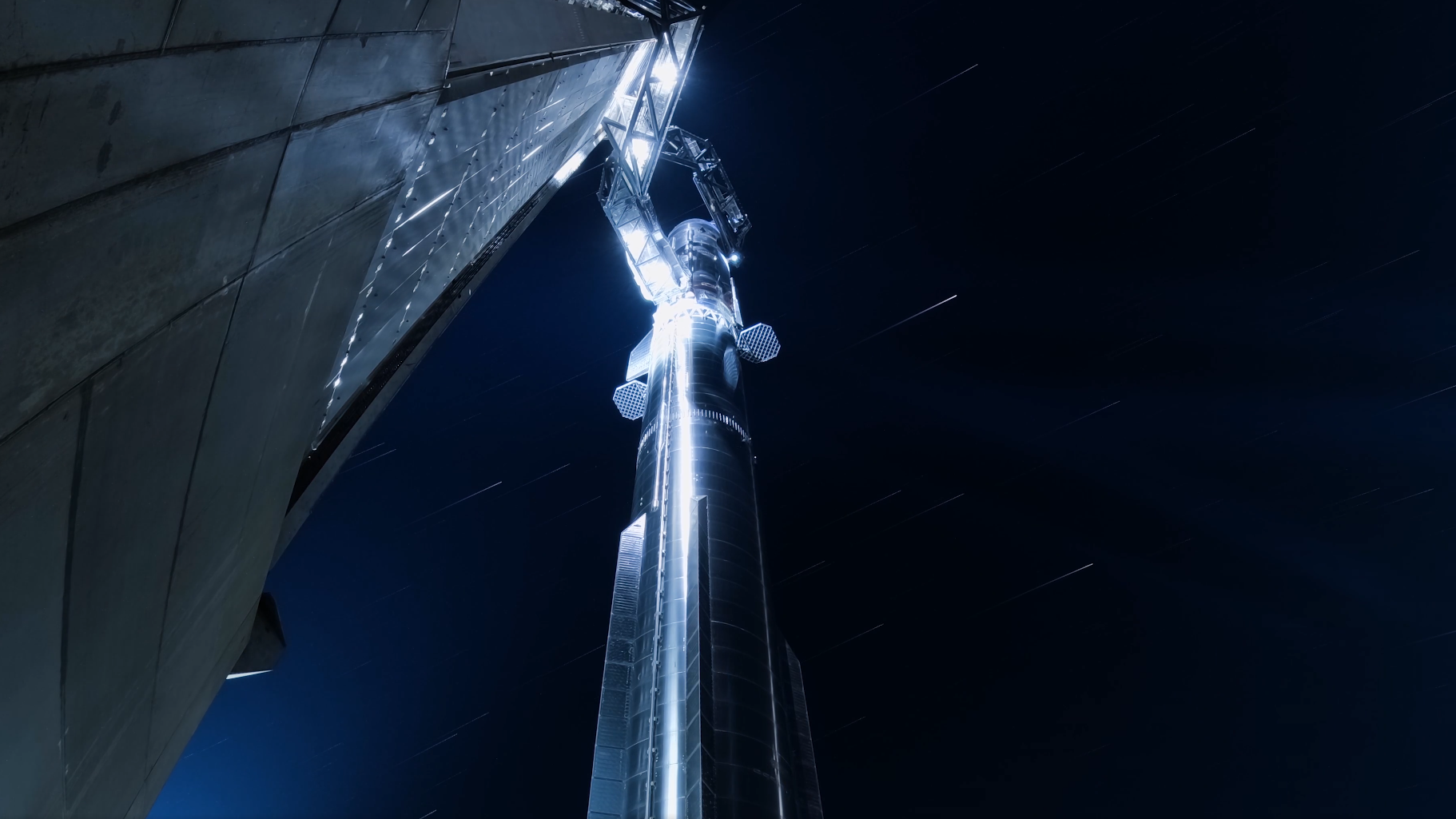
SpaceX has assembled the Starship rocket for its upcoming mission, Flight 14, which aims to be its first attempt to reach orbit. The launch is scheduled during a 75-minute window opening at 8:15 a.m. EDT (1215 GMT) on September 28.
Read More
Earlier this week, the Super Heavy first stage, Booster 21, was moved to Pad 2 at Starbase, followed by the upper-stage Ship 41, which was transported on September 22 and stacked on the booster overnight on September 23. Both components are currently undergoing final checkouts before a key fueling test known as a wet dress rehearsal, expected on September 24.
Flight 14 represents a significant milestone for Starship, which has been in development for 10 years. If successful, it will mark the first deployment of SpaceX’s upgraded Starlink Version 3 (V3) high-speed internet satellites. While previous missions deployed small batches of V3 Starlinks on suborbital trajectories, they burned up in the atmosphere rather than achieving orbit. Ship 41 carries 26 Starlink V3 satellites, which are crucial to SpaceX's ambitious plan for a network that may exceed 100,000 satellites, replacing the existing Starlink system and operating alongside over 1 million AI data center satellites, pending regulatory approval.
For the first V3 Starlinks to be deployed, Starship must reach orbit—a capability it has yet to attempt, as its first 13 flights focused on suborbital testing. The current iteration of Starship, designed as V3, aims to complete critical mission objectives, including reaching orbit and safely returning to Earth.
SpaceX faces technological challenges ahead, such as orbital refueling and the storage of cryogenic propellants in space, which will be essential for delivering payloads beyond low Earth orbit (LEO). NASA has also contracted Starship for its Artemis program, expecting a lunar lander capable of docking with its Orion spacecraft in time for Artemis III, slated for mid-2027, and a crew-certified vehicle for lunar landings on Artemis IV in 2028.
Assuming the wet dress rehearsal on Thursday goes well, SpaceX will seek regulatory approval from the Federal Aviation Administration to proceed with the launch. Flight 14's mission is expected to last roughly 10 hours, from liftoff to the splashdown of Ship 41 in the Pacific Ocean.