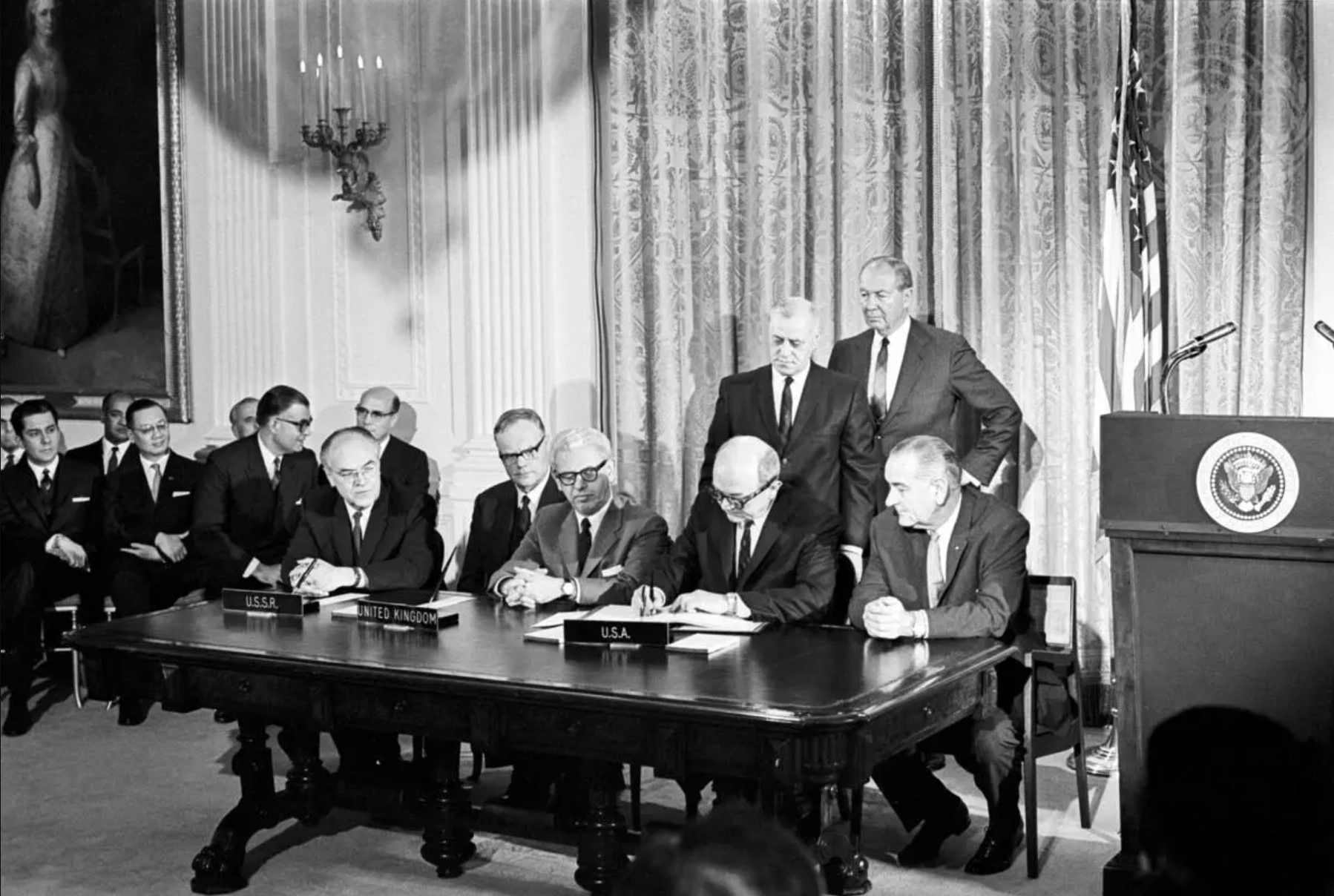
On October 10, 1967, the Outer Space Treaty was ratified, establishing a framework for how countries can explore and utilize outer space. The treaty asserts that "the exploration and use of outer space shall be carried out for the benefit and in the interests of all countries and shall be the province of all mankind." It prohibits any nation from claiming territory in outer space and mandates that celestial bodies are to be used "exclusively for peaceful purposes." To date, more than 100 countries have ratified the treaty.
Read More
The Outer Space Treaty, formally known as the Treaty on Principles Governing the Activities of States in the Exploration and Use of Outer Space, including the Moon and Other Celestial Bodies, is considered the cornerstone of modern space law. It not only provides a theoretical framework for future endeavors but has also been actively enforced in contemporary spaceflight activities.
A primary focus of the treaty is the peaceful use of space. It includes commitments not to place nuclear weapons or other weapons of mass destruction in orbit or on celestial bodies. Moreover, it limits the use of the Moon and other celestial bodies to peaceful activities, explicitly prohibiting military bases, weapon testing, or military maneuvers in outer space.
In addition to its stipulations regarding military activity, the treaty addresses ownership of spacecraft and satellites, whether they are in outer space, on another celestial body, or on Earth. It lays the groundwork for restrictions on off-Earth property rights and calls for cooperation among spacefaring nations, including assistance to astronauts in need, whether in space or during landings.