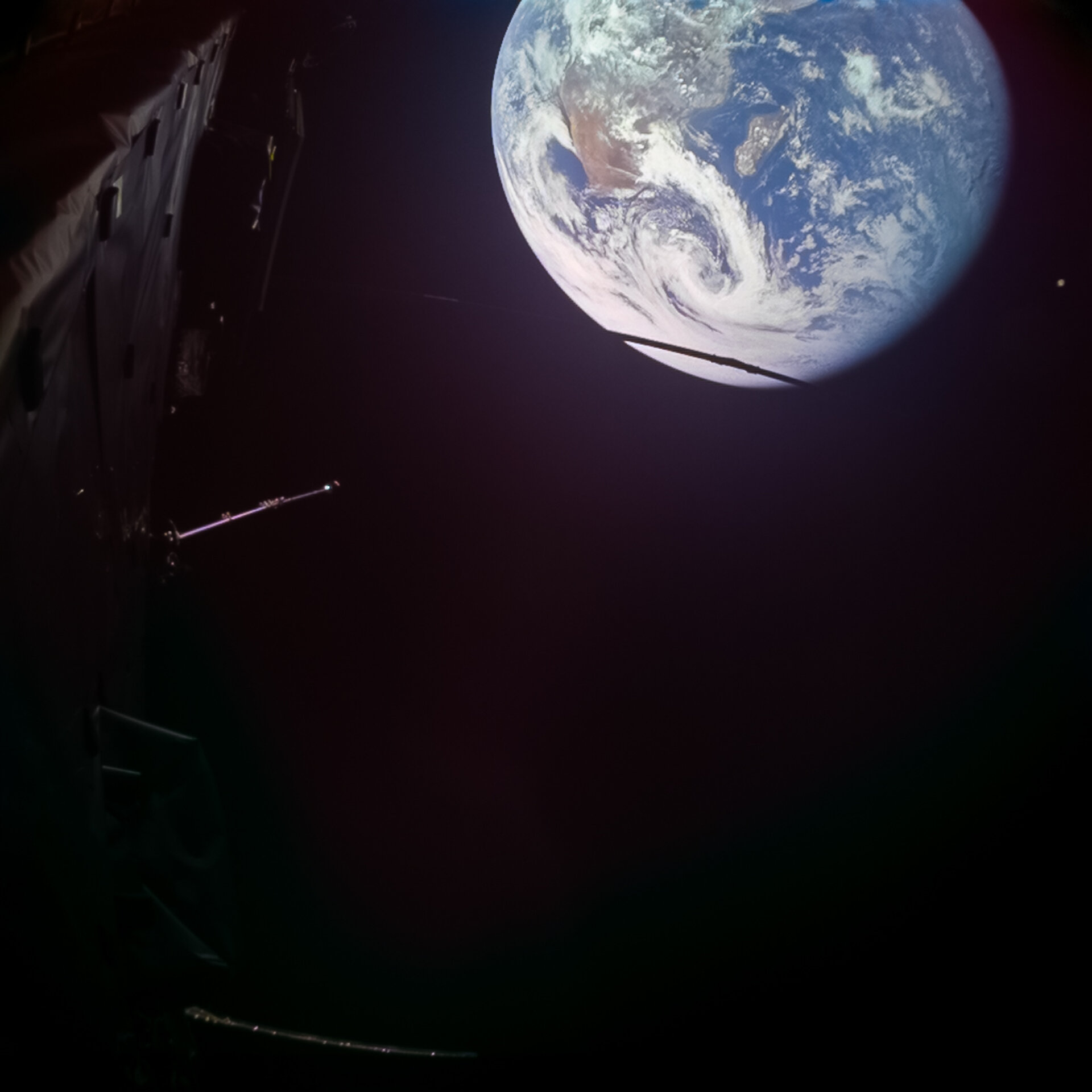
The European Space Agency’s Jupiter Icy Moons Explorer (Juice) conducted a successful flyby of Earth on 28 September, leveraging the planet's gravity to alter its trajectory toward Jupiter while conserving fuel.
Read More
During the flyby, Juice changed its course by 20° and increased its speed by 3.5 km/s. In the four weeks leading up to the flyby, mission operators needed only to make a minor adjustment, out of six planned adjustments, to align the spacecraft accurately for its approach. Close monitoring of Juice has been ongoing since 17 August, a practice that will continue until 10 October. The spacecraft's closest approach occurred at 13:45 CEST (11:45 UTC), where it flew just 8,640 km above the Indian Ocean, capturing a series of images with its onboard cameras.
Angela Dietz, Juice’s Spacecraft Operations Manager, emphasized the complexity involved in the flyby, stating that precise navigation in real time was essential, and the careful planning allowed for minimal use of propellant, preserving resources for future observations of Jupiter’s icy moons.
In addition to adjusting Juice's course, the flyby served as an opportunity to test the spacecraft's scientific instruments in a real-world setting. This testing aligns with upcoming missions, including a lunar-Earth gravity assist in 2024 and observations of Comet 3I/ATLAS in 2025. ESA teams collaborated intensively with external groups to determine the timing for activating Juice's 10 science instruments, maximizing operational time under constrained conditions.
Project scientist Claire Vallat noted that the flyby's unique conditions provide crucial chances for calibration and validation of the instruments before they reach Jupiter. Such opportunities are limited, and during the flyby, the team prioritized calibration activities based on their relevance for upcoming missions. The Earth flyby is comparatively straightforward, especially when considering the more complicated 35 flybys planned around Jupiter’s moons Ganymede, Europa, and Callisto, with discussions about the Europa flybys having started a decade ago.
Juice's journey involved traversing the magnetotail of Earth's magnetic field, enabling measurements of magnetic fields and charged particles far from Earth. Concurrently, the European-Chinese Smile mission has been observing northern lights and measuring magnetic phenomena close to Earth, offering a unique chance to correlate findings from both missions.
Results, including high-resolution images of Earth and the Moon captured by Juice’s JANUS camera, are expected to be published in the coming weeks after analysis by the scientific teams.
Juice is set to return for a final flyby of Earth in January 2029 before continuing its journey to Jupiter, where it will arrive in 2031.
Launched on an Ariane 5 from Kourou in April 2023, Juice aims to explore Jupiter and its large ocean-bearing moons, Ganymede, Callisto, and Europa. This mission, spearheaded by ESA with contributions from NASA, JAXA, and the Israel Space Agency, marks a significant step in understanding gas giant systems across the Universe.