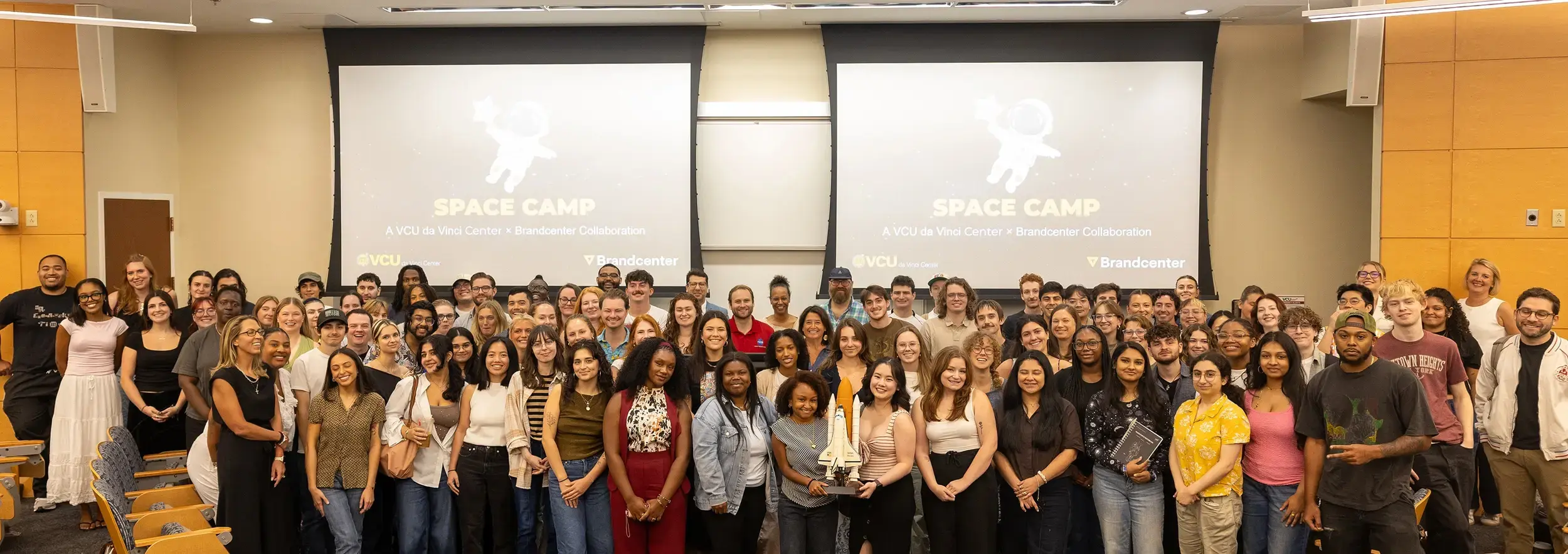
Virginia Commonwealth University’s Brandcenter recently hosted a one-day event known as the NASA Space Camp Design Jam, bringing together students from the Brandcenter, the da Vinci Center for Innovation, and NASA Langley Research Center. This event challenged participants to discover practical applications for NASA technology to solve real-world problems.
Read More
During the event, students heard from experts at NASA’s Langley Research Center, including aerospace engineer Derrick Seubert who discussed advancements in lunar exploration. Technology transfer specialist Katrina Young also spoke about the process of commercializing NASA-developed technologies, which can be licensed for a variety of applications.
Students were split into teams and assigned one of three NASA technologies to work with. They were tasked with identifying new uses for these technologies while addressing four key objectives: translating technical capabilities into human-centered opportunities, building brand narratives, prototyping service concepts, and detailing commercialization pathways.
The technologies assigned included:
1. **Flexible lightweight radiation shielding**: A coating that blocks radiation and can be applied to materials such as cotton and Kevlar.
2. **Optical concentration sensor**: A sensor designed to measure liquid concentration, originally used for the space station’s toilet.
3. **Composite joint connector**: A connector designed to manage stress from multiple directions.
Before diving into the project, Ashley Wenger, the program manager for the da Vinci Center, introduced students to design thinking principles that emphasize empathy, creativity, and rationality. She illustrated the concept of patent mining by encouraging students to brainstorm alternative uses for a common object like a paper clip.
Wenger highlighted the crucial stages of design thinking: ideation, definition, empathy mapping, prototyping, and testing. The emphasis was on fostering an open-minded approach to innovation.
Throughout the event, teams developed their ideas from initial brainstorming to presenting prototypes. Ramy A. Rahimi, Ph.D., a senior advisor for NASA Langley, provided two key pieces of advice: clearly define the problem to find effective solutions and recognize that NASA technology should serve as a foundation for further innovation.
At the end of the day, teams presented their concepts to a panel of judges from NASA, Brandcenter, and the da Vinci Center, with awards given in various categories.