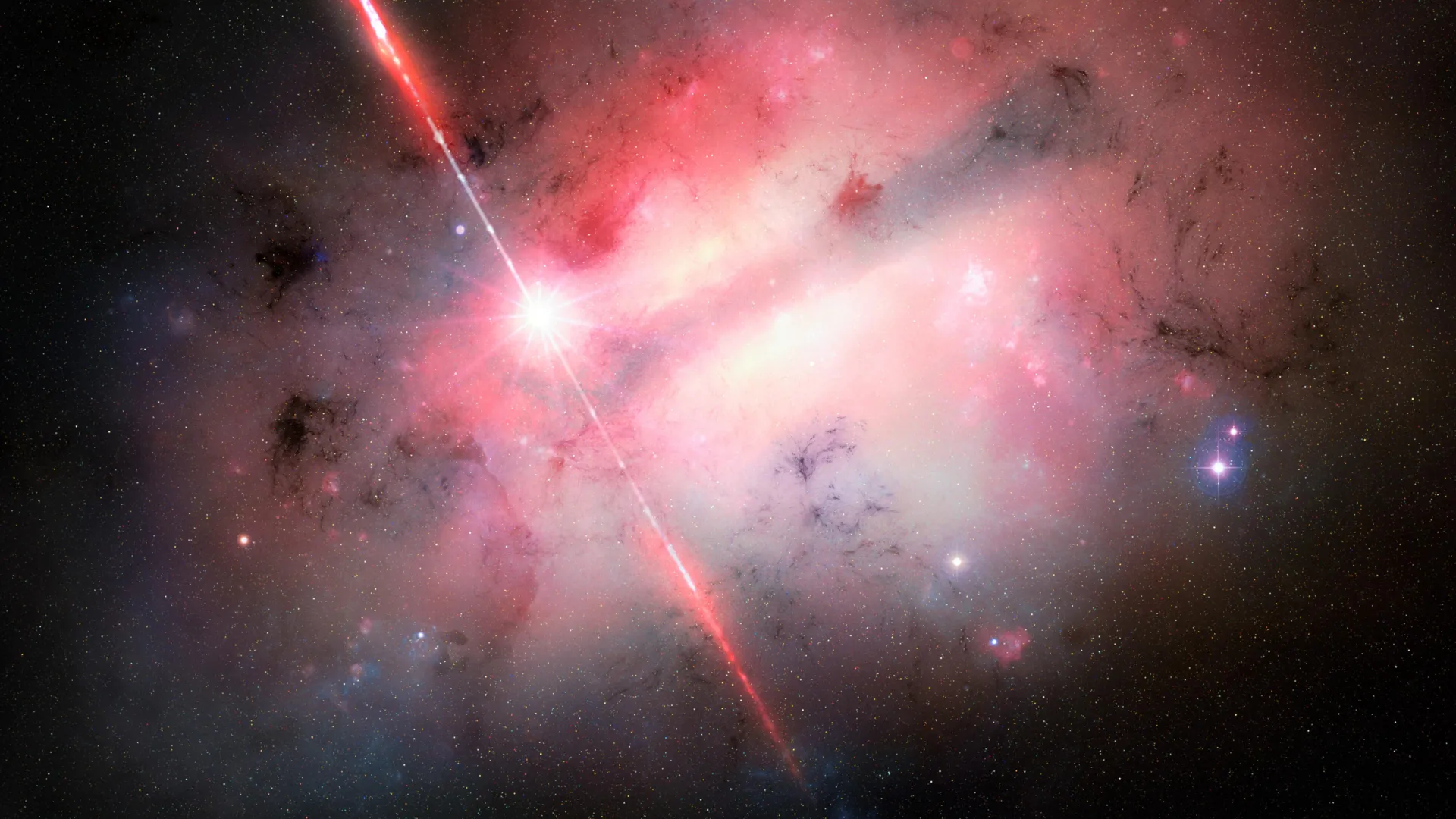
A team of astrophysicists, including experts from Rutgers University, is examining a peculiar cosmic explosion that has sparked intrigue among astronomers. This event, designated GRB 250702B, is a long gamma-ray burst that lasted significantly longer than typical bursts.
Read More
NASA announced that researchers utilized the James Webb Space Telescope to analyze GRB 250702B, which represents one of the most energetic phenomena known in the universe. Normally, gamma-ray bursts occur when a massive star collapses to form a black hole, resulting in a brief but intense flash of gamma rays. However, this event exhibited different characteristics.
Huei Sears, a postdoctoral researcher at Rutgers, noted the unusual properties of GRB 250702B. Unlike typical bursts that last less than a minute, this one persisted for hours and displayed X-ray activity up to a day before the gamma-ray emission began.
Observatories around the world, including China’s Einstein Probe and the National Science Foundation’s Very Large Array, are currently analyzing data from this event. The gamma-ray emissions continued for at least seven hours, exceeding the previous record duration. An animation from NASA illustrates a possible scenario of a black hole merging with a companion star, featuring a black hole about three times the mass of the Sun.
Eliza Neights, an astronomer at NASA's Goddard Space Flight Center, described this explosion as unprecedented in the last 50 years. The investigations are pursuing several potential explanations. One theory suggests it was an unusually extreme gamma-ray burst, while another proposes it might be a tidal disruption event, where a massive black hole pulls a nearby star apart. A further idea posits that a smaller black hole merged with a stripped helium star and consumed it from within.
NASA's Fermi Gamma-ray Space Telescope first detected the explosion on July 2, leading to rapid follow-up observations across multiple instruments since the event was too intense for any one telescope to capture alone. The combined capabilities of space-based and ground-based observatories allowed for a comprehensive analysis across gamma rays, X-rays, infrared light, and radio signals, although the burst was invisible in ordinary light.
Follow-up observations revealed an unusual galaxy near the explosion's location. Initially thought to be two merging galaxies or one split by dust, data from the Webb telescope showed the galaxy lies about 8 billion light-years away, indicating the explosion occurred long before Earth formed. Sears and his team conducted additional observations to analyze the host galaxy's structure.
Despite supporting the notion that GRB 250702B is a gamma-ray burst rather than a tidal disruption event, researchers have yet to reach a definitive conclusion. Sears highlighted the uncertainty in the evolution of tidal disruption events, as few of this type have been documented.
Regardless of the ultimate explanation, scientists acknowledge the significance of this event. Sears noted its potential to enhance our understanding of the complex interactions between stars and black holes, with GRB 250702B possibly leading to new discoveries in astrophysics.
The Webb telescope is also supported by the European Space Agency (ESA) and the Canadian Space Agency (CSA).