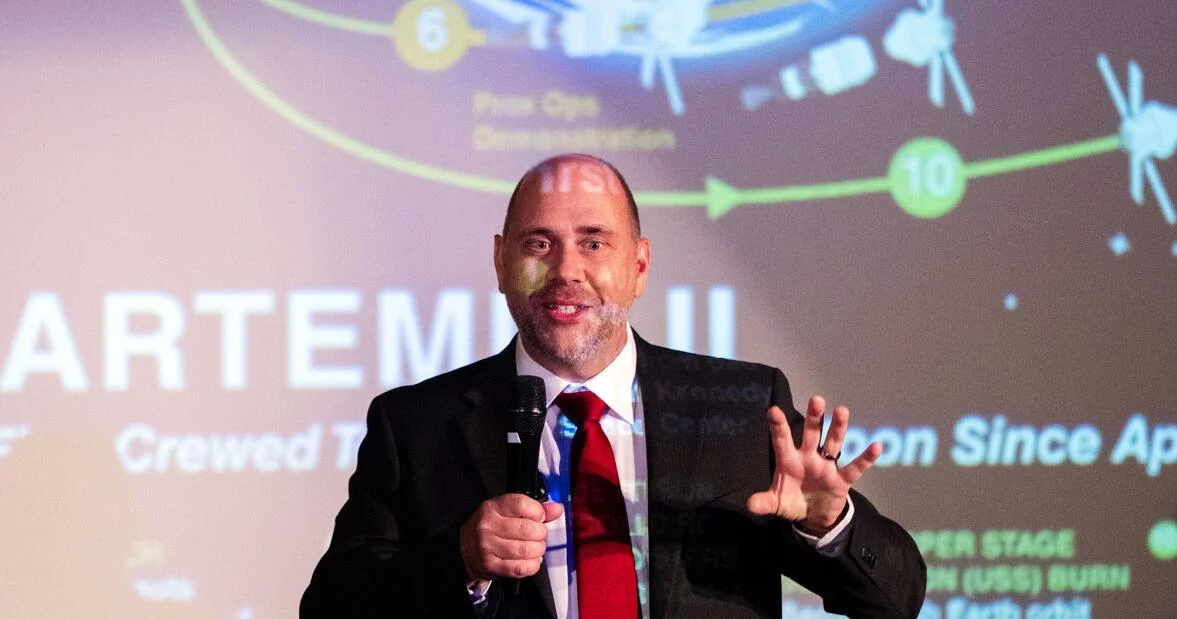
Stephen Damico, an engineering alumnus of the University of Louisiana at Lafayette and veteran NASA engineer, spoke on September 14, 2026, to students and faculty about his career and contributions to NASA's Artemis program.
Read More
Damico has nearly 20 years of experience at NASA, where he serves as the deputy system manager of the Orion Propulsion System. His role involves testing hardware and conducting risk analyses to ensure mission safety. At the UL Lafayette College of Engineering event, he described his responsibilities for Artemis II, NASA's first crewed mission around the moon in over 50 years. Damico stated, "Every single piece of hardware, we’re in charge of knowing its requirements, its limits." He emphasized the significance of ensuring the spacecraft's safety before endorsement for flight.
The Artemis II mission, completed in early April 2026, set a record for the furthest distance traveled by people in space, lasting 10 days. It served to test systems and procedures necessary for future moon landings.
Damico graduated from UL Lafayette with a mechanical engineering degree in 1999 and began his career with Boeing on the space shuttle team before joining NASA. He noted that Artemis II provided a much-needed source of inspiration, stating, "It gave the world something to cheer for that wasn’t political... just people exploring."
Recently, SpaceX announced plans to build a $100 billion rocket launch site near Pecan Island in Vermilion Parish, expected to boost local interest in space exploration. Once operational around 2030, the site may attract numerous spectators keen on rocket launches.
Before SpaceX, UL Lafayette had already produced influential figures in space exploration, including Jay Honeycutt, a 1960 graduate who worked on the Apollo program and later led the Kennedy Space Center. Other notable alumni include Alex McCool, Bernard Marcantel, and William Simon, all of whom had significant roles within NASA.
Geoffrey Stewart, interim vice president for advancement and strategy at UL, highlighted the university's six-decade history of contributing to the space race and preparing for this moment with SpaceX. He expressed optimism for future graduates, stating, "We think there’s going to be a wonderful opportunity for future graduates."
In addition to Damico, other UL alumni were involved in Artemis II, including Megan Borel, who worked on the Lunar Science Team, and Robert Southers Jr. from the Safety and Mission Assurance Directorate at NASA. Damico reflected on the excitement during the mission, sharing, "The energy in the Mission Control room... the excitement was so thick you could almost feed off of it." He expressed joy in observing the planetary landscapes during the mission.