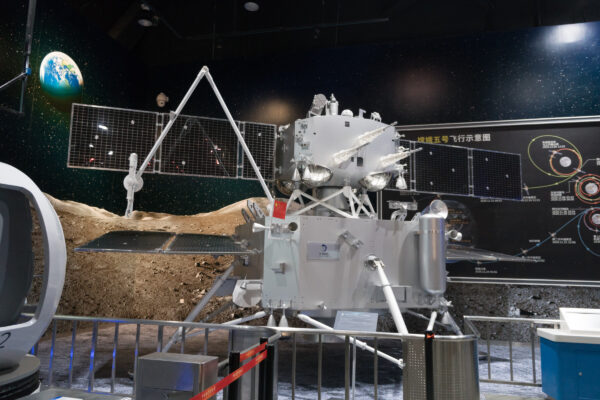
China has postponed its Chang’e 7 lunar mission, initially scheduled for launch in 2023, citing that the lunar probe does not meet necessary launch conditions, according to the China Manned Space Agency (CMSA). Speculation suggests that the mission might be rescheduled for 2027, but the CMSA has not confirmed this timeline.
Read More
The Chang’e 7 probe and its launch vehicle, Long March 5 Y14, were transported to Launch Complex 101 at the Wenchang Space Launch Site in Hainan Province on August 19, only to face a surprising postponement with minimal explanation just hours before launch. While space missions typically encounter delays, the strategic importance of Chang’e 7 for China's lunar objectives makes this lack of a new launch date particularly concerning.
The Chang’e 7 mission is a critical part of China's lunar exploration efforts, focusing on new technologies for lunar ice detection and assessing key lunar resources. The probe aims to conduct comprehensive surveys of the lunar south pole, employing various methods including orbiting, landing, and roving.
Distinct from earlier missions like Chang’e 3 and 4, Chang’e 7 is intended to demonstrate capabilities for utilizing space resources. It is designed to set the stage for the subsequent Chang’e 8 mission, which is targeted for 2029 and aims to further resource utilization and initiate plans for an International Lunar Research Station (ILRS) by 2036.
According to Wu Yanhua, deputy director of the China National Space Administration (CNSA), the fourth phase of China's lunar program aims to establish a basic lunar research station and consists of three key missions: Chang’e 6, Chang’e 7, and Chang’e 8, all intended to launch before 2030.
China's lunar program has evolved through distinct phases, with earlier missions focusing on orbiting and landing, while recent missions have emphasized sample collection and the return of lunar materials. Ultimately, Chang’e 6 and Chang’e 7 are expected to facilitate resource assessment, with Chang’e 8 contributing to foundational infrastructure.
The geological mapping efforts based on samples from Chang’e 5 and Chang’e 6 have resulted in high-resolution maps crucial for future mission planning, outlining potential locations for establishing a lunar base.
The postponement of Chang’e 7 raises several concerns. Firstly, it suggests that the technical demands of Phase Four may be greater than those of earlier phases, as the mission requires intricate coordination between different probe systems and the exploration of challenging lunar environments. Additionally, the CMSA has not clarified whether the delay is due to safety issues or technical complications, creating uncertainty surrounding the mission's future. The absence of detailed public communication implies that an engineering challenge may be at play.
Furthermore, the delay could adversely impact the timeline for the ILRS, as the capabilities demonstrated by Chang’e 7 are essential for Chang’e 8’s objectives. If Chang’e 7 is delayed significantly, it could push back the timeline for Chang’e 8 and disturb plans for a human landing on the Moon by 2030.
As part of China's 15th Five-Year Plan (2026-2030), the country's lunar missions are central to its ambitions of becoming a leading space power. The unexpected postponement of Chang’e 7, coupled with a lack of transparent communication, poses challenges to achieving these strategic goals.