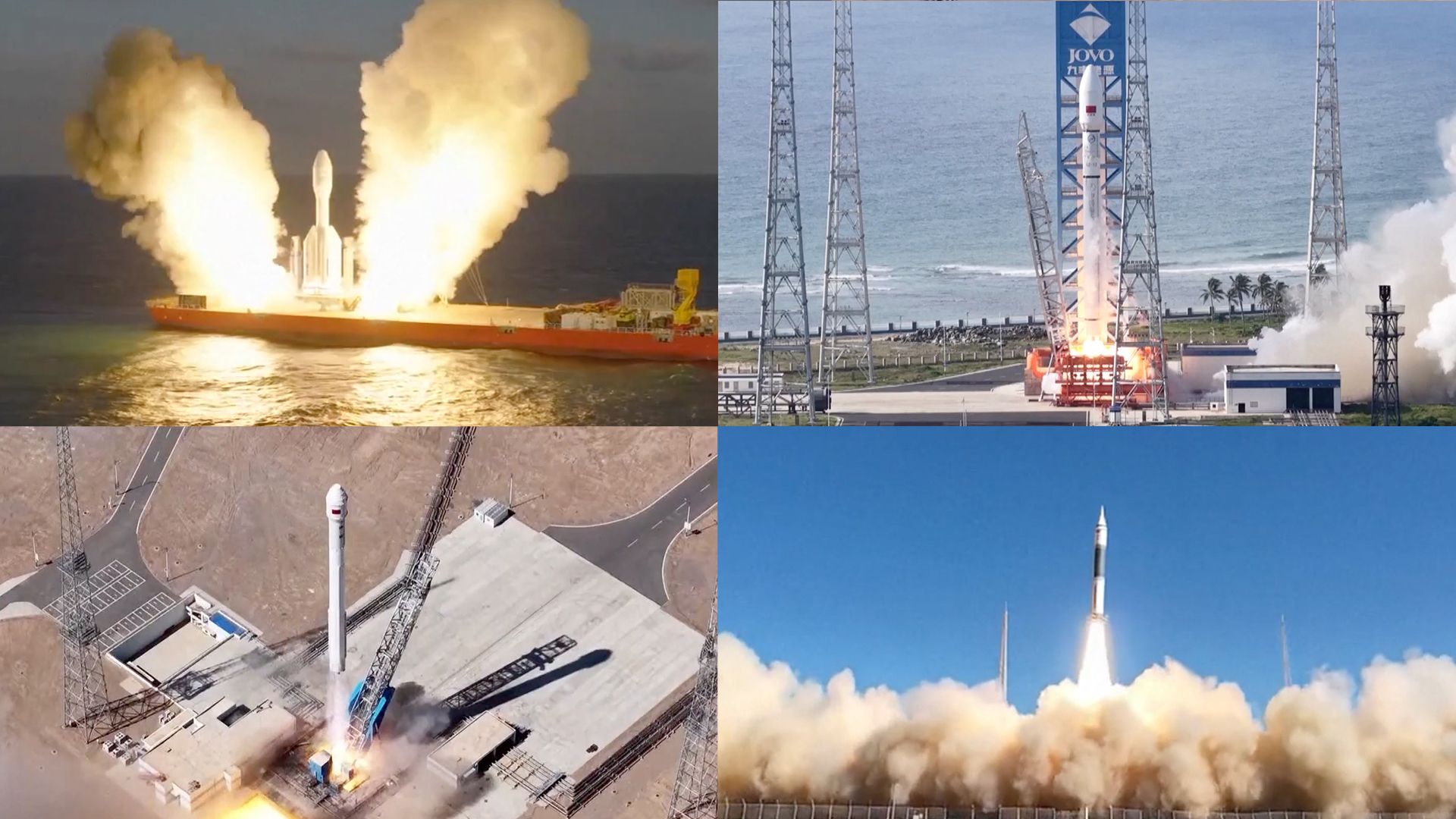
China's launch capabilities were prominently showcased last week with the successful launch of four different rockets within a 45-hour timeframe, from September 15 to September 16, 2026. These launches occurred from three distinct sites and included two private rockets, all completing their missions successfully.
Read More
The series of launches began on Tuesday, September 15, at 2:26 a.m. EDT (0626 GMT), when the Beijing-based company LandSpace launched its Zhuque-2E rocket from the Jiuquan Satellite Launch Center. The Zhuque-2E, which uses liquid methane and liquid oxygen, successfully placed ten satellites into low Earth orbit (LEO) as part of the Qianfan broadband megaconstellation, which aims to comprise approximately 15,000 active satellites in the future.
Later that day, at 6:00 p.m. EDT (2200 GMT), another nine Qianfan satellites were added to orbit via a Gravity-1 rocket. This rocket was launched from a barge near Shanghai and is notable for being the most powerful solid rocket in existence, despite its short and stout design.
The next launch took place on Wednesday, September 16, at 8:32 p.m. EDT (0032 GMT on September 17) when a Long March 12 rocket lifted off from the Wenchang Space Launch Site in Hainan. This mission successfully delivered nine satellites for the SatNet broadband megaconstellation, which is projected to have around 13,000 satellites.
Finally, the launch sequence concluded with the Kuaizhou-11 rocket, which lifted off from Jiuquan at 10:40 p.m. EDT (0240 GMT on September 17). This rocket, operated by a subsidiary of the China Aerospace Science and Industry Corporation, carried two Earth-observing radar satellites for the Chinese company Spacety.
Although these launches highlighted China's advancements in space technology, they did not include any landing attempts. China is actively developing reusable rocket technology and has seen recent successes with its Zhuque-3 and Long March 10B rockets, which have successfully landed their first stages during orbital missions. However, no Chinese rocket has yet completed multiple orbital missions with a reusable first stage.