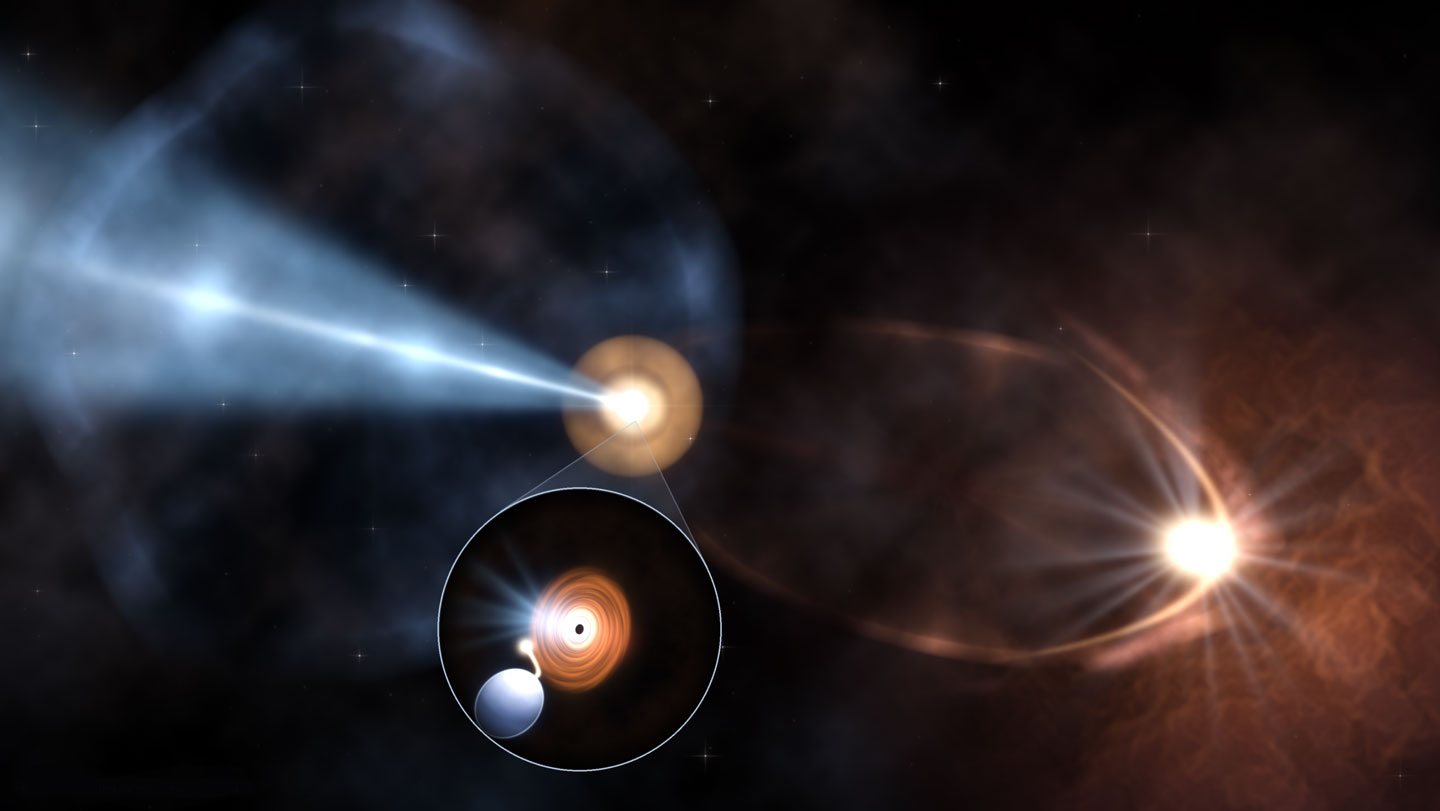
Astronomers have potentially identified a miniature version of a quasar, known as a microblazar, located within the Milky Way galaxy. This finding could help explain the origins of some of the highest-energy particles observed in the universe, according to a forthcoming study in Astronomy & Astrophysics.
Read More
Blazars are a specific type of quasar characterized by supermassive black holes that attract surrounding matter into a rotating disk. These black holes expel superheated material in jets, with blazars specifically pointing one of their jets towards Earth.
While quasars and blazars have not been found close to Earth, astronomers have pursued microblazars—smaller black holes consuming large stars and emitting jets—for nearly 35 years. Due to their smaller scale, these microblazars change much more rapidly than their larger counterparts. According to astrophysicist Pedro Luque-Escamilla from the University of Jaén in Spain, the dynamics of a microblazar can be observed on a much faster timescale compared to supermassive blazars.
Luque-Escamilla and colleague Josep Martí have been analyzing archival telescope data for two decades with limited success, often misidentifying candidates as extragalactic objects. Recently, they revisited a catalog from 1983 created by a Dutch-American spacecraft and identified an object named IRAS 18293−0941. Upon cross-referencing this data with modern observations from radio telescopes, they detected a bright emission accessible from only one side, a characteristic indicative of blazars.
Initially suspecting IRAS 18293−0941 to be an extragalactic blazar, the team continued their investigation and ultimately determined it to be located within our galaxy. Alexandra Tetarenko, an astrophysicist at the University of Lethbridge in Canada, noted the multi-wavelength approach used in this study significantly differentiates it from previous claims around microblazar candidates.
Further analysis revealed IRAS 18293−0941 was situated near a region of ultrahigh energy particles, which possess energies exceeding those generated by the Large Hadron Collider. Martí and his colleagues propose that this proximity is not coincidental; the microblazar’s jet, directed away from Earth, could collide with surrounding matter, functioning as a colossal particle accelerator.
The researchers are now focused on obtaining more data about both the particle hotspot and the visible jet, which may provide deeper insights into the capabilities of this microblazar. Luque-Escamilla remarked on the significance of the findings, likening them to a unique cosmic particle accelerator designed for scientific exploration.