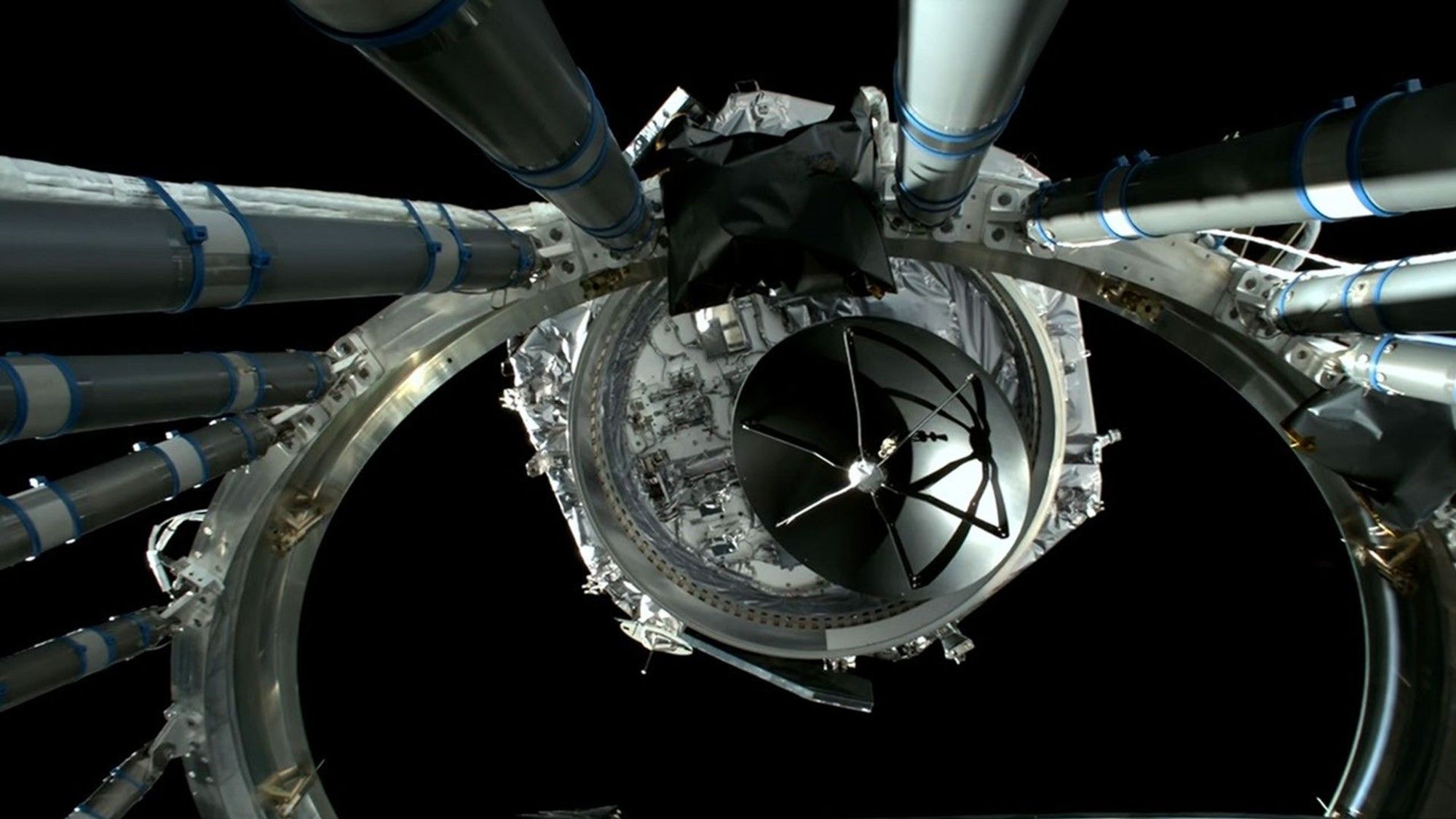
NASA has begun activating the instruments on the Nancy Grace Roman Space Telescope, which launched on August 30. The spacecraft is currently traveling to Lagrange Point 2 (L2), approximately one million miles from Earth, where it will be positioned to observe the night side of the planet with optimal conditions for its scientific instruments.
Read More
While the telescope is not yet ready to collect scientific data, initial downlinks indicate that its components are functioning normally as commissioning efforts are underway. Josh Schlieder, a scientist at NASA's Goddard Space Flight Center, remarked that this activation represents a significant achievement for the team and their partners.
The Wide Field Instrument (WFI) on the telescope features a 300-megapixel infrared camera aimed at surveying vast areas of the sky. It employs 18 infrared detectors to capture images and study dark energy, as well as map cosmic matter distribution. To prepare the WFI for activation, engineers maintained it at -85 degrees Fahrenheit (-65 Celsius) for about ten days to dry out any contaminants pre-launch. On September 11, the team cooled the instrument to -225 degrees Fahrenheit (-143 Celsius) to activate the infrared detectors, which will eventually reach an operating temperature of approximately -300 degrees Fahrenheit (-183 Celsius).
Following this, calibration of the WFI's element wheel commenced, allowing for wavelength detection via optical mechanisms. By the morning of September 13, the focus components were confirmed to be operational.
The coronagraph instrument also progressed towards activation. Operators at Caltech/IPAC in Pasadena confirmed the functionality of its electronic and mechanical systems. This instrument uses mirrors and sensors to block a star's light, facilitating the detection of faint planets in orbit. Initially heated to 72 degrees Fahrenheit (22 Celsius) for testing, the coronagraph will undergo a 30-day decontamination process to clear any contaminants.
NASA plans to release the first images from the Roman telescope in early 2027. Thanks to its efficient launch by a SpaceX Falcon Heavy and effective fuel management, the telescope is expected to operate for the next 22 years.