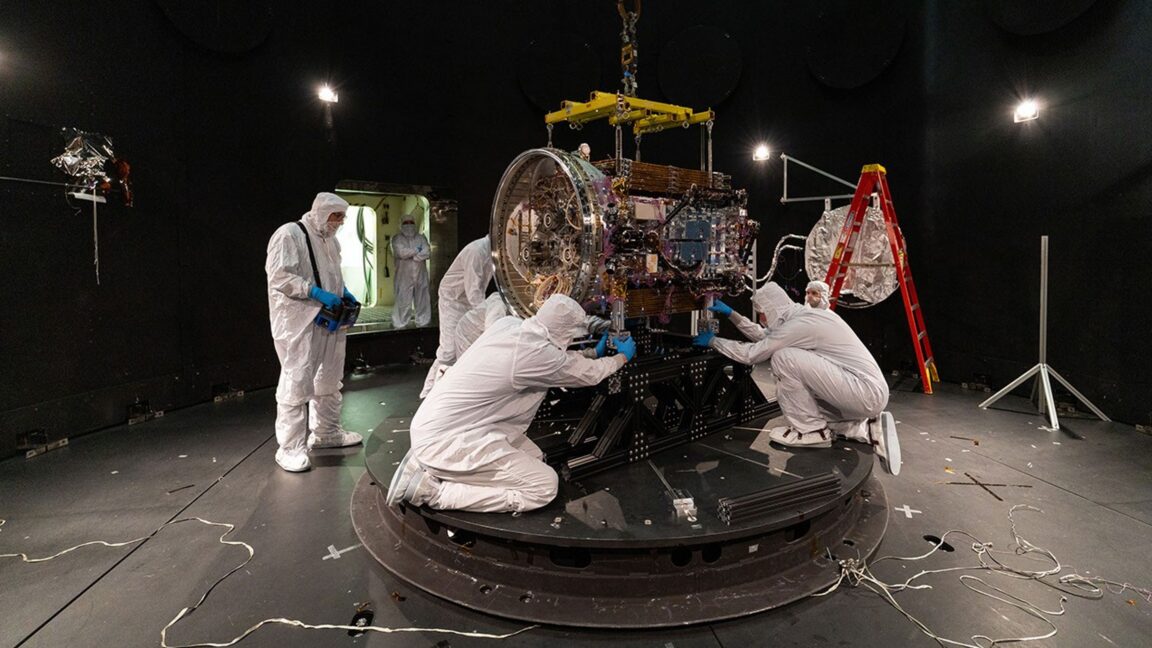
NASA's attempt to rescue the $500 million Neil Gehrels Swift Observatory from orbit has officially ended, though the efforts behind the mission shed light on the complexities involved in satellite servicing, according to government and commercial space officials.
Read More
Under a $30 million contract awarded in September 2025, Katalyst Space Technologies was tasked with developing a satellite to reach Swift, positioned about 200 miles above Earth, and elevate it to a higher orbit. The rescue spacecraft, named Link, launched successfully on July 3, 2025, but encountered a malfunction weeks later that prevented it from reaching its target.
Despite the failure, officials recognized the significant achievement in designing and constructing Link, which is usually a process that takes several years. The satellite, weighing nearly half a ton, was equipped with electric thrusters, robotic arms, and large solar arrays.
Swift, launched in 2004, has significantly exceeded its original design lifespan. It lacks a propulsion system to elevate its orbit, making it vulnerable to atmospheric drag, which has intensified due to increased solar activity, leading to its eventual decline.
NASA and Katalyst are analyzing the mission for lessons that could inform future rapid-response satellite rescues. Shawn Domagal-Goldman, director of NASA's astrophysics division, emphasized the need for earlier intervention in similar scenarios.
NASA initiated a rapid study in August 2025, commissioning three teams to outline strategies for rescuing Swift. Katalyst was selected for the mission despite the tight timeline and numerous obstacles, including supplier delays and a need for in-house production of parts.
Katalyst was given broad instructions to achieve the mission goals without micromanagement, enabling quicker decision-making. However, technical issues arose during in-space operations, including a fault in the power system that caused the spacecraft to spin out of control, ultimately preventing it from completing the reboost.
While many components of Link, such as robotic arms and plasma thrusters, performed as designed, key failures led to its inability to rendezvous with Swift. After reaching within approximately 10 kilometers of Swift, Link reentered the atmosphere on September 25, 2025. Swift has since resumed limited scientific operations but is expected to face reentry later this year, which will impact critical research in gamma-ray and x-ray astronomy.
Looking forward, NASA officials see potential in commercial partnerships for future missions, noting that advancements in commercial capabilities are changing the landscape of satellite servicing. There are proposals on the table for servicing other aging NASA satellites, including the Hubble Space Telescope and Chandra X-ray Observatory, although NASA has not yet pursued these offers.
The loss of Swift is significant for NASA, creating a gap in its scientific capabilities, prompting Domagal-Goldman and his colleagues to seek alternatives to replace the observatory's contributions.