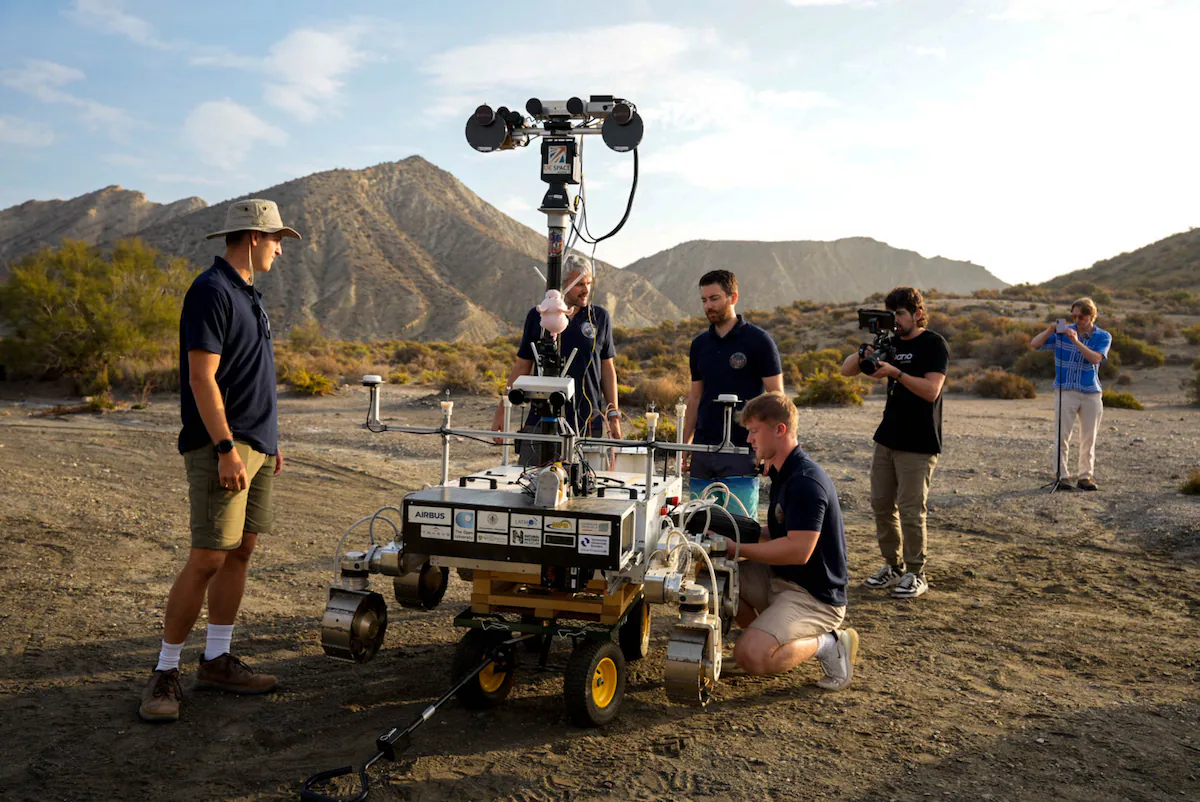
A team of engineers and scientists is testing a new rover prototype named Charlie in the Tabernas desert of Almería, Spain. This experimental setup aims to simulate Martian conditions as closely as possible for the European Space Agency's (ESA) ExoMars mission, which plans to land its first rover on Mars in 2030 after a year-long journey.
Read More
Before the sun warmed the ground, the team transported Charlie, which has been developed in collaboration with Airbus and various European scientific institutions, to a location characterized by fine dust, rocky terrain, and salt-encrusted surfaces. Benoit Pouffary, chief exploration engineer for the ESA's ExPeRT team, noted that this desert region closely resembles the targeted Martian landscape.
The team spent two weeks in Almería testing Charlie's capabilities on different terrains, marking the final day for the rover's trial. Observers from a mission control center in Turin, Italy, monitored the rover's movements remotely to prepare for the challenges it will face during its actual mission. Pouffary emphasized the importance of training in a representative environment to mimic real conditions that mission operators will encounter on Mars.
Charlie is part of the ExoMars program, which began over a decade ago. The program previously faced setbacks, including the crash of the Schiaparelli module during its Mars descent. Importantly, the failures informed improvements in the design of the Rosalind Franklin rover, of which Charlie serves as a prototype. Unlike the upcoming mission, Charlie will not be deployed to Mars; its learnings will instead inform the execution of Rosalind Franklin's design.
Scheduled for launch in 2028, the Rosalind Franklin rover aims to drill up to two meters into the Martian subsurface, where potential signs of past or present life may be better protected from radiation. The rover will be equipped with a laboratory to analyze samples in situ and is designed to complete its tasks autonomously according to a daily agenda. While Charlie did not carry these instruments during its tests, it was essential for evaluating its autonomous navigation system, which will be critical for the mission ahead.
During the tests, Charlie's movements showcased the deliberate nature of its design, with independent wheel operation allowing for cautious navigation across uneven terrain. Although the operation distance between Almería and Turin—1,645 kilometers—is vastly shorter than the distance to Mars, it still provided valuable data regarding the rover's functionality.
As preparations continue for the Martian mission, the ExoMars team is focused on demonstrating that the design can support safe exploration without mobility issues.