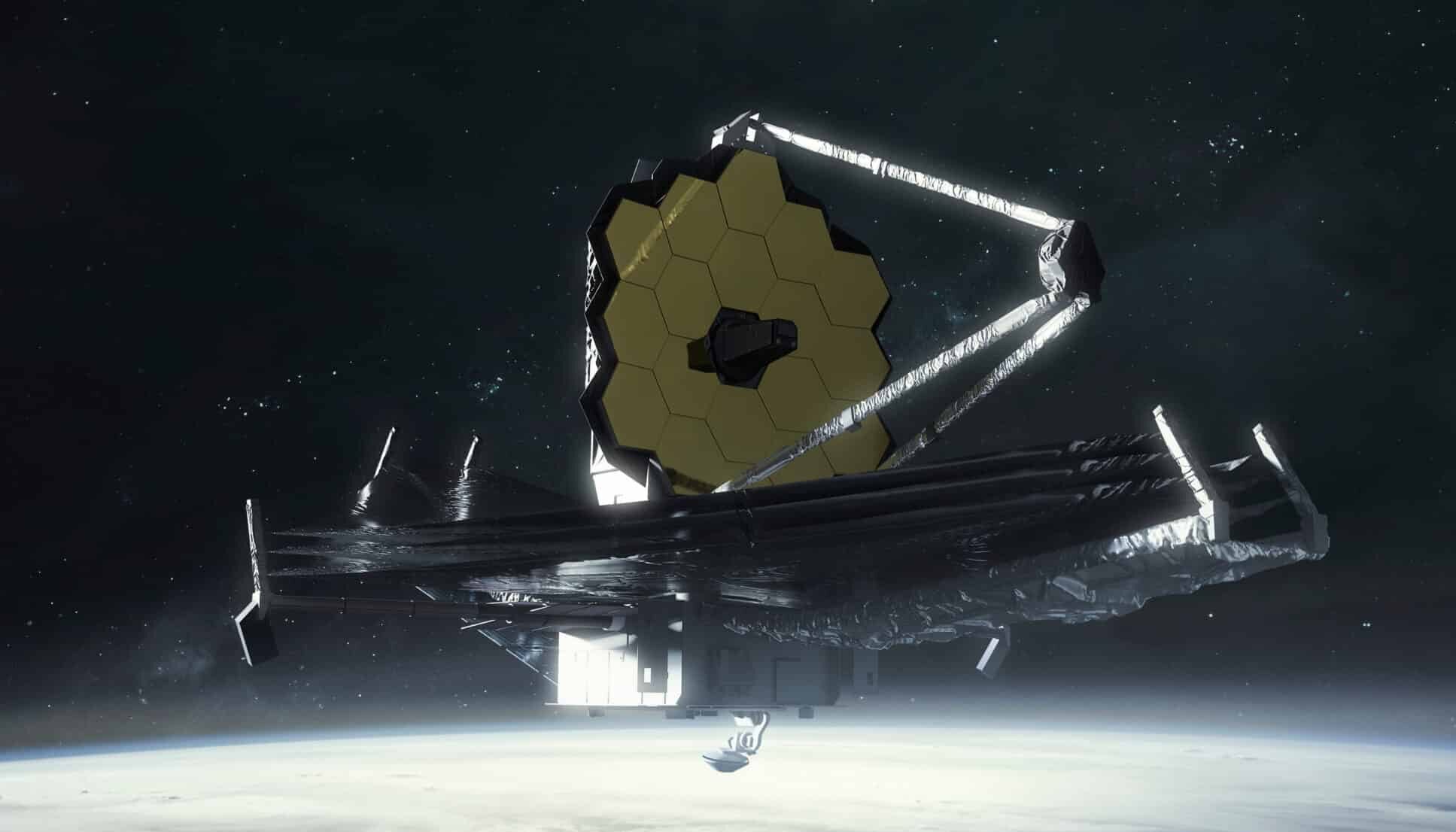
In June 2025, Anne-Marie Lagrange’s team at the Paris Observatory announced the discovery of TWA 7 b, the first exoplanet identified by the James Webb Space Telescope (JWST). This planet, similar in size to Saturn, is noted for being the lightest exoplanet ever observed through direct imaging. This finding highlights the exceptional capabilities of the JWST and represents a significant advancement in the quest for new celestial bodies.
Read More
The journey towards this discovery began in the mid-1980s when astrophysicists started to study debris disks—rings of dust and particles that surround certain stars. The first image of such a system, that surrounding Beta Pictoris, was captured in 1984. These disks are believed to house planetary systems, and the gaps formed within them were theorized to indicate the presence of planets despite their faint brightness compared to stars.
Research efforts in the early 2000s proposed that anomalies observed in these disks might suggest the existence of planets. However, many of these potential planets remained undetectable due to their dimness. To circumvent this, scientists adapted a technique called coronagraphy, which creates an artificial eclipse of the star to enhance the planet's visibility. This allowed for direct imaging of a limited number of exoplanets, primarily those more massive than Jupiter.
The JWST, equipped with advanced instruments, was designed to expand the possibilities of exoplanet detection. A crucial aspect of JWST's design is its coronagraphs integrated into the Mid-Infrared Instrument (MIRI). These instruments, developed by teams from CNRS and CEA, are optimized to improve the contrast between a star and its planets, particularly in the mid-infrared spectrum where younger, hotter planets emit more light.
TWA 7, located 111 light-years away, was chosen for its well-defined debris disk and the presence of clear gaps suitable for observation. The system's youth—approximately 6.5 million years—indicates that any forming planets would still be hot enough to be detected effectively by JWST.
At a distance of 50 astronomical units from TWA 7, MIRI successfully captured images of TWA 7 b, confirming predictions about its location within the debris disk.
The discovery of TWA 7 b carries important implications for our understanding of planetary formation and the evolution of debris disks. It corroborates existing theories and enables the development of more sophisticated models to explain the structuring of such systems. Lagrange notes that it illustrates how young systems can harbor planets with masses less than that of Jupiter, providing valuable data for refining planetary formation theories.
Moreover, the exoplanet's discovery presents opportunities to investigate its primitive atmosphere, which could yield insights into the early conditions of similar planets. Observations of such youthful atmospheres could be challenging to reconstruct from older planetary systems, such as those within our own solar system, which are over 4.5 billion years old.
As for future prospects, JWST’s capabilities are unlikely to unearth even lighter exoplanets, particularly Earth analogs in habitable zones. Lagrange indicates that a significant increase in sensitivity will be required in future missions. Upcoming instruments, such as the Extremely Large Telescope (ELT) and the Habitable Worlds Observatory, currently under development, may provide the advanced technology necessary to explore these possibilities further.