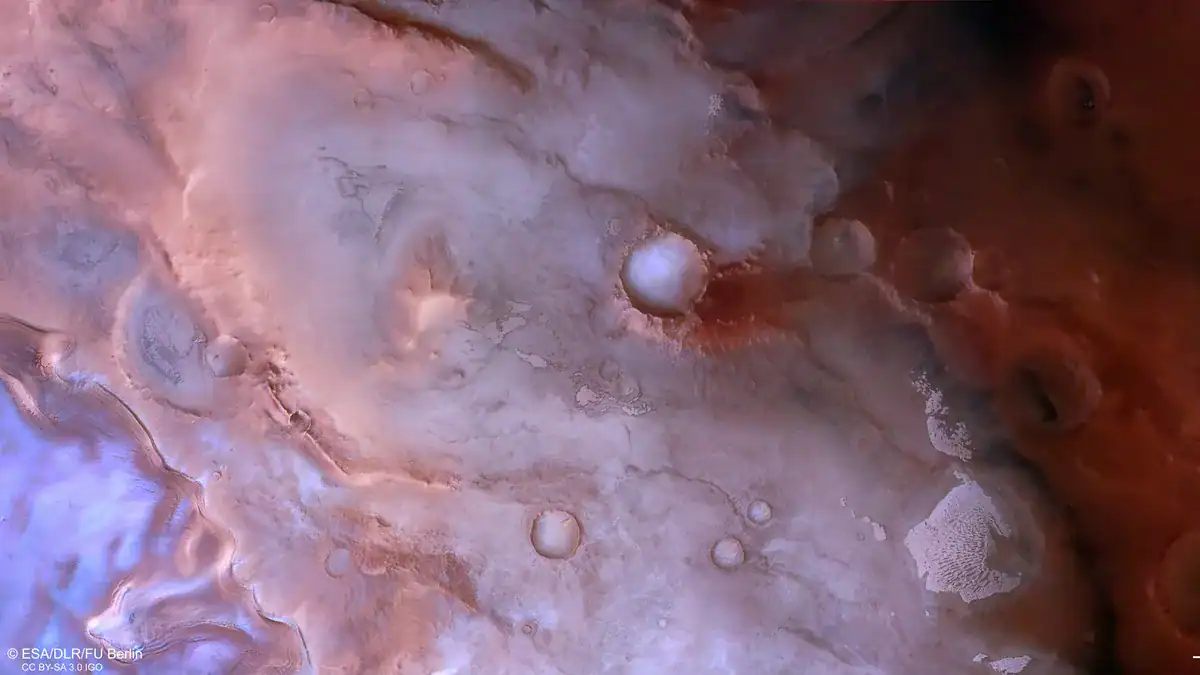
The European Space Agency's Mars Express spacecraft recently captured an eye-catching image of Mars, revealing a purple region near the planet's south pole. This observation, made on February 17, 2026, shows Thyles Rupes, a vast system of cliffs located in Mars's southern highlands, where the landscape is characterized by swirls of raspberry, pink, and violet alongside dark volcanic materials and pale frost.
Read More
While known as the "Red Planet," Mars exhibits a spectrum of colors, ranging from rusty brown to nearly black and brilliant white. The unexpected coloring in this specific image is not due to any new geological phenomenon but rather to a combination of familiar Martian elements—dust, ice, dark minerals, and the angle of sunlight.
Currently, it is spring in Mars's southern hemisphere, where cold temperatures allow patches of frozen carbon dioxide to persist near the pole. The varying surface materials, including darker volcanic deposits containing olivine and pyroxene, contribute to the scene's complex color palette. According to ESA, the purple hue results from the interplay of reddish dust and light, which is further altered by atmospheric dust that affects the colors perceived by the camera.
This colorful depiction highlights how illumination and seasonal changes can dramatically alter Mars's appearance. Thyles Rupes itself stretches over hundreds of kilometers, featuring cliffs that rise more than a kilometer above the surrounding terrain. The formation of these ridges is believed to be linked to the cooling and contraction of Mars's crust, which contrasts with Earth's plate tectonics.
Mars’s color spectrum continues to surprise scientists. Beneath its red dust, the planet is predominantly dark gray volcanic basalt. The typical view of Mars’s sky changes throughout the day, with the atmosphere often appearing yellowish or orange due to fine dust. However, during sunset, blue hues can appear around the Sun—contrasting with the red sunsets familiar on Earth.
Moreover, recent research indicates that the rusty appearance related to hematite may actually be linked to ferrihydrite, an iron mineral associated with water. This suggests the possibility of a wetter history for Mars, adding another layer of complexity to our understanding of the planet's surface and atmosphere.