Mars, as we know it today, is characterized by cold, dry conditions. However, geological evidence suggests that between 3.8 and 3.6 billion years ago, it may have been much warmer and wetter, with possibilities of surface water, including rivers, lakes, and possibly an ocean in the northern hemisphere.
Read More
Research indicates that formaldehyde (H₂CO) could have formed in the atmosphere of early Mars, and when delivered to water, it could facilitate chemical reactions that yield sugars, amino acids, and other complex organic molecules essential to the emergence of life. A critical question, however, remains: where on Mars did this formaldehyde reach the surface?
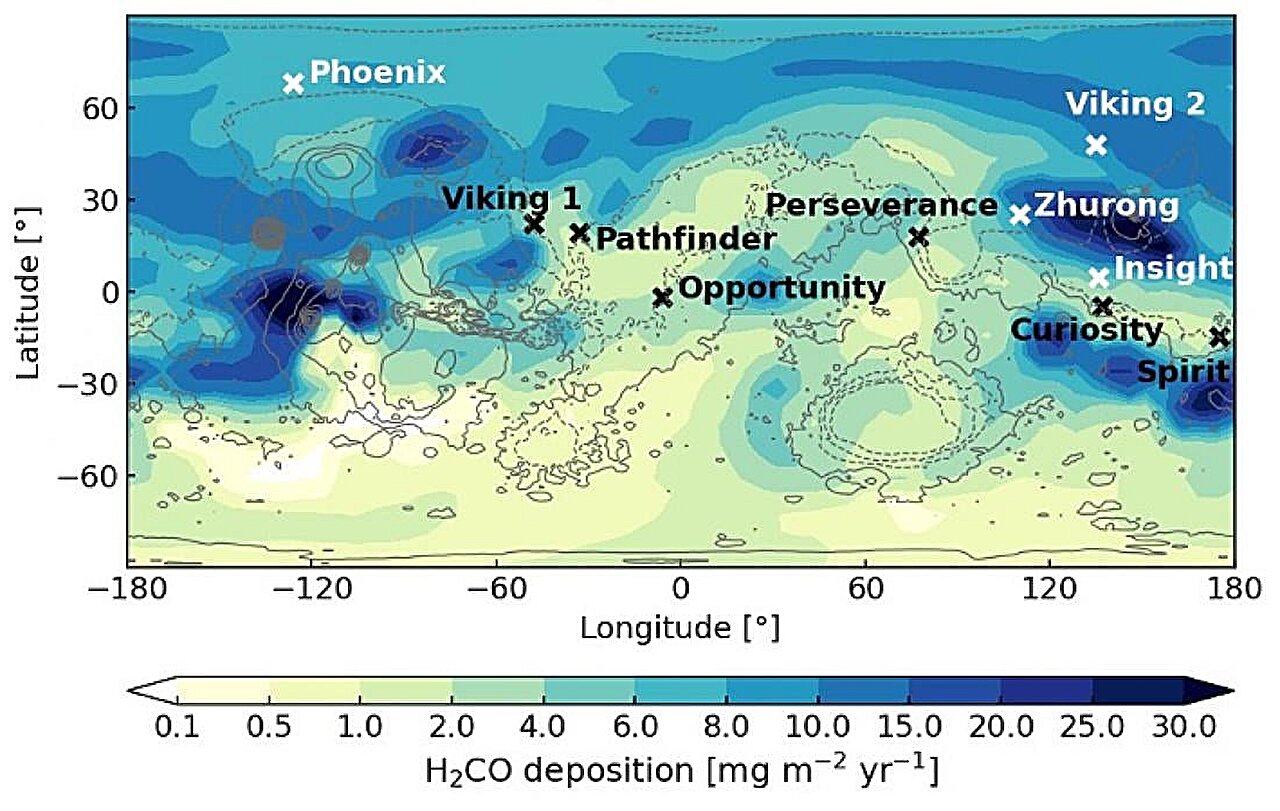
To address this, a research team from Tohoku University, the Earth-Life Science Institute, and the Institute of Science Tokyo created a global map showing the predicted distribution of atmospheric H₂CO on early Mars. The study has been published in The Planetary Science Journal.
The researchers simulated the warmer conditions of early Mars, examining how temperature, water vapor, pressure, and UV light contributed to H₂CO formation. Their findings revealed that water vapor played a crucial role in the production of formaldehyde. UV light breaks down water molecules, releasing reactive hydrogen necessary for H₂CO formation, while rainfall transports formaldehyde to the surface. Consequently, regions abundant in water were predicted to receive more formaldehyde than drier areas.
The researchers concluded that the Martian water cycle likely influenced the accumulation of prebiotic molecules. Their map highlights potential hot spots in relation to current rover landing sites. Dr. Koyama noted, "By comparing our map with findings from rovers, we can begin to test whether places that received more H₂CO were also more favorable for early life-related chemistry."
Certain regions, like the Tharsis and Elysium mountainous areas, were predicted to receive approximately 10 times more H₂CO than the global average. These estimates reflect past conditions rather than current H₂CO levels.
This study could aid in identifying landing sites for future Mars missions aimed at understanding the development of organic chemistry on the planet billions of years ago, potentially shedding light on the origins of life there.
The research reference is: Shungo Koyama et al, Global Distribution of Atmospheric Formaldehyde Deposition Correlated with Water Vapor on a Warm Early Mars, The Planetary Science Journal (2026). DOI: 10.3847/psj/ae9942.