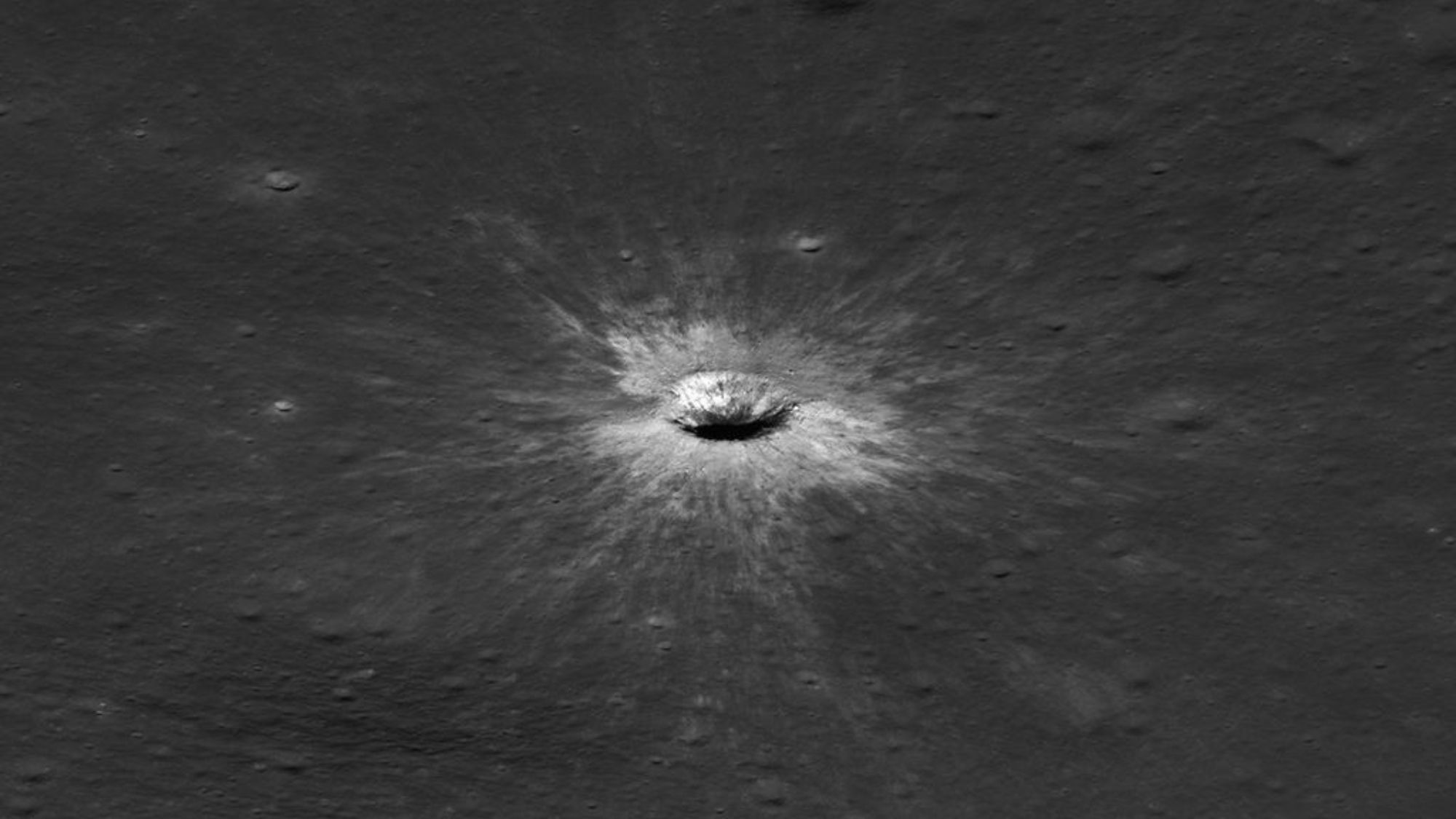
NASA has identified a new crater on the moon named McGetchin, formed between April 11 and May 22, 2024, by the impact of an asteroid or comet fragment. The crater measures approximately 728 feet (222 meters) in diameter and 141 feet (43 meters) deep, making it the largest newly formed impact crater discovered so far in the solar system. Such a significant impact is expected to occur only about once every century, highlighting the rarity of this discovery.
Read More
The findings were released in two studies on September 16, published in the journal Science Advances. One study, led by Mark Robinson of Intuitive Machines, details the crater and the vast amount of material ejected across the lunar surface due to the impact. The second study focuses on a broader area around the crater examined with NASA's Lunar Reconnaissance Orbiter's (LRO) Diviner instrument. The studies provide a unique opportunity for scientists to observe a pristine impact site before other processes begin to alter it.
Tyler Powell, lead author of one of the studies, stated, "A crater of this size is expected to form on the moon only once per century, so we're extremely lucky it formed during the lifetime of the LRO mission and that we are able to observe the region both before and after impact." The LRO has been observing the moon for over 17 years, allowing researchers to track subtle changes in the area that might have otherwise gone unnoticed.
The crater was discovered in 2025 when researchers analyzed LRO imagery of the moon's surface. Subsequent observations revealed the new crater and the surrounding material displaced by the impact. The studies show that McGetchin's effects extend significantly; an extensive ejecta blanket surrounds the crater, and data from the Diviner Lunar Radiometer detected a thermal anomaly—a roughly 4.3-mile-wide (7 kilometers) cold spot—that is about 14 to 16 degrees Fahrenheit (8 to 9 kelvins) cooler than the surrounding area during the lunar night. This temperature difference is believed to result from disturbances in the lunar soil caused by the impact, creating a less dense layer that retains less heat.
Understanding lunar impacts is crucial for interpreting the moon's geological history. Powell remarked, "Impact cratering is one of the most common and important processes in the solar system. Understanding how impacts modify the surface and their surroundings is important for interpreting lunar geology and history."
Given its pristine state, McGetchin crater offers a valuable reference for studying the formation and evolution of craters. Its location along a geographical boundary between darker basalt-covered mare and brighter highlands allows for the analysis of impacts across distinct geological environments. Future missions could further explore this site, providing insight into the correlation between orbital observations and surface conditions.
The crater presents significant implications for future lunar exploration, as understanding how impacts affect regolith physical properties will aid in preparing for upcoming lunar missions. Therefore, McGetchin serves as a natural laboratory for uncovering the moon's past and preparing for future explorations.