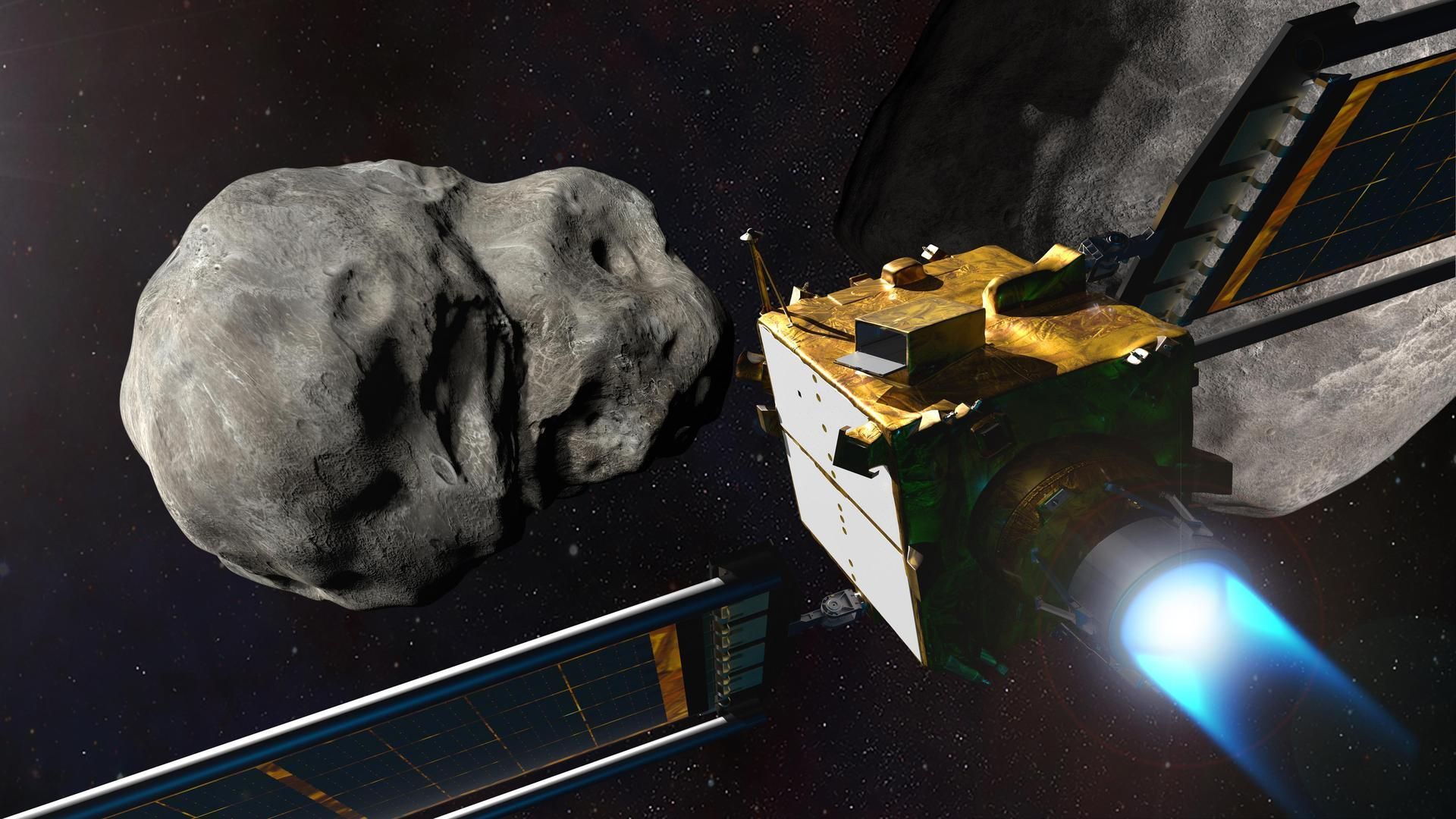
NASA's Double Asteroid Redirection Test (DART) mission has unveiled the first visual evidence of small asteroids exchanging rocks and dust, a process that reshapes their surfaces over millions of years. Images taken in late 2022, shortly before DART intentionally struck the asteroid moon Dimorphos, revealed faint, fan-shaped streaks across its surface, according to a study published on March 6 in The Planetary Science Journal.
Read More
Researchers suggest these streaks were likely formed by debris ejected from Dimorphos' larger companion, Didymos, which drifted between the two bodies and caused slow-motion impacts. Jessica Sunshine, the study's lead author from the University of Maryland, initially doubted the findings, wondering if there were issues with the camera or image processing. However, further analysis indicated that the streaks were the result of low-speed impacts from drifting material, described by Sunshine as akin to throwing "cosmic snowballs."
The study's findings confirm recent material transport within a binary asteroid system. The research also reported that DART not only altered Dimorphos' orbit but also shifted the entire binary system's trajectory around the sun by approximately 11.7 microns per second—roughly 1.7 inches per hour. Rahil Makadia, a researcher at the University of Illinois Urbana-Champaign, emphasized the significance of even minor changes in an asteroid's motion, stating they can influence whether a potentially hazardous object will collide with Earth.
It is estimated that about 15% of near-Earth asteroids exist in binary systems, where a smaller body orbits a larger one. These systems can exhibit complex behaviors, especially due to the YORP effect, which causes small asteroids to spin faster as they absorb and re-emit sunlight over time. Evidence of this effect has been seen on other asteroids; NASA's Lucy spacecraft found similar features on the asteroid Dinkinesh and its moon Selam. Similar ridges are present on Dimorphos and Didymos, likely from material shed during rapid rotation.
To identify the fan-shaped streaks, Sunshine's team developed advanced image-processing techniques to eliminate shadows and adjust for uneven lighting on the asteroid's surface. Co-author Tony Farnham stated that as they refined their 3D model of Dimorphos, the streaks became clearer, confirming the legitimacy of their observations. The team determined that debris was ejected from Didymos at a rate of approximately 30.7 centimeters (12.1 inches) per second, resulting in deposits rather than craters.
The streaks seem to cluster around Dimorphos' equator, aligning with predictions about where debris from Didymos would land. Scientists are keen to examine Dimorphos more closely, with the European Space Agency's Hera mission slated to arrive at the system in December 2023. The $398 million Hera mission aims to conduct a detailed survey of Dimorphos post-impact and may reveal whether the fan-shaped streaks remain or if new patterns have emerged from the collision.
Jessica Sunshine noted that the findings are crucial for understanding the evolution of near-Earth asteroids, indicating they are more dynamic than previously thought, which will enhance planetary defense strategies.