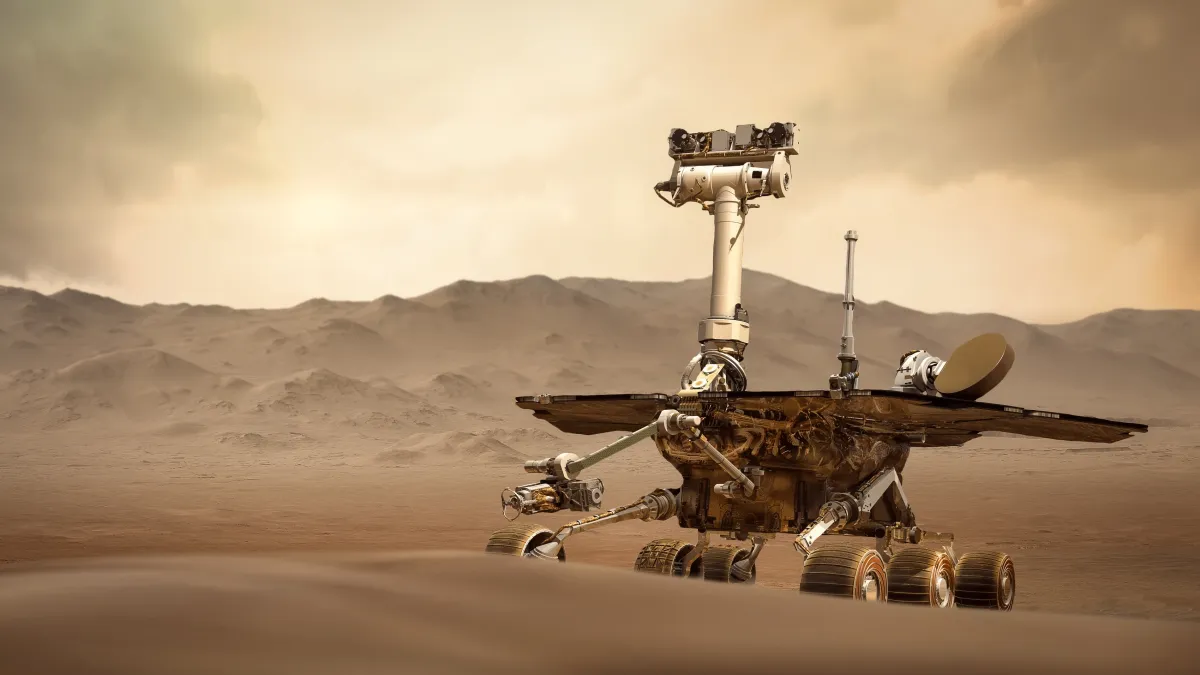
NASA's Perseverance rover has set a new record for the greatest distance traveled by a vehicle on another planet, reaching 28.10 miles on Sunday, according to an announcement from NASA. This surpasses the previous record of 28.06 miles held by NASA's Opportunity rover, which operated on Mars from 2004 until 2018.
Read More
The milestone was achieved on the 2,006th Martian day, or sol, of Perseverance's mission. Over approximately 5 1/2 years, the rover has traveled a distance that took Opportunity nearly 15 years to cover.
Landed on Mars in February 2021, Perseverance has been investigating Jezero Crater, focusing on finding signs of ancient microbial life and collecting rock and soil samples. Steven Lee, project manager for the Curiosity and Perseverance rovers at the Jet Propulsion Laboratory (JPL), remarked on the significant progress, noting that the original mission was expected to cover only 12.4 miles. He expressed confidence in Perseverance's continued performance, stating that with fully operational mobility systems, the rover is expected to add to its distance record in the coming years.
A key factor in the rover's enhanced driving capability is its autonomous navigation system, known as AutoNav, which enables Perseverance to identify hazards and navigate routes without constant input from Earth-based controllers. This technology allows the rover to travel up to 1,351 feet in a single Martian day.
Mark Maimone, deputy team chief for robotic operations on Perseverance, highlighted the rover's autonomous decision-making as a critical improvement, allowing it to chart its own course. The record was broken while Perseverance was heading toward an area called Idubi, located beyond the western rim of Jezero Crater in a region known as Lac de Charmes.
Scientists believe this area may contain some of the oldest terrain studied by robotic missions and could provide insights into ancient hydrothermal systems that may have supported life on Mars. To date, Perseverance has collected 29 rock and soil samples, including materials believed to be around 4 billion years old. Among its findings is a rock named "Cheyava Falls," which shows potential biosignatures that may hint at past microbial activity, though this does not confirm the existence of life on Mars.
NASA has recently approved the first extension of Perseverance's mission, allowing it to continue exploring the crater rim until approximately the end of 2028.