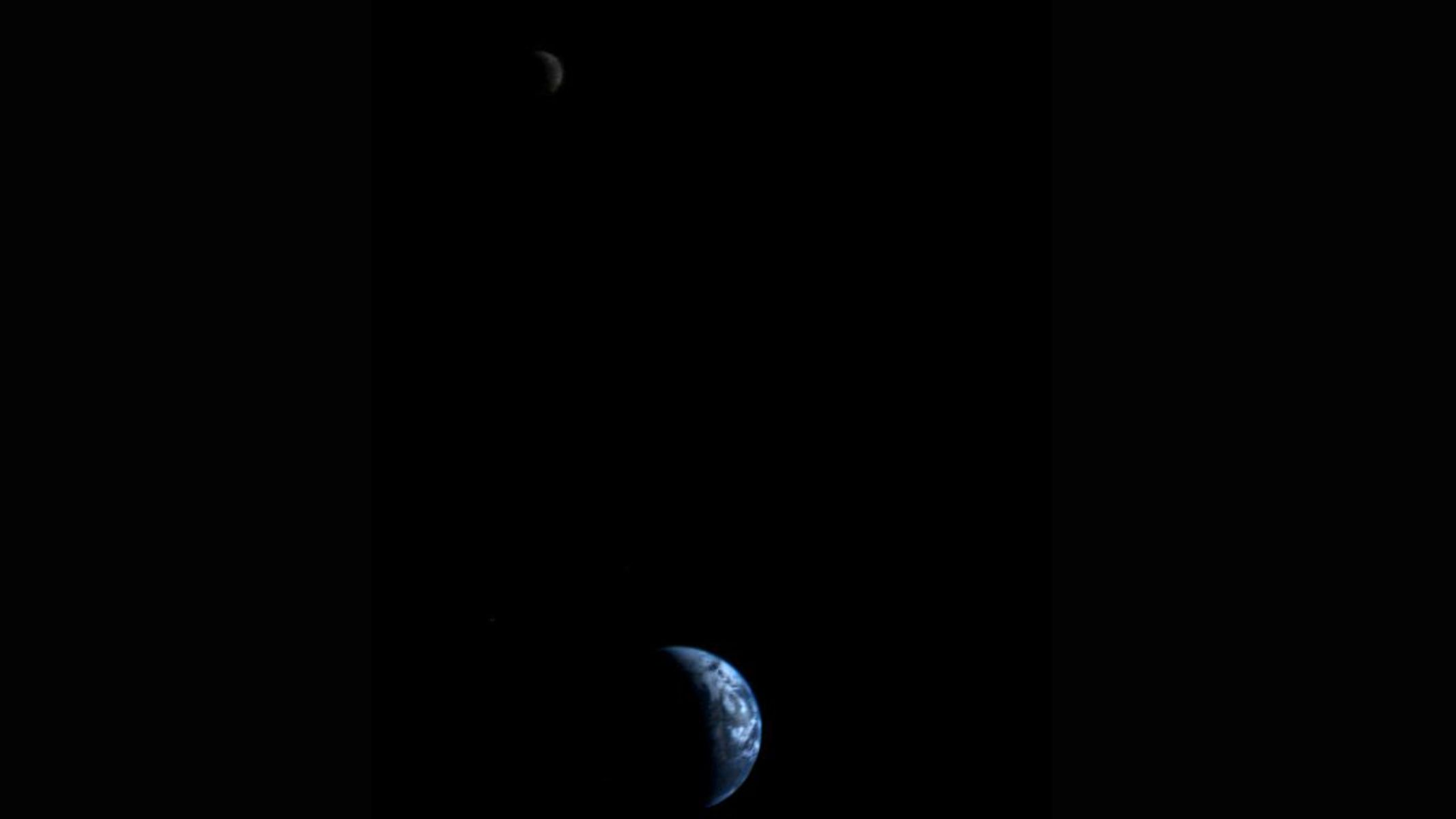
On September 18, 1977, NASA's Voyager 1 spacecraft captured its first image of Earth and the moon together in a single frame. At the time, Voyager 1 was located 7.25 million miles (11.7 million kilometers) from Earth, having launched just two weeks earlier on a mission to explore the outer planets.
Read More
After successfully passing through the asteroid belt and visiting Jupiter and Saturn, Voyager 1 made a decisive turn to head out of the plane of the solar system. Before venturing into interstellar space, astronomer Carl Sagan persuaded NASA to use the spacecraft's cameras one last time to take a family portrait of all the planets, resulting in the famous "Pale Blue Dot" image, where Earth appears as a tiny speck amidst a ray of sunlight.
The photograph of the crescent-shaped Earth and Moon represented humanity’s only known home, encompassing the locations where people have lived, worked, and explored. While the image may look grainy by today's standards, in 1977, it provided an invaluable perspective on humanity's place in the cosmos.
Due to the brightness disparity between Earth and the moon, NASA enhanced the image to make the moon appear three times brighter than it naturally was, ensuring both celestial bodies were visible.
As of September 18, 2026, Voyager 1 is approximately 15.98 billion miles (25.72 billion kilometers) from Earth, making it the farthest human-made object in space. Voyager 1 is set to achieve a milestone on November 18, when it will become the first probe to reach a distance of one light-day from Earth, equivalent to 16.094 billion miles (25.902 billion kilometers). Hanneke Weitering, a multimedia journalist specializing in aviation and space reporting, has contributed to this historical account.