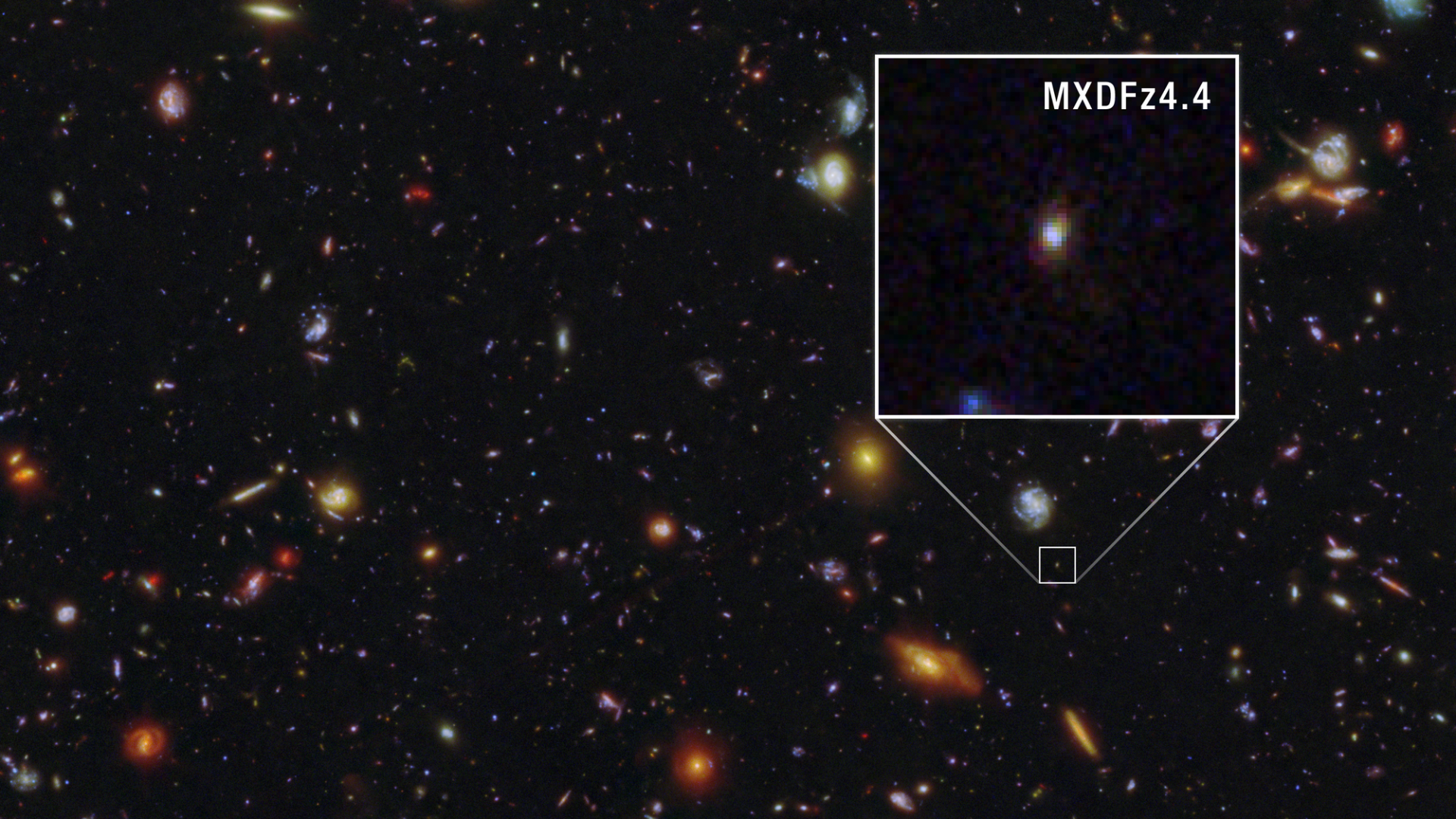
The Hubble Space Telescope has identified the distant galaxy MXDFz4.4, which existed 1.4 billion years after the Big Bang and is emitting ultraviolet light. This finding contributes to understanding the early universe, which was once obscured by neutral hydrogen gas that blocked ultraviolet light from luminous objects.
Read More
The presence of ultraviolet light from MXDFz4.4 indicates that star formation within the galaxy helped to produce ionizing radiation, clearing away the neutral hydrogen. After the Big Bang, the universe was largely filled with neutral hydrogen gas, making it opaque to ultraviolet light. However, the ionizing effect of ultraviolet light eventually made the cosmos transparent at those wavelengths, a process known as the Epoch of Reionization.
Astrophysicists have theorized that two main sources could have generated enough ultraviolet light to ionize the neutral hydrogen: active supermassive black holes and the first generations of hot, massive stars. Identifying the source has been challenging due to the opacity of neutral hydrogen. The James Webb Space Telescope previously found a galaxy producing sufficient energy to ionize neutral gas about 900 million years after the Big Bang.
Hubble's discovery of MXDFz4.4 marks a significant advancement. Ilias Goovaerts from the Space Telescope Science Institute stated that observing such a galaxy was thought to be impossible due to the dense fog of neutral hydrogen. He noted that Hubble's observations confirmed the presence of ionizing light and provided detailed information about the galaxy's characteristics.
MXDFz4.4 was first identified in the MUSE eXtremely Deep Field, with a redshift measurement indicating it existed 12.37 billion years ago. Although many galaxies from this period have been found, MXDFz4.4 is unique in that it is emitting ionizing photons. It is smaller than the Milky Way—about 100 times smaller—but forms stars at a rate ten times that of our galaxy.
The dense cluster of young, hot stars within MXDFz4.4 is more effective at producing ionizing radiation. Goovaerts highlighted that these clusters generate bursts of star formation, contributing to the clearing of neutral hydrogen over time. The galaxy is observed approximately 250 million years after it completed reionizing the surrounding gas, with supernova explosions from its massive stars creating pathways for ultraviolet light to escape.
Marc Rafelski, Hubble's Deputy Mission Head, emphasized that Hubble's findings allow for testing theories regarding the Era of Reionization and underscore the role of luminous star clusters in ionizing the early universe. The results were published on June 23 in The Astrophysical Journal.