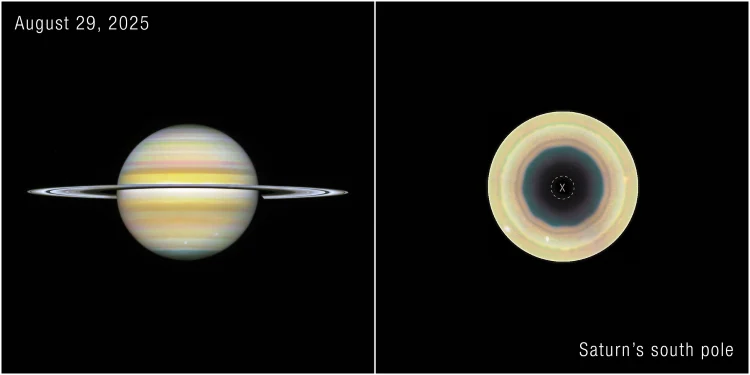
An international team of researchers has identified a newly formed decagon-shaped atmospheric structure in Saturn's southern polar region. This finding, discussed in a study published in Science Advances, adds to our understanding of Saturn's dynamic atmosphere, especially considering the long-known hexagonal feature in its northern pole.
Read More
To arrive at this conclusion, the researchers analyzed images from NASA’s Hubble Space Telescope (HST) and ground-based observations from the Calar Alto Observatory in Spain. The HST images are part of the Outer Planet Atmospheres Legacy (OPAL) program, which has been monitoring the outer planets annually since 2014 to gain insights into their atmospheric dynamics.
The decagon, a 10-sided shape, stands in contrast to the 6-sided hexagon observed in the northern hemisphere. The jet streams responsible for forming these structures travel at speeds of 320 to 354 km/h (200 to 220 mph) in the north and 400 to 420 km/h (250 mph) in the south. Unlike the stable northern hexagon, the southern decagon appears to be migrating eastward, oscillating every 32 days and behaving more like a meandering wave than a fixed entity.
Dr. Amy Simon, Senior Scientist for Planetary Atmospheres Research at NASA's Goddard Space Flight Center, noted that the variation in Saturn's southern hemisphere is unprecedented. "The northern hexagon has been stable for over 40 years, but this feature seems to be strengthening, offering a unique opportunity to observe the evolution of a large atmospheric pattern," she stated.
Notably, while HST revealed evidence of the decagon in 2023, NASA's Cassini spacecraft, which studied Saturn from 2004 to 2017, had not detected any distinct shapes in the southern polar region. The discovery of the decagon could enhance understanding of atmospheric behavior and dynamics, offering potential parallels to the polar cyclones observed on Jupiter.
The researchers plan to use computer models to investigate how changing wind patterns and solar radiation may influence the formation of polygonal structures like the newly discovered decagon. As future studies delve deeper, they aim to reveal new insights into Saturn's atmospheric phenomena.