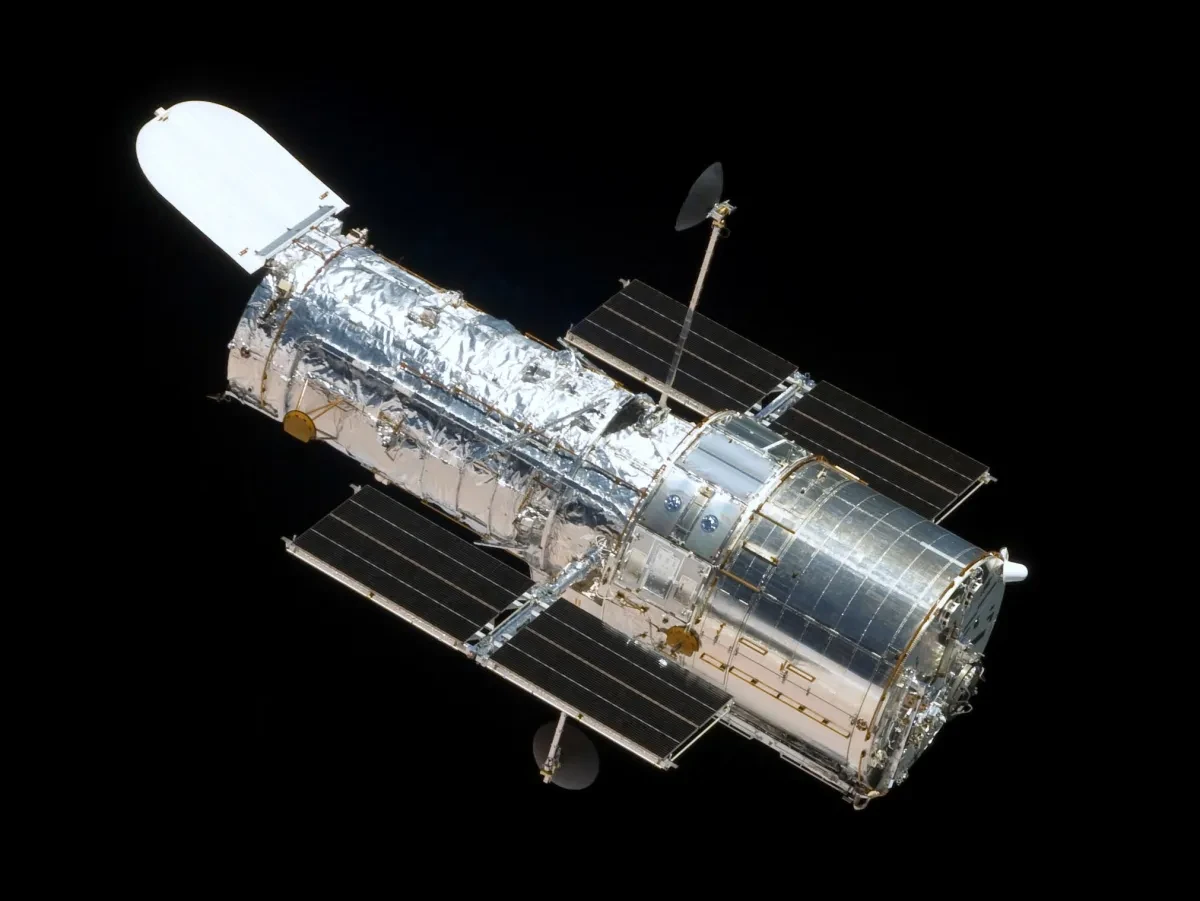
The Hubble Space Telescope, launched in 1990, has significantly advanced our understanding of the universe through its powerful observations.
Read More
Despite its age and a relatively modest 2.4-meter mirror, Hubble continues to outperform many modern ground-based telescopes. Its high-altitude location allows it to avoid atmospheric interference, leading to exceptional clarity in optical and ultraviolet astronomy, with a high demand for its research capabilities.
Some notable facts about Hubble include:
1. It travels at a speed of 17,500 mph and has covered a distance equivalent to reaching Neptune.
2. Hubble has observed light from locations over 13.4 billion light-years away.
3. Since its mission began, it has completed more than 1.3 million observations.
Hubble's unique vantage point enables it to act as a time machine, revealing how objects in space appeared in the past. For instance, the nearby Andromeda galaxy is seen as it was 2.5 million years ago. This capability has allowed Hubble to make several significant contributions to science:
- It helped establish the universe's age at 13.8 billion years.
- It discovered two moons of Pluto, Nix and Hydra.
- It assessed the universe's expansion rate.
- It found that nearly every major galaxy is centered around a black hole.
- It created a three-dimensional map of dark matter.
Key milestones in Hubble's history include:
- **1990**: Launch of Hubble after extensive planning.
- **1993**: Astronauts fixed a mirror flaw that initially blurred images.
- **1994**: Hubble observed Comet Shoemaker-Levy 9 impacting Jupiter and provided evidence for supermassive black holes.
- **1995**: Famous image of the Eagle Nebula, known as the 'Pillars of Creation.'
- **2004**: Release of the Hubble Ultra Deep Field, allowing deeper cosmic analysis.
- **2005**: Discovery of two new moons orbiting Pluto.
- **2012**: Captured images of galaxies formed over 13 billion years ago.
- **2015**: Observed gravitational lensing effects on a distant supernova.
The Hubble Space Telescope is named after Edwin Hubble, an American astronomer who, in the early 20th century, discovered that what were thought to be nebulae were actually galaxies, which led to the realization of the expanding universe.
The telescope's construction costs were over $2 billion, with total expenses surpassing $10 billion over its lifetime. Despite these figures, Hubble's contributions to astronomy are widely considered invaluable, both for its scientific insights and for bringing the beauty of the cosmos to global audiences.