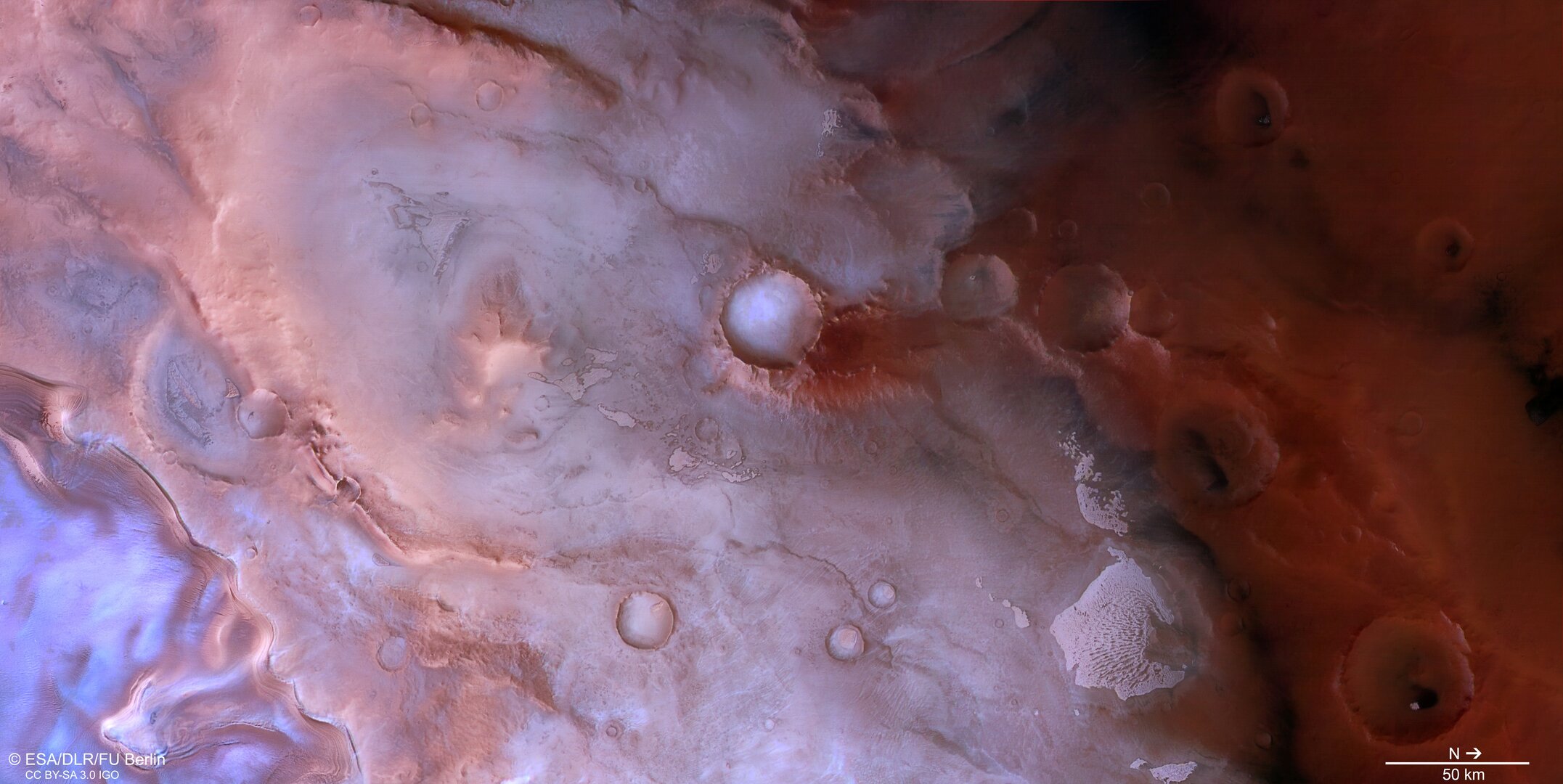
A recent image from the European Space Agency’s Mars Express spacecraft reveals a striking ice cliff near Mars’s south pole, featuring vibrant swirls of purple, pink, and red. This colorful view contrasts sharply with the more familiar hues of tans and reds typically associated with the Red Planet, primarily due to high levels of oxidized iron.
Read More
The image, taken by Mars Express’s High Resolution Stereo Camera (HRSC), showcases Thyles Rupes, a craggy icy formation. The darker tones in the image stem from volcanic material rich in mafic minerals like olivine and pyroxene, which are also found in Earth's mantle. In contrast, lighter areas are frosted deposits of carbon dioxide that persist even during Martian spring, noticeable on sand dunes and within craters.
The overall berry-purple hue results from a combination of light, dust, and frost. The variable Martian atmosphere can lead to different color renditions of the landscape throughout the day. In this instance, the soft morning light, dust in the air, and a ground cover of frost and mixed ice contribute to the captivating colors.
The topographic aspects of Thyles Rupes reveal steep cliffs rising over 1 kilometer tall. These were likely formed through tectonic processes where sections of Mars’s crust were pushed together as the planet cooled, creating significant elevation changes. Unlike Earth, Mars currently shows no active tectonic activity, and the cliffs we see today are remnants of processes that occurred billions of years ago.
Thyles Rupes spans hundreds of kilometers in the southern highlands of Mars and is interspersed with numerous impact craters. Some craters have been eroded by the cliffs, while others have formed later, situated atop the cliffs.
In addition to the cliffs, various types of sand dunes are evident in the lower regions of the image, shaped by winds from multiple directions over time. The HRSC has previously revealed Mars in unexpected colors, highlighting the diversity of its landscape.
Mars Express, which launched in 2003, has been instrumental in mapping the planet's surface in high detail, enhancing our understanding of Mars’s geological history and processes. The HRSC operates under the German Aerospace Center (DLR), with data processing conducted in Berlin.