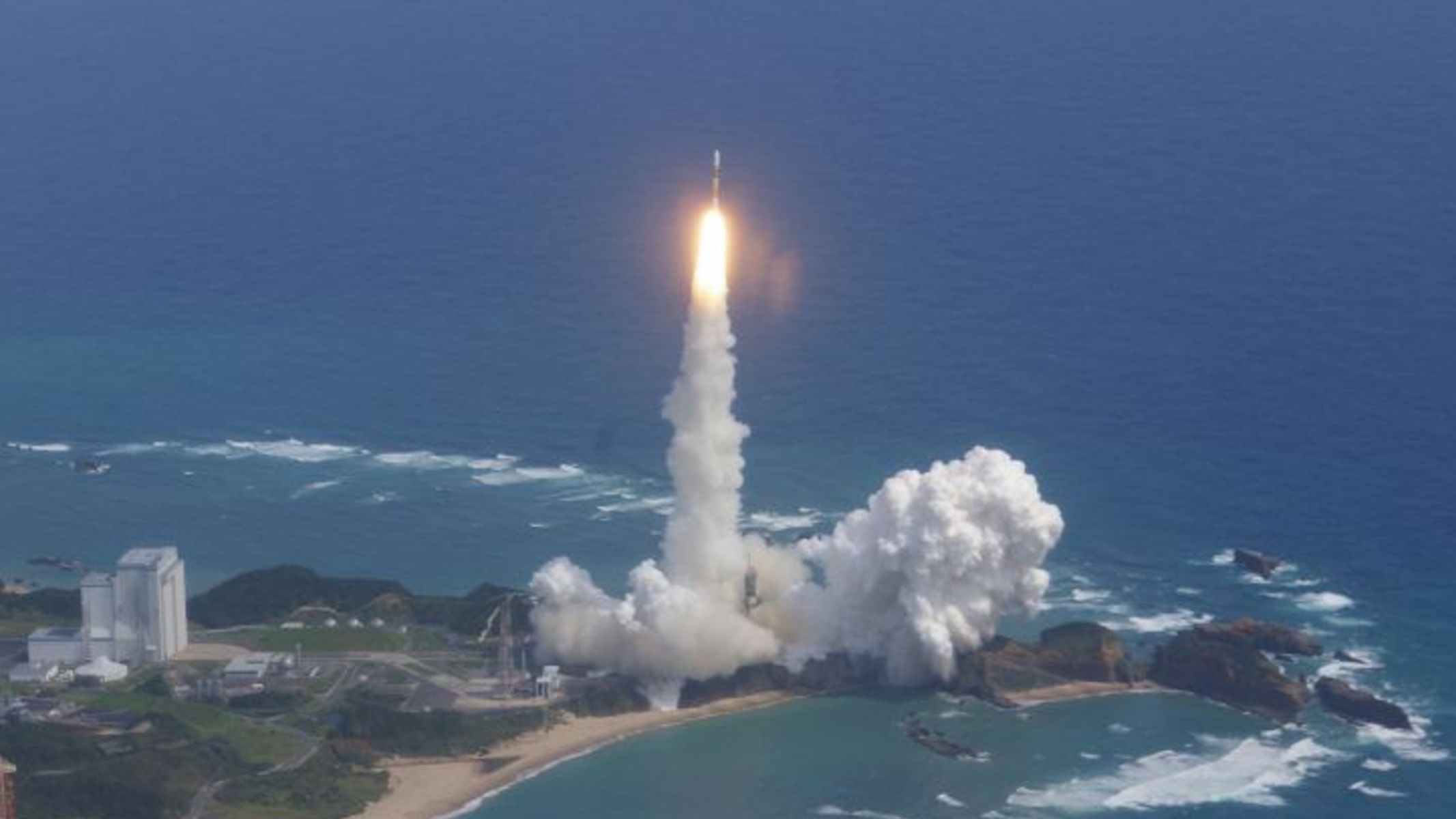
On September 13, 2007, Japan launched the Kaguya spacecraft, officially known as SELENE (SELenological and ENgineering Explorer), marking its second moon mission. The spacecraft took off from the Tanegashima Space Center aboard a Japanese H-IIA rocket, looping around the Earth twice before heading to the moon. The launch occurred in the evening Eastern Time, but it was 10:31 a.m. on September 14 at the launch site.
Read More
Kaguya was equipped with 14 scientific instruments and two microsatellites designed to map the moon's surface and study its gravitational field. After a 20-day journey, it arrived at the moon, where it operated with a main orbiter and two small satellites: one for communications and another for gravity measurements. The mission concluded with a planned impact landing on the lunar surface after about a year of observations.
This mission was significant as it was Japan's first spacecraft to successfully orbit the moon, following the previous Hiten mission in 1990 that had only conducted flybys. The name Kaguya was chosen through a public poll, inspired by the moon princess from Japanese folklore. The small satellites were named Okina (the relay satellite) and Ouna (for radio source experiments).
Kaguya captured stunning imagery from its high-definition cameras, including the first HD video and images of the moon, and notable views like Earthrise—reminiscent of visuals from NASA's Apollo missions. The spacecraft produced a complete topographical map of the lunar surface, detected gravity anomalies, and provided the first optical observations of the permanently shadowed interiors of Shackleton Crater, located near the moon's south pole.
The primary mission of Kaguya ended in October 2008, and although there were plans to extend its operation into early 2009, a malfunctioning reaction wheel necessitated an early conclusion. The spacecraft was directed to crash into the moon on February 12, 2009, near Gill Crater.