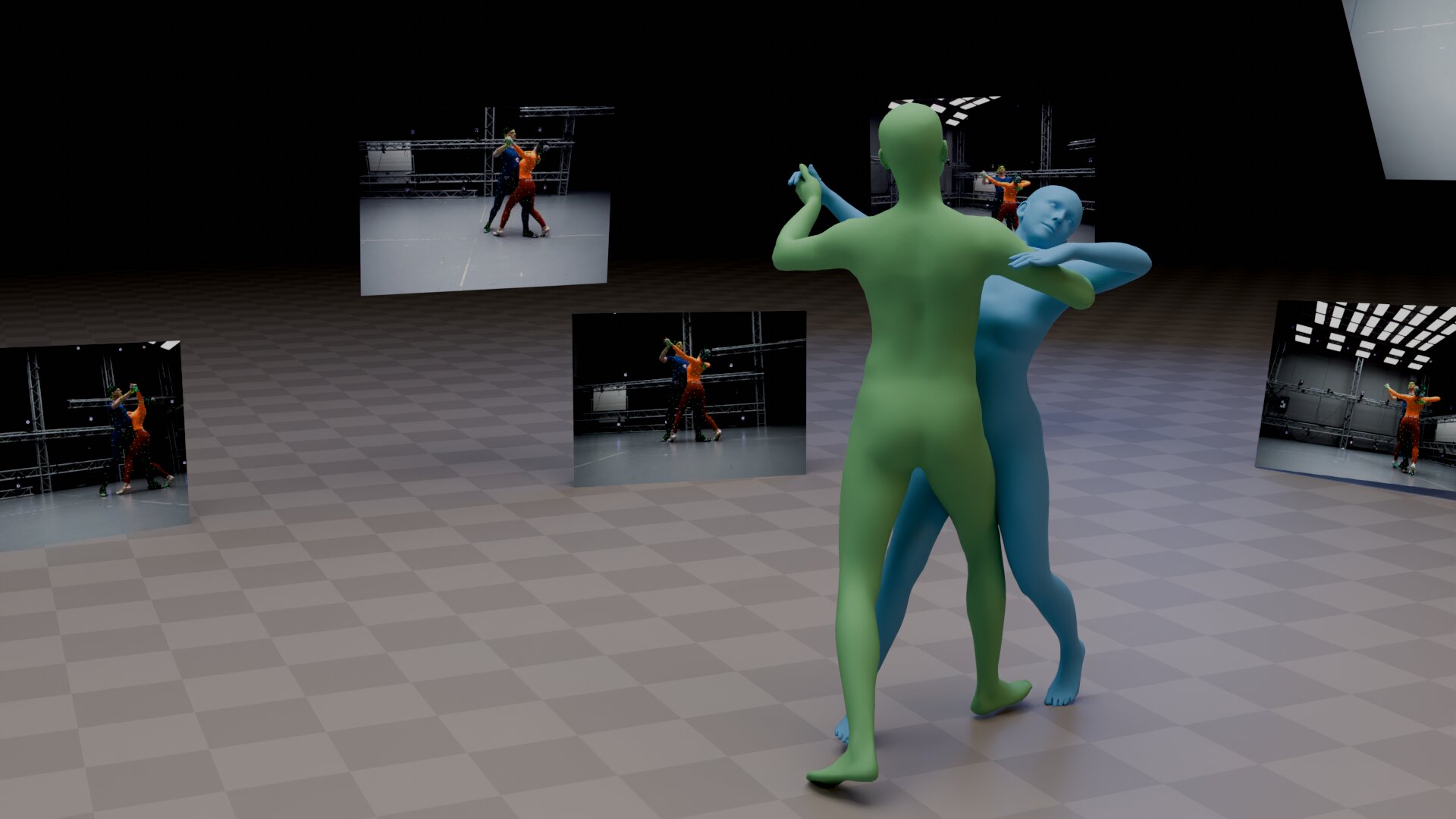
Researchers at the Max Planck Institute for Intelligent Systems (MPI-IS) and Carnegie Mellon University have developed a computer vision technology called Markerless Accurate Multi-person Motion Acquisition (MAMMA). This system captures multi-camera video, identifies virtual markers across all camera views, and fits them to a human body model (SMPL-X), enabling the detection of 512 virtual tracking points on individuals' skin.
Read More
Traditional motion capture methods require actors to wear suits with physical markers, which can be expensive, time-consuming, and prone to errors, particularly when people interact closely. In contrast, MAMMA streamlines this process by utilizing standard smartphone cameras, offering comparable accuracy to traditional systems—less than 1 millimeter variance—while processing data nearly three times faster. This capability allows it to accurately track complex interactions such as hugs or dances, which often challenge conventional methods.
The research was shared at the CVPR 2026 conference in June in Denver, and relevant papers are available on the arXiv preprint server. Hanz Cuevas Velasquez, a research scientist at MPI-IS and first author of the study, highlighted that MAMMA can be employed with consumer-grade devices like iPhones.
The technology is expected to impact numerous fields, including medicine, virtual reality, sports science, and entertainment. Anastasios Yiannakidis, a research engineer at MPI-IS, noted its application in tracking patient movement for physical therapy in less intrusive, more natural settings.
MAMMA's lifelike digital avatars could enhance social interactions in virtual environments, while allowing sports coaches to analyze athlete techniques without the distraction of traditional motion capture gear. Tsvetelina Alexiadis, another author of the study, emphasized that MAMMA could democratize high-quality animation production for smaller studios and research teams.
The team plans to release their data and tools to the academic community to further innovation in motion capture technology. The findings are documented in Hanz Cuevas-Velasquez et al., MAMMA: Markerless & Automatic Multi-Person Motion Action Capture, arXiv (2025). DOI: 10.48550/arxiv.2506.13040.