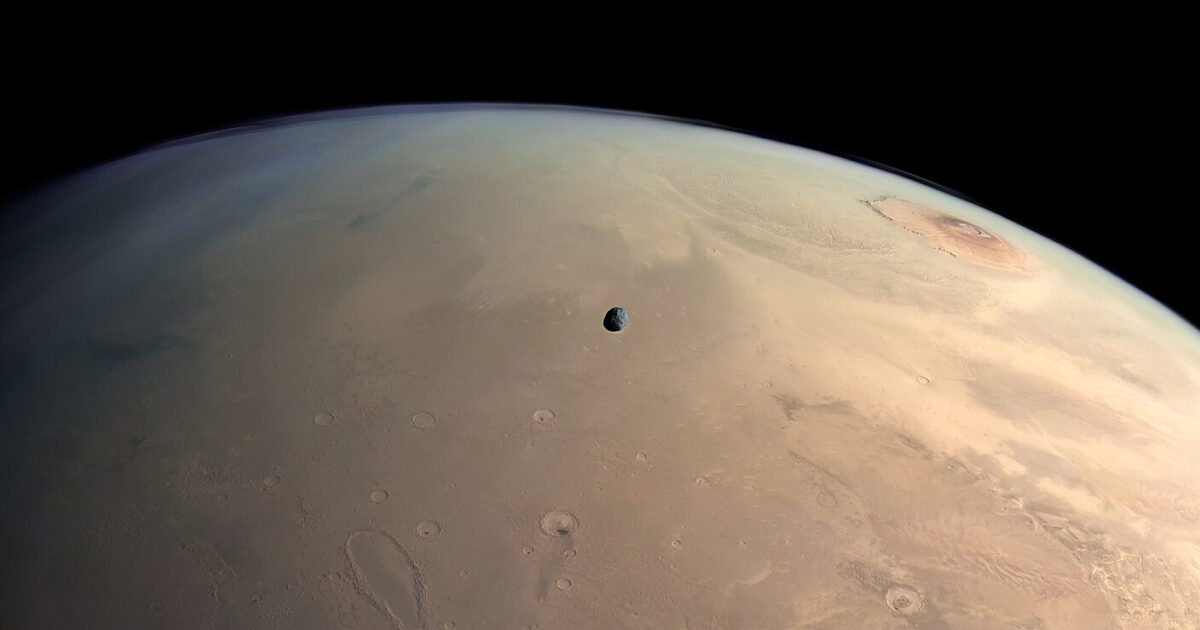
The next phase of Mars exploration is primed for significant developments, notably with the international focus shifting towards the moons of Mars, especially Phobos. Phobos, the larger of Mars’ two moons, has been less explored, but this is set to change as new missions come online.
Read More
Traditionally dominated by NASA, Mars exploration has featured a consistent array of satellites, landers, and rovers aimed at uncovering signs of water and life. However, NASA's Mars sample return program (MSR) has been put on hold. Upcoming robotic missions by NASA are designed to maintain momentum, yet their selection process has drawn criticism for lacking transparency compared to previous competitive methods. Noteworthy is the upcoming SR-1 Freedom mission, which aims to be the first nuclear fission-powered spacecraft, sending three helicopters to Mars to help identify potential human landing sites.
The Mars Telecommunications Network (MTN) has also been emphasized, receiving special funding from Congress to improve data transfer capabilities, which will be essential for future human communication from Mars. Additionally, the Aeolus mission by Relativity Space aims to demonstrate the feasibility of a low-cost small satellite mission to Mars with instruments designed by NASA to measure Martian winds and heat flow.
Global competitors are enhancing their Mars programs, with the United Arab Emirates' Hope probe and China’s Tianwen-1 mission making significant strides. Already, three major international collaborations are preparing for ambitious scientific exploration over the next five years. The China National Space Administration’s Tianwen-3 mission aims to land on Mars and return samples by 2030, although specific details remain limited. In contrast, the European Space Agency (ESA) and Japan Aerospace Exploration Agency (JAXA) are working collaboratively on missions that will not only explore the Martian surface but also Phobos for the first time.
JAXA's Martian Moons eXploration (MMX) mission, scheduled to launch as soon as November this year, will mark a historic effort to analyze a Martian moon. It will collect samples from Phobos, sending back data that could clarify its origins—whether it is a captured asteroid or leftover material from Mars' formation. This mission has gained collaborative support from agencies like NASA, ESA, and others, enriching Mars science.
ESA's ExoMars Rosalind Franklin rover, set for launch in 2028, is another example of a project that has navigated significant hurdles, including changes in international partnerships. It will explore Oxia Planum, a clay-rich area that may hold clues to the origins of life. The rover aims to drill up to 2 meters beneath the surface—far deeper than any previous mission—to collect soil samples, potentially revealing biosignatures.
As these various missions unfold, they could provide crucial insights into Mars' past, including the formation of Mars and its moons, and whether life ever existed on the planet. The growing involvement of multiple nations signifies a collective prioritization of these discoveries, suggesting a future where scientific exploration is increasingly collaborative with shared responsibility and purpose.