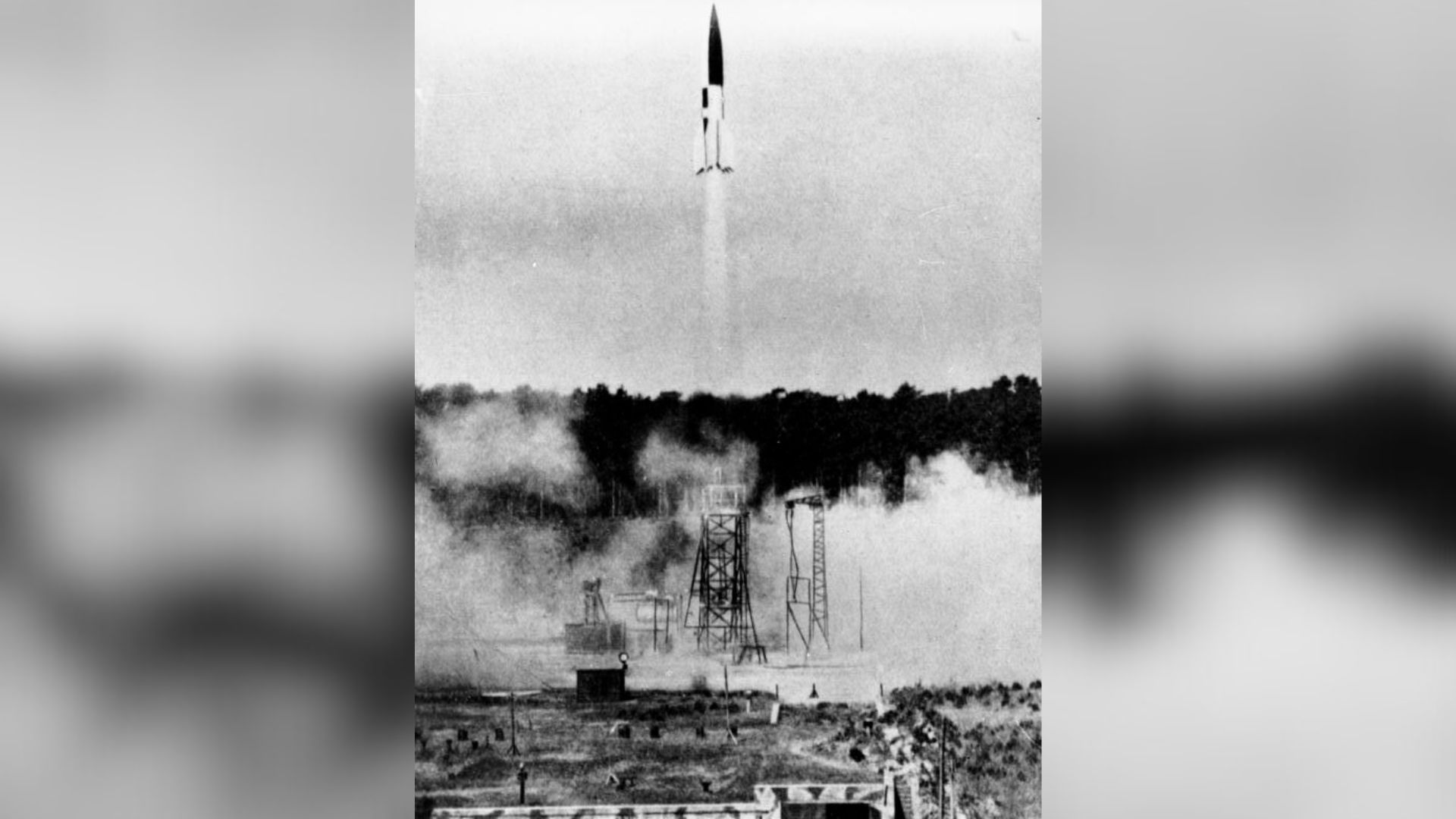
On October 3, 1942, Germany conducted the first successful test launch of its ballistic missile, known as the V-2 or Aggregat 4 (A4). Designed by rocket scientist Wernher von Braun, the V-2 became a significant weapon during World War II. The rocket was launched from Peenemünde, an island off the Baltic coast, and achieved an altitude of 52.5 miles (84.5 kilometers), just shy of the Kármán Line, which is recognized as the boundary of outer space at 62 miles (100 kilometers). It hit a target 118 miles (190 kilometers) away.
Read More
The V-2 was notable not only for its role in warfare but also as a precursor to modern space technology. At 46 feet tall (14 meters), it traveled at speeds up to 3,400 mph (5,470 kph) and could carry a 2,200-pound (1,000 kilograms) warhead to distances of 200 miles (320 kilometers). Though it was heavily utilized by Nazi Germany, especially during its introduction in combat on September 6, 1944, the missile lacked precision compared to conventional bombing raids.
According to the Smithsonian National Air and Space Museum, over 3,000 V-2 rockets were launched, primarily targeting London and Antwerp, resulting in approximately 5,000 civilian deaths. This was a stark contrast to the estimated 10,000 to 20,000 concentration camp prisoners who died during the V-2 manufacturing process, highlighting the weapon's tragic legacy.
The significance of the V-2 extends beyond wartime use; it was a revolutionary technological advancement that laid the groundwork for future space exploration. Von Braun and over 100 members of his team were brought to the United States after the war as part of Project Paperclip. They initially worked at Fort Bliss in Texas before relocating to Redstone Arsenal in Alabama in 1950, where they played pivotal roles in the development of the U.S. Army’s nuclear-armed ballistic missiles.
Following the Soviet Union's launch of Sputnik in October 1957, von Braun's group, which had grown to thousands, contributed to launching the United States' first satellite, Explorer I. In 1960, they transitioned to NASA, where they led the development of the Saturn rockets that eventually enabled the Moon landing in 1969.